Automation saves time, but some business processes should never be fully automated. Here are the five areas where judgment still matters.
In this article
Automation is not supposed to remove people. It is supposed to remove mechanical work.
That difference matters, because a lot of businesses are now asking the wrong question. They are not asking, “What is repetitive enough to automate?” They are asking, “How much of this can we hand to the system?”
That is how good businesses automate the wrong things. They keep the admin and remove the judgment.
Why “never automate” is the wrong question
Almost every business should automate more than it currently does.
Repetitive data movement, reminders, routing, scheduling, and low-risk admin work should not stay manual just because the team is used to doing it. The real cost of not automating that layer is slower service, more rework, and more founder dependence.
But the opposite mistake is just as expensive. If you automate a process that depends on context, emotional intelligence, accountability, or commercial judgment, you do not remove work. You usually create hidden damage.
PwC puts it well: automating an inefficient process just makes you inefficient faster. The same logic applies to high-judgment work. If the moment needs a brain, automating it badly only scales the mistake.
The five processes you should never fully automate
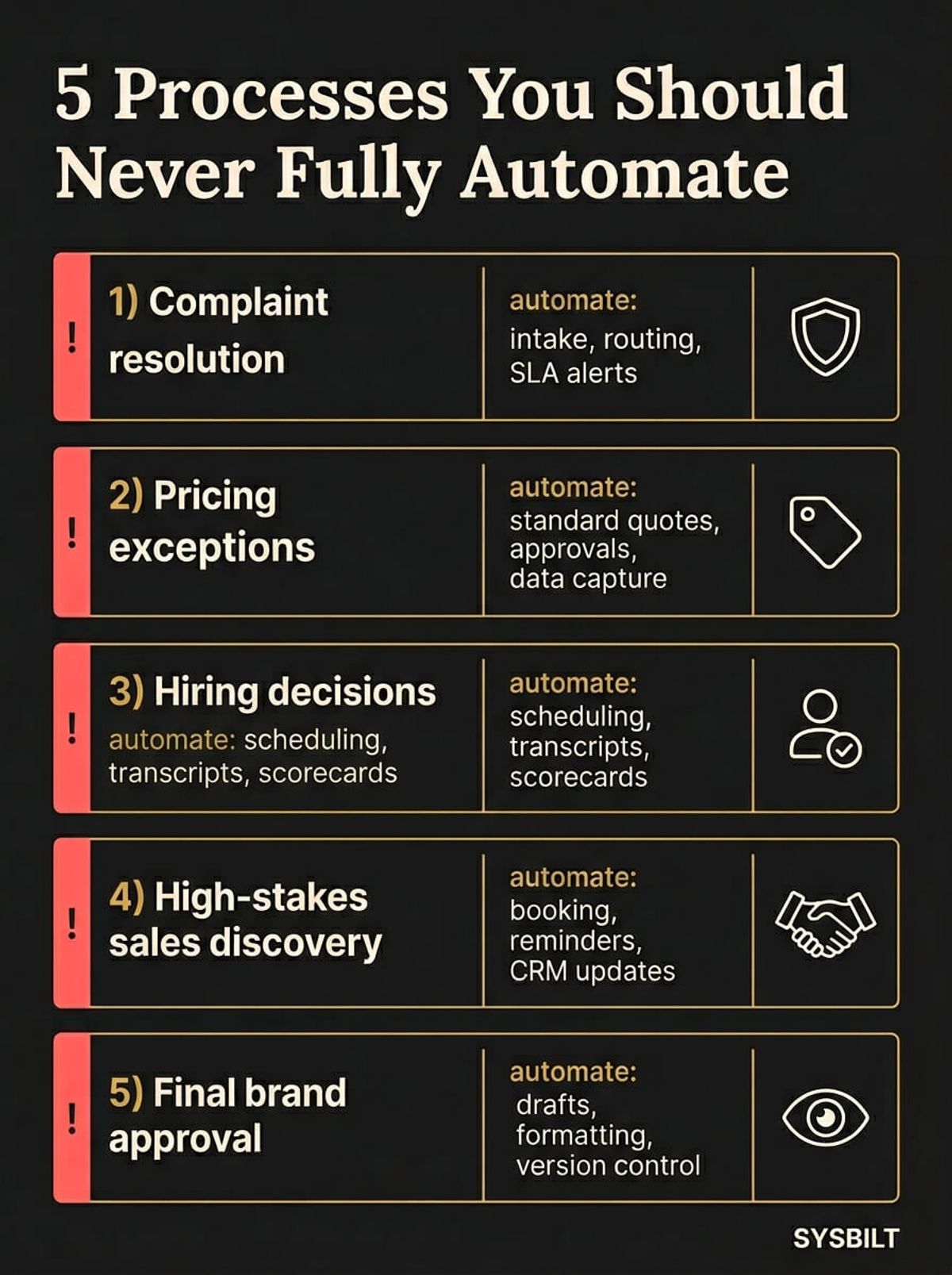
01Complaint resolution
You can automate complaint intake, routing, tags, and response-time alerts.
You should not fully automate the actual resolution when a customer is frustrated, disappointed, or escalating risk. That moment affects trust, retention, and reputation.
A system can help gather the facts. A person should decide how to respond.
02Pricing exceptions and unusual commercial decisions
Standard quoting logic can absolutely be automated. That is good systems design.
But edge cases should stay human-led. Custom scope, unusual risk, strategic discounts, one-off contract terms, and messy exceptions need commercial judgment.
If you fully automate that layer, you either create margin leaks or force the team into rigid rules that break real deals.
03Hiring decisions
Automation can help with application collection, scheduling, screening prompts, and note capture.
What it should not do is make the final call on who joins the business. Hiring is not just pattern matching. It is judgment about fit, communication, trust, and how someone will actually behave inside your operation.
That is especially true in close-knit teams, where one wrong hire changes the culture immediately.
04High-stakes sales discovery
Lead routing, meeting booking, reminders, transcription, and follow-up tasks are all fair game for automation.
But the actual discovery conversation should stay human when the sale is complex, valuable, or emotionally sensitive. That is where nuance matters. A scripted automated flow can collect details, but it cannot reliably read hesitation, confidence, politics, or hidden objections.
That is why automated sales systems work best when they qualify the obvious layer and hand the important conversation to a person.
05Final brand and publishing approval
AI and automation can help draft, repurpose, format, and schedule content. They are brilliant at the mechanical layer.
But final approval should stay human when the content affects positioning, reputation, or trust. The last review is where someone checks whether the claim is true, whether the tone sounds like the brand, and whether the piece actually says something worth publishing.
That is the same reason AI content looks fake when nobody edits it. The workflow can be automated. The judgment cannot.
What parts of those processes should be automated anyway
This is the part most articles miss. “Keep it manual” does not mean “do everything by hand.”
The smarter split looks like this:
- complaint resolution: automate intake, tagging, routing, and SLA alerts
- pricing exceptions: automate standard quotes, approvals workflow, and data gathering
- hiring: automate applications, scheduling, transcription, and scorecard capture
- sales discovery: automate booking, reminders, summaries, and CRM updates
- brand approval: automate first drafts, resizing, scheduling, and version control
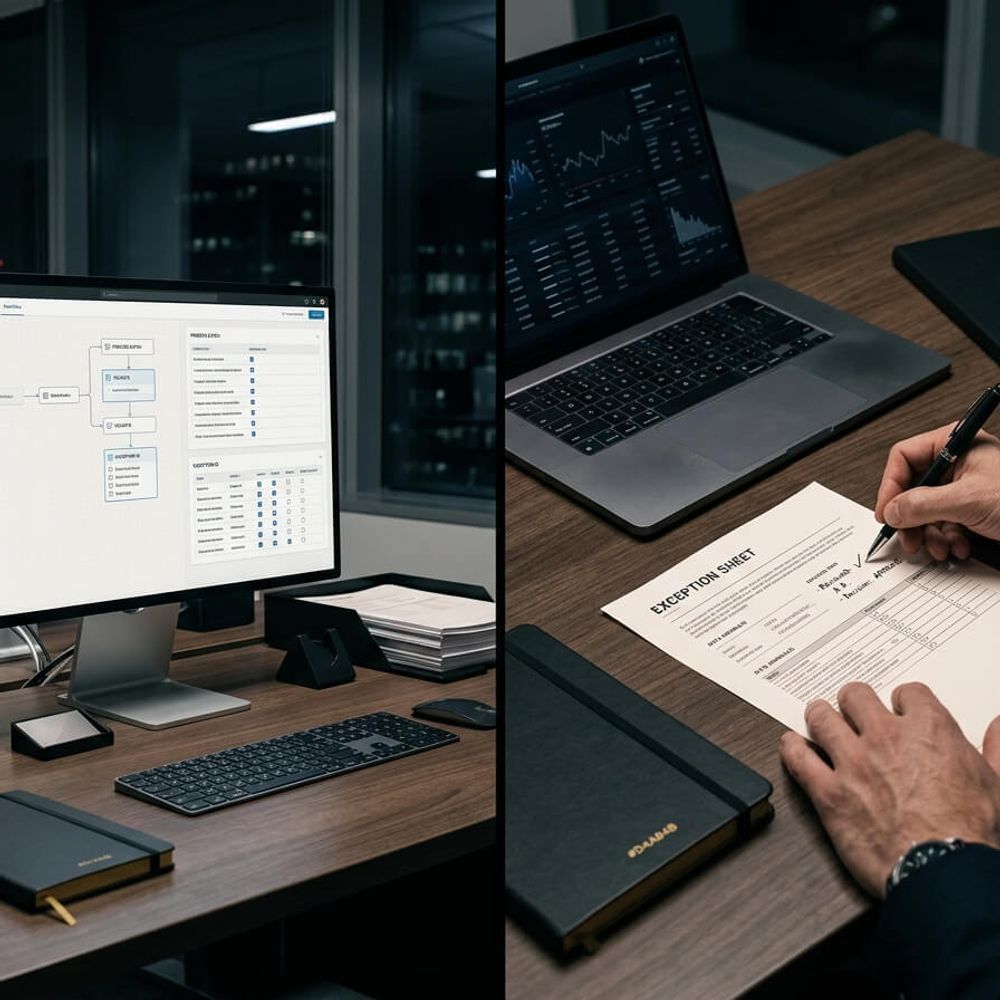
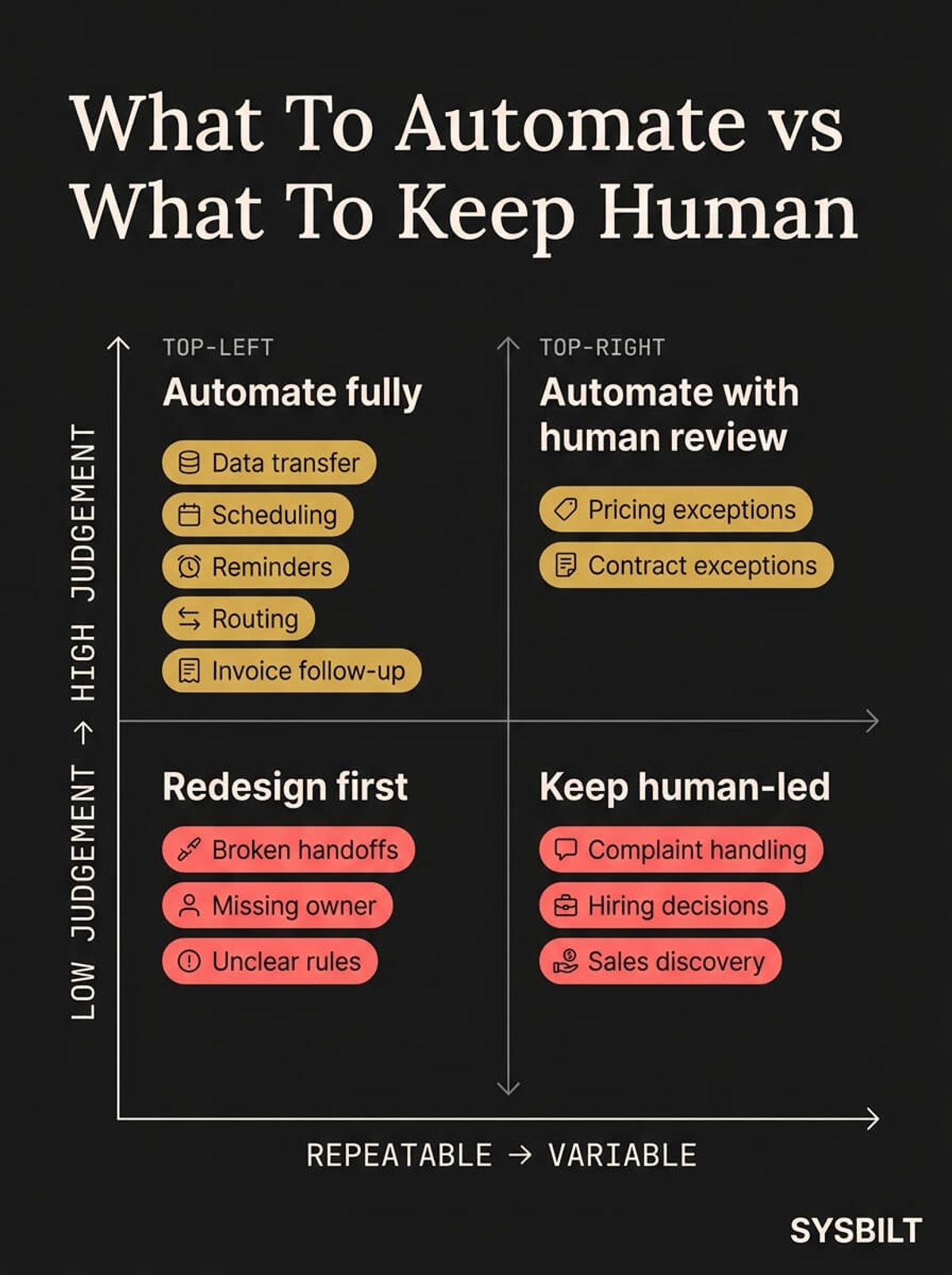
That is the real pattern. Automate preparation, movement, and admin. Keep the decision, exception, and accountability layer human.
If you want the aggressive automation case from the other side, The First 3 Tasks Every Service Business Should Automate covers the obvious wins. If you want the cost side, The Real Cost of Not Automating Your Business in 2026 picks up the other half.
A simple filter for deciding manual versus automated
If you are unsure whether a task should stay manual, run it through five questions.
01Is the task mostly repetition or mostly judgment?
If the answer is repetition, automate aggressively.
If the answer is judgment, be careful.
02What happens if the system gets it wrong?
If the downside is low, automation is easier to justify.
If the downside is reputational, legal, financial, or emotional, keep a human in the loop.
03Does the task involve an exception more often than a rule?
Tasks with constant variation often look automatable from far away and fall apart in practice.
That is usually a sign you should automate the setup, not the final call.
04Does trust matter in that moment?
If the task shapes trust, there should usually be a person responsible for the outcome.
That does not mean they have to do every step. It means they should own the last meaningful decision.
05Will automation remove friction or just hide it?
Bad automation often moves the mess somewhere less visible.
It looks efficient on the surface, then creates rework, customer frustration, or internal confusion later.
How to scale without automating away judgment
The goal is not to keep more work manual. The goal is to keep the right work human.
A good systems business automates the predictable layer so the team has more time, energy, and attention for the moments that actually need them.
That is also why software adoption can go sideways. If you force people into automation that strips away judgment or creates clumsy edge cases, they work around it. Why Your Team Refuses to Use the New Software You Bought is really about that exact problem.
The best operating model is not manual versus automated. It is automated where the path is clear, human where the stakes are real.
That is how you scale without becoming slower, colder, or more brittle.
See how we fix this
See the exact system we build to fix this
Show me what we should automate and what should stay human
WRITTEN BY
Felipe Chaparro
Systems Architect and Founder of SYSBILT. Felipe engineers custom automation, AI workflows, and performance web architectures for scaling Australian service businesses.