
Missed calls after hours are costing you work. Compare AI, human, and hybrid after hours phone answering services for businesses and pick the right fit.
In this article
You're losing work while you sleep. Every call that rings out after 5 PM is a potential client choosing someone who picks up instead.
If you've been searching for the right after hours phone answering service for businesses like yours, you've probably noticed something. Every comparison article out there is written by a vendor selling you one side of the equation. This post is the honest breakdown from a team that builds these systems, covering when AI wins, when humans win, and why the real question isn't which service to buy.
The After-Hours Problem Is Bigger Than You Think
Standard business hours cover roughly 40 of the 168 hours in a week. That means your phone is unattended for more than 75% of the time your customers might need you.
Your customers don't stop searching at 5 PM. They search when they finally have a quiet moment, which is often at 8 PM on a Tuesday or Saturday morning. If your phone rings and nobody answers, most of those callers won't try again, and that job goes to the next result on Google before you wake up.
"SMBs contribute more than half of Australia's private sector GDP and generate 60% of company profits. However, they also lag larger enterprises in productivity per hour worked."
This isn't just about missed calls. It's about missed revenue that compounds every single week, and if you're already stretched during business hours, the after-hours gap is the one you notice last.
The pattern looks different depending on your industry, but the cost is the same. A dental clinic misses a new patient booking at 7 PM. An immigration agent loses a consultation request on Saturday morning. A service business misses an urgent job because the caller got voicemail and rang the next company on Google. The work doesn't wait for your business hours, and neither do your competitors.
Your Three Real Options (and What They Actually Cost)
There are three serious options for handling after-hours calls. Each one comes with a different cost structure, a different set of trade-offs, and a different fit depending on how your business operates.
AI answering services typically cost at a low monthly cost. They run 24/7/365, handle multiple calls simultaneously, and most can book appointments, send SMS summaries, and answer common questions without human involvement. The best ones integrate directly with your calendar and CRM, so the lead doesn't just get answered, it gets captured.
Human answering services cost at a higher monthly investment, depending on call volume and coverage hours. You get a real person answering in your business name, which works well when callers need warmth and judgment. The trade-off is that each operator handles one call at a time and relays messages manually.
A full-time receptionist costs approximately a full salary and on-costs (Industry estimate, 2025) and gives you someone who knows your business deeply. But they only cover business hours, they take leave, and they can still only handle one call at a time. For after-hours coverage specifically, a full-time hire doesn't solve the problem unless you're paying overtime or adding a second shift.
Some providers now offer a hybrid model that combines AI for routine calls with human escalation for complex ones. These typically start around $145 per month and give you the scalability of AI with a human safety net. It's worth considering if your call mix is genuinely split between simple and complex enquiries.
| Factor | AI Answering | Human Answering Service | Full-Time Receptionist |
|---|---|---|---|
| Monthly cost | Low monthly cost | Mid-range monthly | Premium tier |
| Availability | 24/7/365 | After hours or 24/7 | Business hours only |
| Simultaneous calls | Unlimited | One per operator | One |
| Appointment booking | Automatic | Manual message relay | Direct booking |
| Business knowledge | Trained on your FAQs | Basic script | Deep, evolving knowledge |
| Caller experience | Consistent and neutral | Warm and personal | Warm and personal |
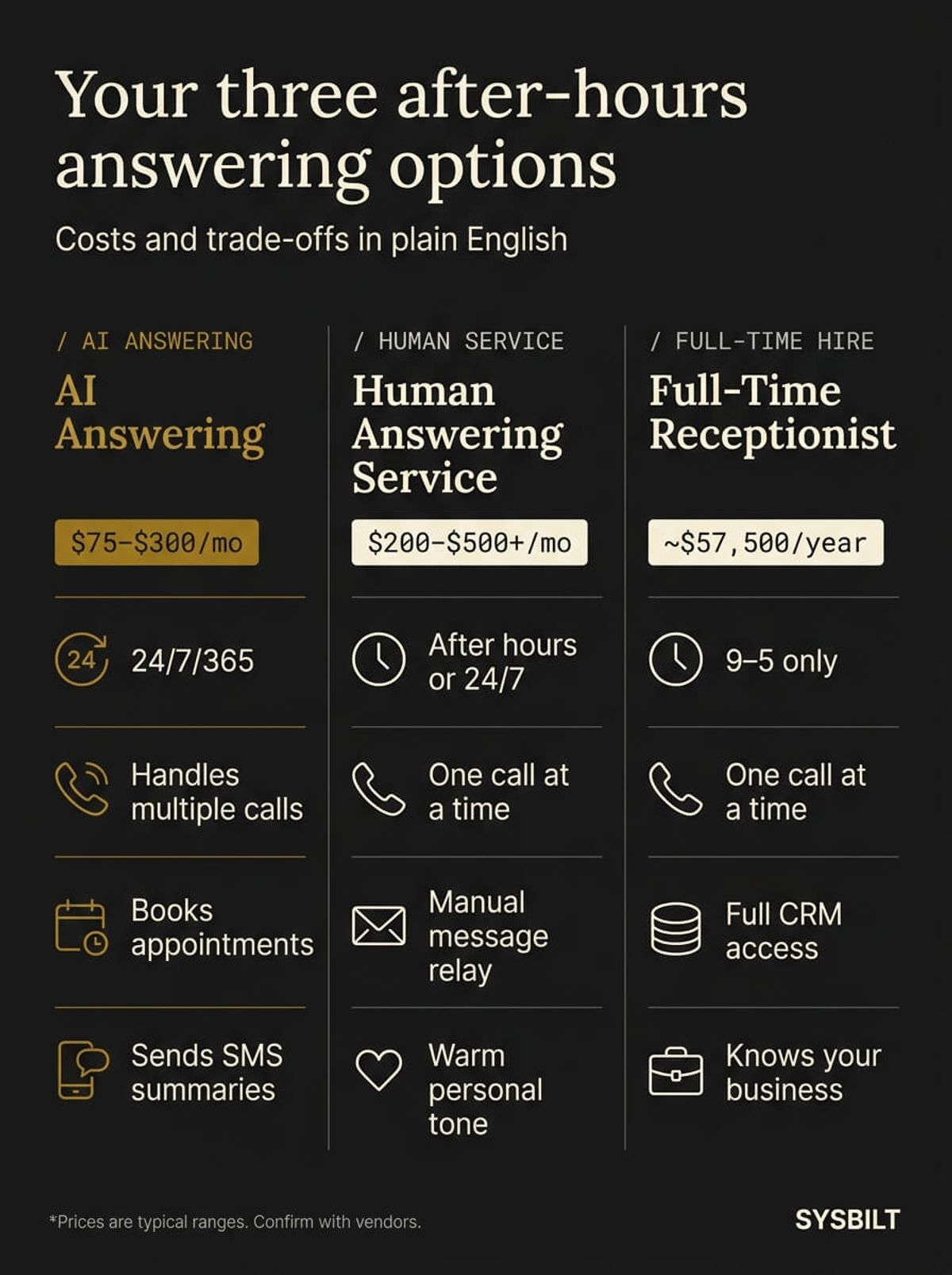
The cost gap between AI and human services is real, but cost alone shouldn't drive this decision. The right choice depends on what your callers actually need when they ring after hours.
One thing to watch with AI services: the quality gap between providers is enormous. The cheapest options use basic voice recognition that frustrates callers, while better providers sound close to human. If you're considering AI, test the actual call experience yourself before committing. Call the demo number and see how it handles an unusual request. That ten-minute test tells you more than any feature comparison.
When AI Wins and When It Doesn't
AI answering wins clearly in specific scenarios. If most of your after-hours calls are routine enquiries, appointment requests, or basic questions that follow a predictable pattern, AI handles them faster, cheaper, and more consistently than any human service.
AI also scales effortlessly. A human answering service has a fixed number of operators, so if five people call at once, three of them wait on hold. AI handles all five simultaneously with the same quality.
Where AI is the better choice
- Routine enquiries and appointment bookings. "What are your hours?", "Can I book for Thursday?", "Do you service my area?" These are the calls AI was built for. It answers instantly, books into your calendar, and sends a confirmation.
- High call volume with unpredictable spikes. If you're running ads that generate bursts of calls after hours, AI handles the spike without putting anyone on hold. A human service has a fixed number of operators and overflow callers wait.
- Automatic follow-up and documentation. AI sends an SMS summary to the caller and a notification to your team the moment the call ends. No waiting for message relay and no handwritten notes lost in translation.
- Consistent quality regardless of time. The AI sounds the same at 2 AM as it does at 6 PM. Human operators working late shifts don't always deliver the same energy.
Where a human service is the better choice
- Calls involving emotional distress. Legal intake, health concerns, or genuinely upset clients need someone who can read tone and adjust in real time. AI can follow a script, but it can't genuinely empathise with a caller who's distressed.
- High-value clients who expect personal contact. If your top clients are worth $50,000+ in annual revenue and they call after hours, they expect a real person. The AI might handle the call competently, but the perception matters more than the efficiency.
- Strict compliance requirements. Some industries have regulatory obligations around how client information is gathered and stored. If a scripted AI response creates liability, a trained human operator is the safer option.
- Complex situations that need judgment. When a caller describes a problem that doesn't fit your FAQ categories and needs someone to think on their feet, a human answering service earns its premium.
Be honest with yourself about your call mix. If 80% of your after-hours calls are "What are your hours?" and "Can I book for Thursday?", AI is the obvious choice. If most of your calls involve someone describing a complex situation that requires real human judgment, a human answering service is worth the premium. Most businesses find their split is heavily weighted toward routine calls, which means AI covers the majority and you only need a human escalation path for the exceptions.
What to Ask Before You Choose
Before you compare vendors, answer these questions about your own business:
- How many after-hours calls do you actually get? If you don't know, that's the first problem to solve. Track it for two weeks before making any decision.
- What do your callers typically need? Information, appointments, urgent triage, or emotional support? The answer changes the recommendation completely.
- What happens to the call data after the call ends? Does it go into your CRM? Does it trigger a follow-up? Or does it sit in a voicemail inbox until someone remembers to check?
- Are you buying a standalone tool or building a connected system? That's the question most comparison articles skip entirely, because most of them are written by vendors selling a single product.
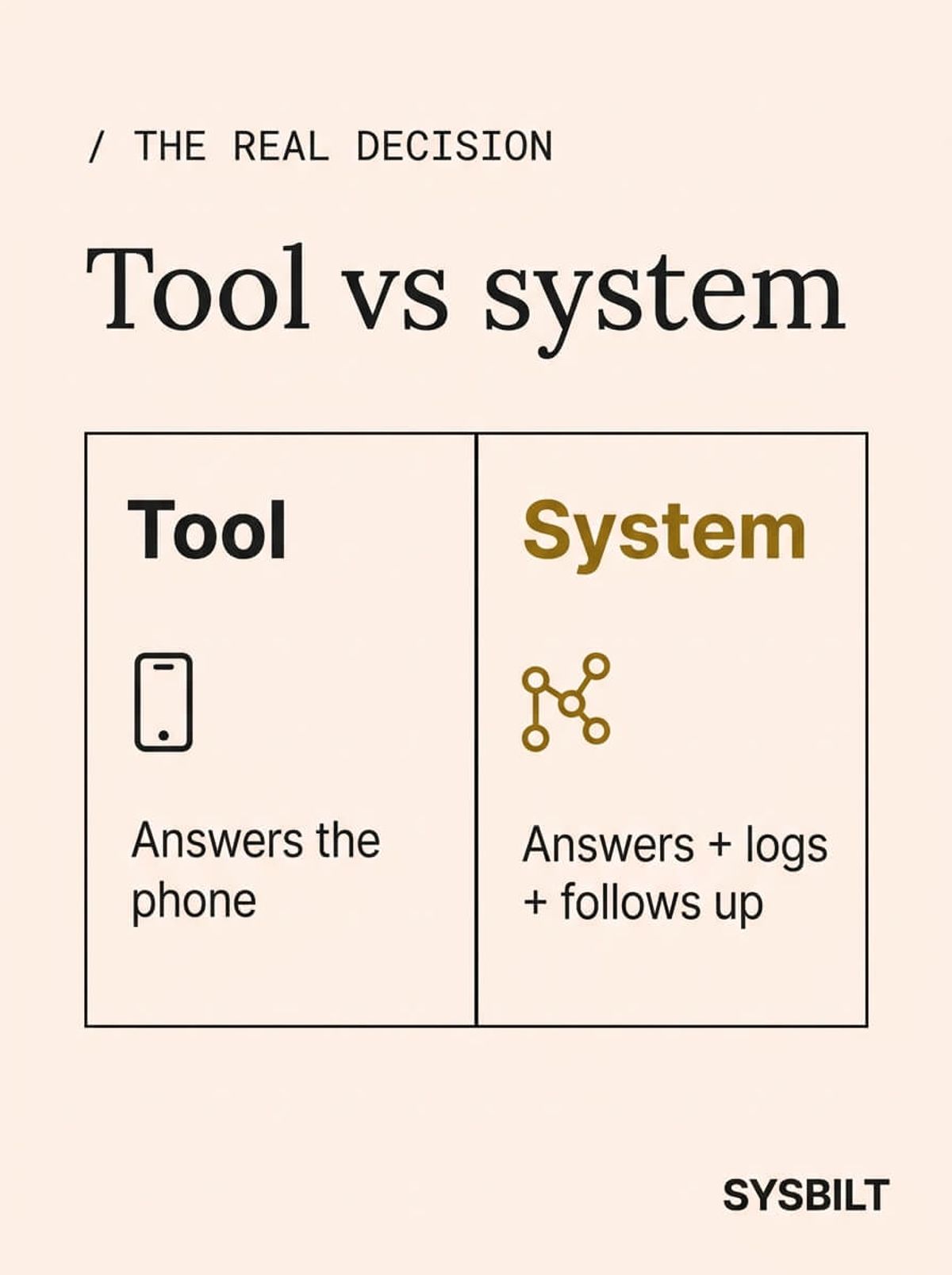
The difference between a tool and a system matters more than the difference between AI and human. A tool answers the phone. A system answers the phone, logs the lead, triggers an automated follow-up, and shows the conversion data on your dashboard the next morning.
How After-Hours Answering Fits Into Your Business System
Here's where most businesses get it wrong. They buy an after-hours answering service, the calls get answered, messages get relayed, and the immediate pain goes away. But the call data stays trapped in the answering service's own portal.
It doesn't connect to your CRM. Nobody follows up automatically. You can't see which after-hours calls converted into paying work because the data never made it into your pipeline.
Australian businesses that move from basic to intermediate AI use could see a 45% increase in profitability (Deloitte Access Economics, 2025). Those gains don't come from the AI answering calls. They come from connecting the AI to the systems that run the rest of your business.
What a connected system actually looks like
Here's the difference in practice. Without a connected system, a caller rings at 8 PM, the AI takes a message, and someone on your team checks the portal the next morning. They copy the details into your CRM by hand and send a follow-up email hours later. The lead has been sitting cold overnight.
With a connected system, the same call triggers a chain automatically. The caller's details land in your CRM as a new contact tagged with "after-hours call." A follow-up SMS goes out within minutes. Your team gets a notification with the caller's name, what they need, and a link to their CRM record. The lead shows up in your pipeline with the source tracked, so you can measure the return on your answering investment over time.
That's not an answering service. That's a revenue capture system that happens to answer the phone.
If you want an AI receptionist that plugs into your CRM, automation, and reporting, see how SYSBILT builds AI assistants that connect everything into one workflow.
See how we fix this
See the exact system we build to fix this
Set up AI phone answering for my business
WRITTEN BY
Felipe Chaparro
Systems Architect and Founder of SYSBILT. Felipe engineers custom automation, AI workflows, and performance web architectures for scaling Australian service businesses.