
Everything runs through you and your team can't keep up. Learn what AI agents for business actually do and how to start using them the right way.
In this article
You've heard the term "AI agent" in every second article, podcast, and LinkedIn post this year. But most of what's written about AI agents for business reads like it was written for a CTO at a bank, not someone running a growing company with 10 to 50 staff. This post cuts through the jargon and explains what AI agents actually do, why they're different from the chatbot you tried last year, and how to figure out if your business is ready for one.
What an AI Agent Actually Is
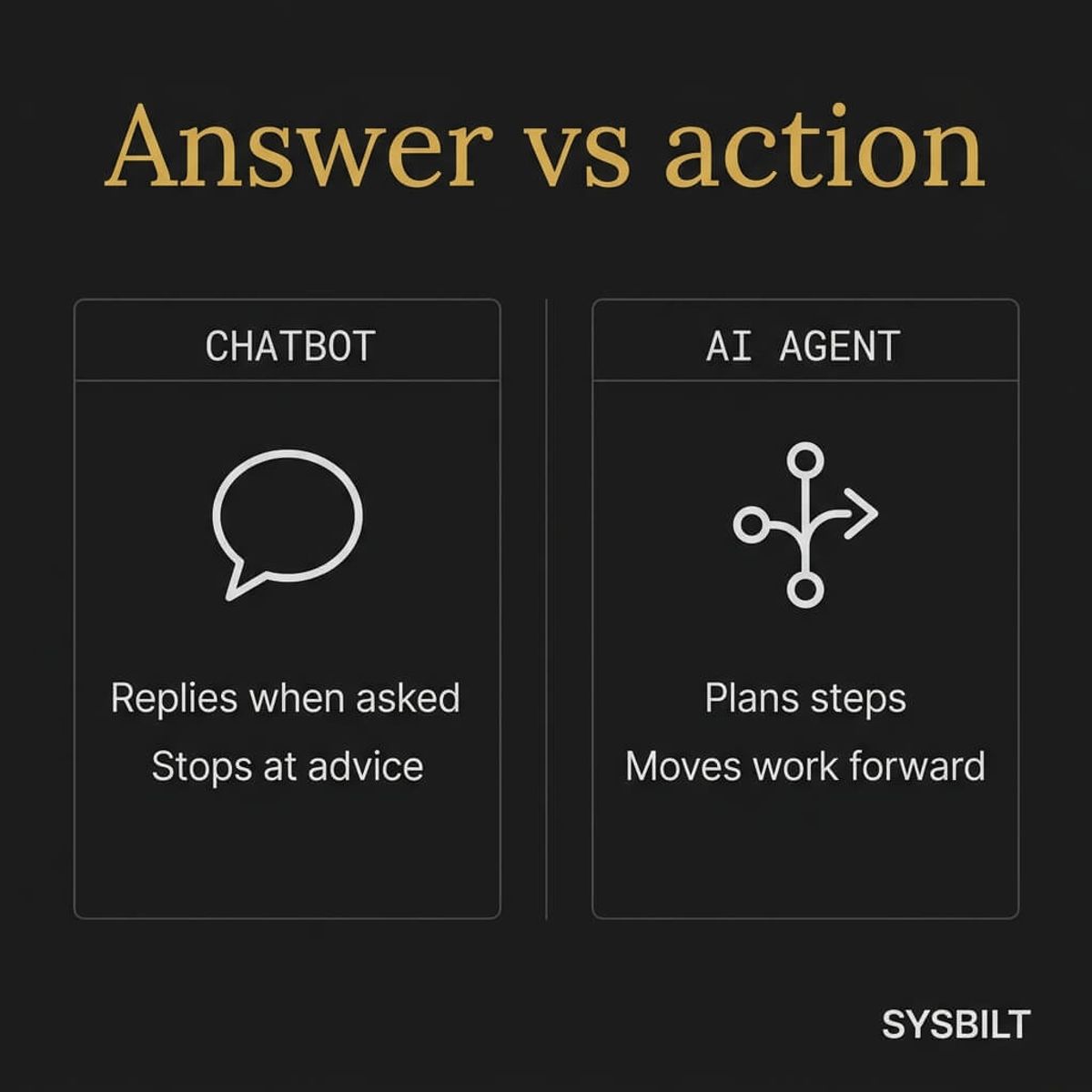
An AI agent is software that can plan steps, take actions, and make decisions toward a goal you set, all within boundaries you define. It's not a single tool or a single prompt. It's a layer that sits across your existing systems and pushes work through them on your behalf.
Think of it as the difference between an assistant who answers your questions and one who actually goes and does the work. You tell it "follow up with every lead that hasn't responded in three days," and it checks your CRM, drafts the email, and sends it. You don't open the CRM, find the leads, write the message, or hit send. The agent handles the full sequence.
That distinction matters because most businesses already have the tools. They have a CRM, an inbox, a quoting system, and a project tracker. What they don't have is a way to connect the steps between those tools without relying on someone's memory or a manual checklist.
Why the Agent vs Chatbot Distinction Matters
A chatbot waits for someone to ask it something, then gives an answer. That's useful for FAQs on your website. An AI agent goes further: it can follow up on a lead that went quiet, update your CRM after a call, draft a reply to a customer enquiry, book a meeting, or route a support request to the right person. It doesn't just talk, it moves work forward.
"Australian businesses contribute more than half of Australia's private sector GDP and generate 60% of company profits. However, they also lag larger enterprises in productivity per hour worked."
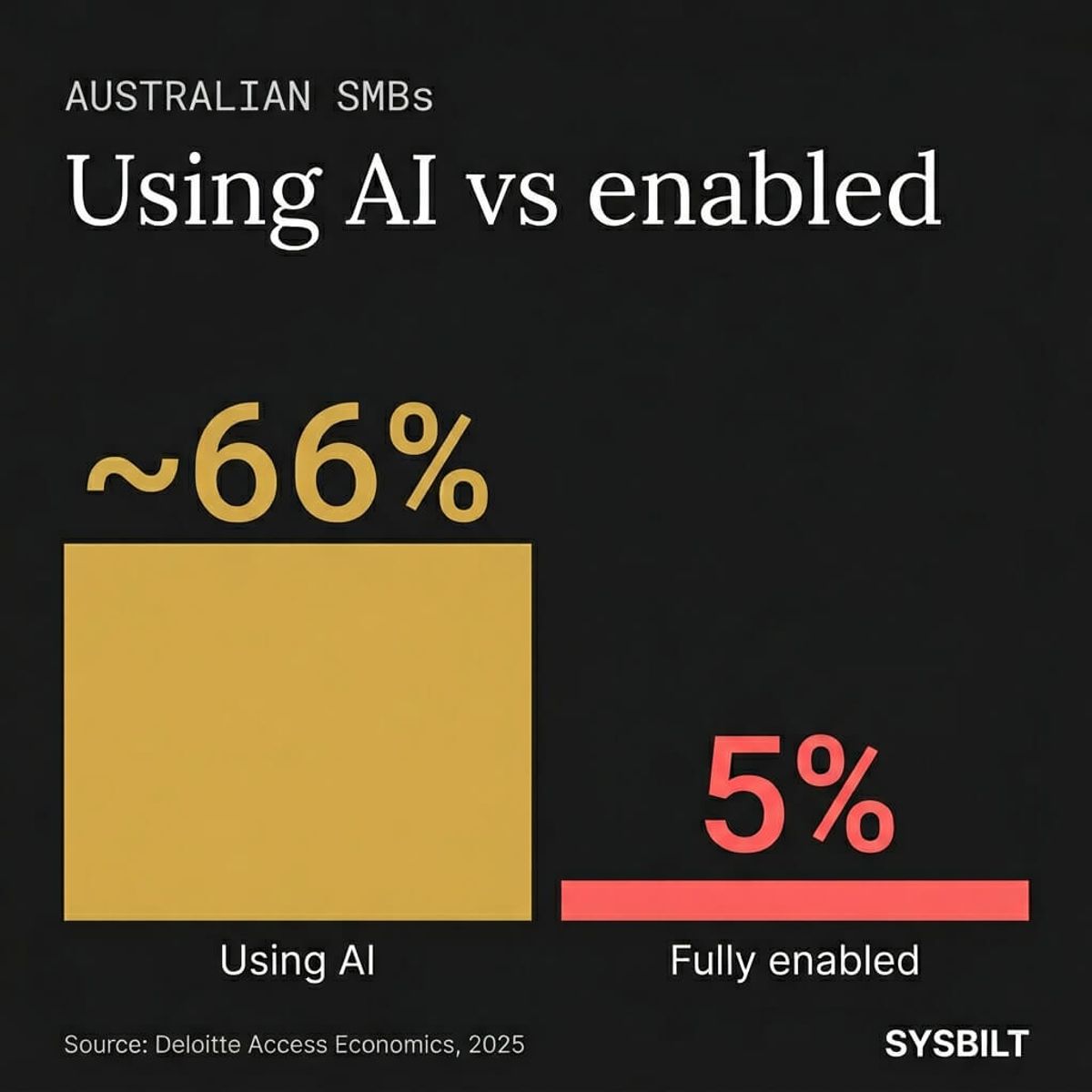
That productivity gap matters here. Two-thirds of Australian businesses are already using AI in some form, but only 5% are fully enabled to realise its potential benefits (Deloitte Access Economics, 2025). The gap between using AI and getting real value from it is exactly where agents come in. If your business already uses a chatbot for basic customer questions, you've seen the floor. Agents show you what the ceiling looks like when software can act, not just respond.
Four Jobs AI Agents for Business Do Well Right Now
You don't need to rethink your entire operation. These are the four areas where agents already deliver measurable results in growing businesses.
Admin and workflow triage. Incoming emails, form submissions, and internal requests get sorted and routed automatically. The agent reads the content, categorises it, and sends it to the right person or system. You stop being the human switchboard.
Sales follow-up and pipeline hygiene. When a lead goes quiet for three days, the agent sends a follow-up. When a deal stalls in your pipeline, it flags it. When a proposal gets opened, it logs the activity. Your CRM stays current without anyone remembering to update it.
Customer comms and FAQs with guardrails. An agent can handle common questions on your website or by email, using your actual content and policies as its source material. It doesn't fabricate answers if you set the boundaries properly, and it escalates anything outside its scope to a real person.
Internal operations assistant. Your team asks the same questions every week: where's the process doc, what's the status of that job, who handles returns. An agent connected to your knowledge base can answer those questions instantly, freeing your senior staff from being a walking FAQ.
80% of Australian businesses are now using AI in some form, and 41% reported it reduced at least 25% of labour time (Small Business Loans Australia, 2026). The businesses getting the most from it aren't the ones with the fanciest tools. They're the ones who pointed AI at specific, repeatable tasks.
What Needs to Be in Place Before an Agent Helps
This is where most businesses skip ahead and regret it. An AI agent can only be as good as the systems it connects to. If your data is scattered across inboxes, spreadsheets, and sticky notes, an agent won't fix the mess. It'll automate the chaos faster. Before you start evaluating agent platforms or pricing pages, get these three foundations right.
Three things need to exist before an agent adds real value:
- One source of truth. A CRM, a job management system, or a knowledge base where your core data lives. The agent needs somewhere to read from and write to.
- Defined process steps. They don't need to be perfect, but someone has to have written down the basic flow: lead comes in, gets qualified, gets a follow-up, gets a proposal. If the process only exists in your head, the agent can't follow it.
- Clear permissions. What can the agent do on its own, and what does it need to ask a human about? Sending a follow-up email is low risk. Sending a contract or quoting a price requires a person in the loop. Draw the line before you switch anything on.
Businesses that move from basic to intermediate AI use can expect a 45% increase in profitability, and those going from intermediate to fully enabled use see gains of up to 111% (Deloitte Access Economics, 2025). The returns are real, but they require the foundations to be in place first.
How to Start Without Breaking Trust
The smartest approach is to pick one low-risk, high-volume task and let the agent handle it with human oversight for the first few weeks. Internal admin triage or lead follow-up reminders are good starting points because the cost of a mistake is low and the time savings are immediate.
Set three rules from day one:
- Money, contracts, and critical client communication require human approval. The agent can draft a quote reply, but a person sends it.
- Build a feedback loop. Measure time saved, errors avoided, and leads captured. If the numbers don't move in 30 days, adjust the scope or the rules.
- Tell your team. The fastest way to lose trust internally is to quietly automate something without explaining why. Show your staff what the agent does, what it doesn't do, and how it makes their job easier.
Most failed AI projects don't fail because of the technology. They fail because the business skipped the groundwork, or because nobody told the team what was happening. When you start small, set clear boundaries, and measure the results, an agent becomes a reliable part of how work gets done rather than a tool nobody trusts.
AI agents aren't a new app you install and forget about. They're a new way to push work through your existing systems so you stop being the bottleneck. The technology is ready, and the question is whether your business has the structure to use it properly.
We help businesses build that structure from the ground up, starting with the systems that matter most.
If this sounds like your business, book a call and we'll walk you through how this applies to your situation.
See how we fix this
See the exact system we build to fix this
See how AI assistants work for your business
WRITTEN BY
Felipe Chaparro
Systems Architect and Founder of SYSBILT. Felipe engineers custom automation, AI workflows, and performance web architectures for scaling Australian service businesses.