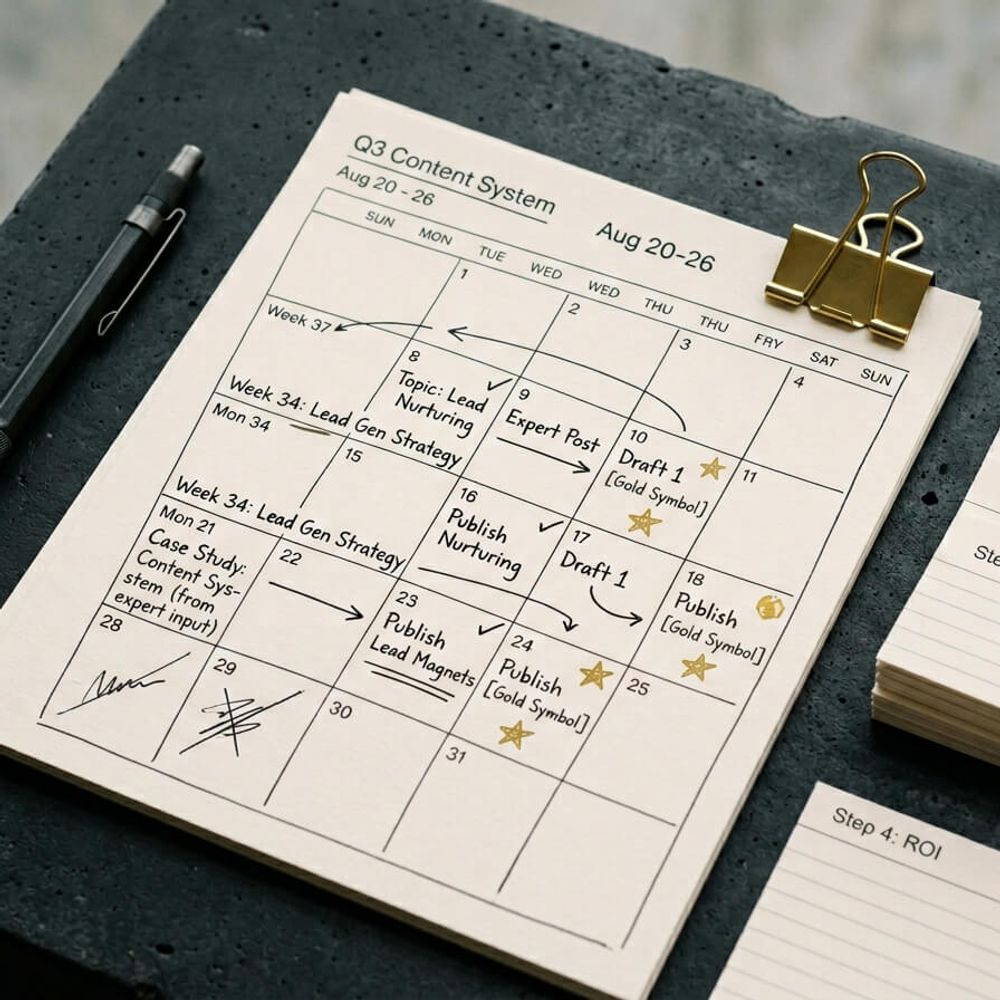
Struggling to post content consistently? Build a B2B content strategy for your service business that generates leads without eating your weekends.
In this article
- //Why Most Service Businesses Fail at Content
- //What a B2B Content Strategy Actually Means for a Service Business
- //The Three Content Types That Actually Generate B2B Leads
- //How to Build a B2B Content Strategy That Runs Without You
- //What to Post on LinkedIn When You Sell Services, Not Products
- //How Often to Post and Where to Start
- //How to Know Whether Your Content Is Actually Working
Why Most Service Businesses Fail at Content
The pattern looks the same in almost every service business we work with. The owner decides to "get serious about content," posts on LinkedIn for two or three weeks, gets buried in quoting and delivery, and stops. A month later they feel guilty, start again, and the content never compounds because it never runs long enough to gain traction.
This isn't about willpower, it's about treating content like a personal task instead of a business process. Australia's content marketing industry is valued at $444M in 2026 and growing at 8.7% year on year (IBISWorld, 2026). The businesses capturing that growth aren't posting harder, they're building systems that post for them.
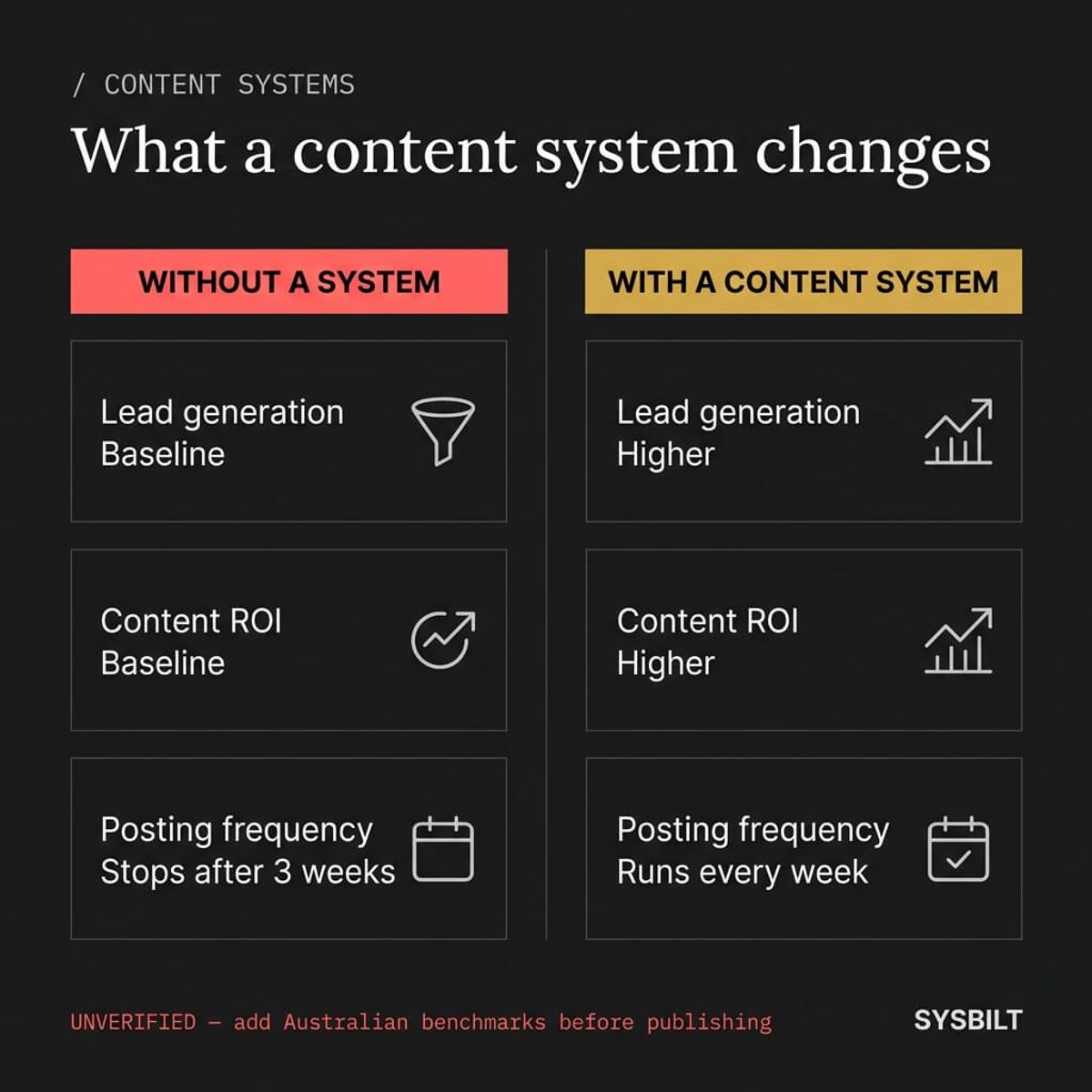
Industry research suggests that businesses with a documented content strategy see roughly 3x higher ROI compared to those without (Content Marketing Institute, 2025). The gap isn't talent or creativity, it's whether content runs as a repeatable process inside the business.
The difference between service businesses that make content work and those that don't comes down to one thing: the ones that succeed treat content as infrastructure, the same way they treat their CRM or their invoicing system. They don't rely on motivation or spare time. They build a process that runs whether the founder feels creative that week or not, and they measure it the same way they measure any other business function.
"When taking a content-first approach, our job as marketers is not to create more content... it's to create the minimum amount of content with the maximum amount of results."
What a B2B Content Strategy Actually Means for a Service Business
Most content strategy guides are written for SaaS companies and enterprise marketing teams. They assume you have a content calendar, a design team, and a dedicated writer. If you're running a commercial service business with 5 to 50 staff, none of that applies to your situation.
A B2B content strategy for a service business means having a clear answer to three questions:
- What problems do your ideal clients search for before they hire someone?
- What content proves you know how to solve those problems?
- How does that content get in front of the right people consistently without depending on you?
Everything else, the editorial calendars, the audience segmentation frameworks, the content matrices, is overhead that slows you down before you've published a single thing. The goal isn't to build a media operation. It's to build a repeatable process that turns your expertise into a pipeline of enquiries.
The businesses that show up consistently on Google and LinkedIn aren't necessarily smarter or more experienced than you. They just have a system that keeps publishing while they're busy with clients. That's the real advantage, and it's an operational one, not a creative one. When you reframe content from "something I should be doing" to "a business process I need to build once," the whole equation changes. You stop blaming yourself for not posting and start building the machine that posts for you.
The Three Content Types That Actually Generate B2B Leads
Not all content does the same job. Service businesses that treat every post as the same type of output end up with a feed full of tips that nobody connects to buying anything. There are three types that matter, and each one plays a specific role.
Authority content is the long-form material that ranks on Google and brings in people actively searching for answers. Blog posts, guides, and how-to articles build search visibility over months and create a consistent stream of inbound traffic that doesn't depend on you being online.
Trust content is what converts that traffic into enquiries. Case studies, project breakdowns, and client results give the reader proof that you've done this before. APAC research suggests that B2B buyers who rate content as "extremely influential" are significantly more likely to purchase (Green Hat & 6sense, 2025). For a service business, one strong case study often does more than twenty blog posts.
Presence content keeps you visible between deals. LinkedIn posts, short-form video, and email updates remind your network that you exist and that you know what you're talking about. This isn't about going viral. It's about being the name that comes to mind when someone in your network needs what you sell.
How to Layer the Three Types
The mistake most service businesses make is trying to do all three at once from day one. Start with authority content because it compounds over time through search rankings. Add trust content once you have client results worth sharing. Layer in presence content once the first two types are running without you managing every post.
A practical split for a service business in the first six months:
- Month 1–2: Publish one blog post per fortnight targeting a keyword your clients actually search for
- Month 3–4: Add one case study or project breakdown per month as trust content
- Month 5–6: Start posting on LinkedIn twice a week, repurposing from your existing blog and case study material
How to Build a B2B Content Strategy That Runs Without You
The shift that changes everything is moving from "I need to create content" to "I need a system that creates content." Once you make that shift, the founder bottleneck disappears.
Start With One Core Piece
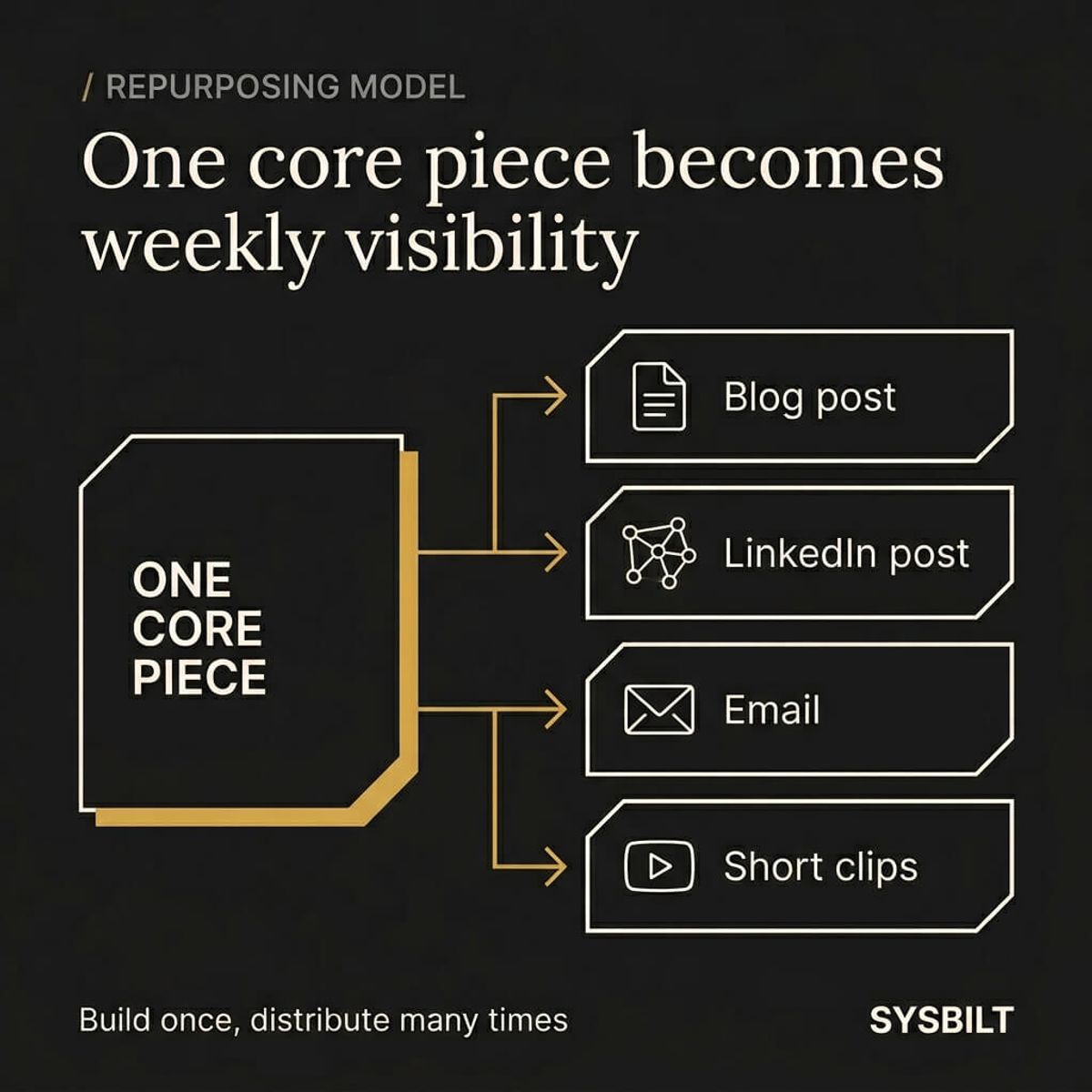
Pick a frequency you can sustain, weekly or fortnightly. Record a single blog post, video, or detailed LinkedIn article that captures your expertise in your own words. This anchor piece becomes the raw material for everything else. You do the thinking once, and the system handles the rest.
Don't overthink the format. A 10-minute voice memo on your drive home works. A quick screen recording walking through how you solve a common client problem works. The content doesn't need to be polished at this stage, it just needs to capture your knowledge in a form that can be repurposed.
Repurpose Into Multiple Formats
From that one core piece, break out 3 to 5 smaller assets. A blog post becomes a LinkedIn post, an email snippet, a couple of social graphics, and a short-form video quote. Each format reaches a different segment of your audience on a different platform, but the thinking behind all of them happened once.
This is where the system earns its value. Without repurposing, every post requires original thought and original production time. With repurposing, one hour of input turns into a month of output across multiple channels.
Batch and Schedule
Don't create content in real time. Set aside one morning per month to record or write your core pieces for the coming weeks. Then schedule everything in advance using a publishing tool. The entire month's content is queued before the month even starts, and it publishes whether you're busy with clients or not.
The Repeatable Workflow
The system looks like this when it's running:
- Month start: Record or write 2 to 4 core pieces in one sitting
- Week 1–2: Repurpose each core piece into 3 to 5 smaller assets
- Ongoing: Scheduling tool publishes everything automatically
- Month end: Review which pieces drove enquiries and adjust topics for next month
This is exactly what a content system does. It takes the knowledge already in your head and distributes it across the channels your buyers use, on a rhythm that doesn't require you to show up every day. If you want a content system built for your business, see how we build content systems for Australian service businesses.
What to Post on LinkedIn When You Sell Services, Not Products
LinkedIn is the primary B2B channel for Australian service businesses, but most owners either post nothing or post content that reads like a brochure. Neither generates leads.
Three post formats consistently work for service businesses:
- Pain-naming posts describe a problem your ideal client faces in specific, concrete language. No solutions yet, just make them feel seen. These get shared because people tag colleagues and say "this is us." An accountant posting "Your bookkeeper sends you a BAS summary and you have no idea if the numbers are right" will get more engagement than a generic tip about tax planning
- Proof-showing posts share a real result, a before-and-after metric, or a client win with permission. Keep it specific. "Reduced quoting time from 3 hours to 20 minutes" beats "we helped a client improve efficiency" because specificity builds trust where vague claims create suspicion
- Process-revealing posts show how something works behind the scenes. Walk through a workflow, explain a decision you made, or show a system in action. This builds trust because it demonstrates competence without asking for anything in return
Consistency matters more than perfection. Posting twice a week on a steady rhythm beats posting five times in a burst and then going silent for a month. Your audience won't remember a single brilliant post, but they'll remember the person who showed up every week with something useful to say.
How Often to Post and Where to Start
The question every service business owner asks is "how often should I post?" The honest answer is: as often as you can sustain without stopping.
A realistic starting point for most service businesses:
- Blog: One post per fortnight, targeting a keyword your clients actually search for
- LinkedIn: Two posts per week, rotating between the three formats above
- Email: One newsletter per month to your client and prospect list
That's roughly 10 pieces of content per month. If you're using the repurposing model from the previous section, most of it comes from one or two core pieces. The production effort is far lower than it looks from the outside.
The trap is starting with an ambitious schedule you can't maintain. Posting daily for two weeks and then disappearing for two months is worse than posting twice a week consistently for a year. Google rewards consistency in publishing frequency, and your audience rewards consistency in showing up.
If you're starting from zero, begin with the blog. It's the only content type that compounds over time through search rankings. A good blog post written today can still bring in leads two years from now. A LinkedIn post from last Tuesday is already invisible in the feed.
Once your blog rhythm is stable and publishing runs without you checking on it, add LinkedIn. Once LinkedIn is running, add email. Build one layer at a time and don't add the next until the current one runs without you managing every detail. The whole point of a content system is that each layer runs independently once it's set up.
How to Know Whether Your Content Is Actually Working
Likes and comments feel good, but they don't pay invoices. The only metrics that matter for a service business are the ones connected to revenue.
Track these three:
- Enquiries generated: How many new leads mentioned your content, found you through search, or responded to something you posted? This is the number that justifies the time
- Pipeline influenced: Of the deals in your pipeline, how many touched a piece of content before making contact? Even if content didn't generate the lead directly, it often warms the conversation before the first call
- Search visibility: Are your blog posts ranking for the keywords your buyers search? Check Google Search Console monthly, and if traffic is growing, the system is working
Ignore vanity metrics unless they correlate with enquiries. A post with 2,000 impressions and one qualified lead is worth more than a post with 20,000 impressions and zero. The goal isn't an audience, it's a pipeline.
Ask every new lead "how did you find us?" and track the answers in your CRM. Over time, you'll see patterns: which blog posts drive the most enquiries, which LinkedIn formats generate the most profile visits, and which email topics get replies. That data tells you where to double down and what to stop doing.
When your content generates consistent enquiries and your search visibility trends upward month on month, you've built something that compounds. When it doesn't, the answer isn't to post more. It's to fix the underlying system: the topics you're covering, the distribution channels you're using, or the call to action at the end of your content.
SYSBILT builds content systems for Australian service businesses through Content Systems. We connect the strategy, the tools, and the workflow so your content runs as a business process, not a side project. When content is systemised, it stops depending on the founder's availability and starts generating leads on its own.
If this sounds like your business, book a call and we'll walk you through how this applies to your situation.

WRITTEN BY
Felipe Chaparro
Systems Architect and Founder of SYSBILT. Felipe engineers custom automation, AI workflows, and performance web architectures for scaling Australian service businesses.