Most dashboard articles sell you software. This one gives you the five numbers every Australian service business should track weekly.
IN THIS ARTICLE
You're running a real business. Revenue is there, the team is busy, clients keep coming. But when someone asks how the business is actually doing, you hesitate. You check Xero, open a spreadsheet you haven't touched in weeks, glance at your bank app, and wait for your accountant's monthly email. By the time you've pieced together a picture, the moment to act has already passed.
The best KPI dashboard for Australian service businesses doesn't give you more data. It gives you five numbers on one screen so you can stop guessing and start deciding. This post covers exactly which KPIs belong on that screen, how to choose a tool, and how to have a working dashboard before the end of the week.
You're Running a Real Business on Gut Feeling
Nearly 80% of Australian businesses experienced significant cash flow impacts in the past 12 months (CommBank & UNSW, 2025). Of those affected, 27% used personal savings or skipped their own salary to keep the business running. These aren't failing businesses. They're profitable companies with blind spots.
You know this feeling. Revenue looks fine until you check the bank balance. Margins feel okay until you realise one job ate three weeks of profit. The data backs up what you already suspect: Businesses that actively monitor KPIs are 35% more likely to avoid insolvency than those that don't (Xero Small Business Insights, 2024).
The problem isn't that you don't care about the numbers. Your numbers live in five different places and none of them talk to each other. You log into Xero for financials, check HubSpot for leads, open a spreadsheet for job margins, and glance at your bank app for cash. A dashboard changes that. It is one screen you open on Monday morning that tells you exactly where your business stands and where to focus this week.
"What gets measured gets managed."
The Five Numbers That Tell You Where Your Business Actually Stands
Most articles give you a list of 15 or 20 KPIs and leave you to figure out which ones matter. For a service business turning over $1M to $5M in Australia, you need five.
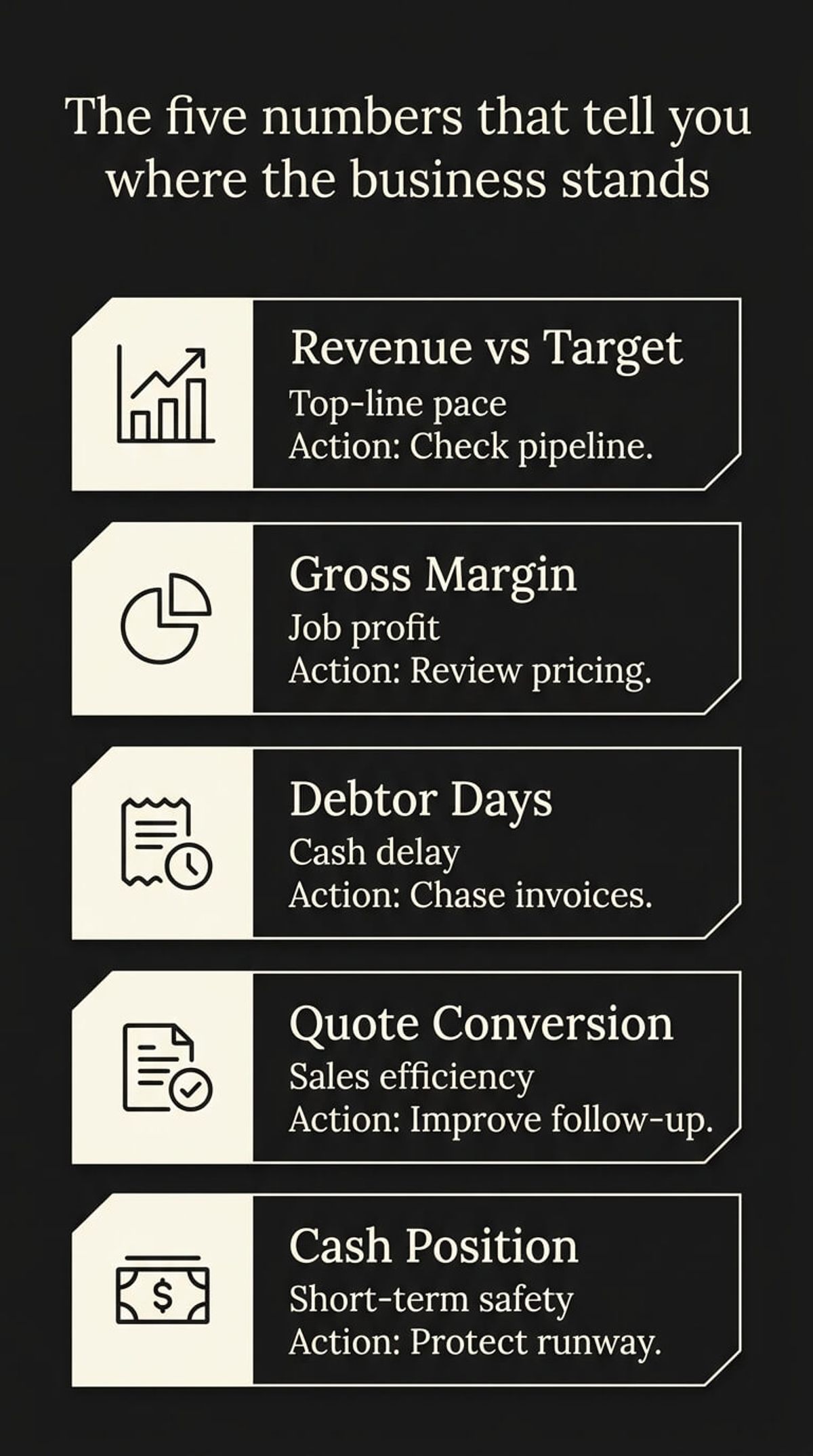
01Revenue vs. Target
What it tells you: Whether your top line is tracking to plan or drifting.
Healthy benchmark: Within 5% of your weekly or monthly target.
When it moves: If you're consistently under, the problem is upstream — not enough leads or a dropping close rate. Look at your pipeline first.
Where to find it: Xero (invoiced revenue), HubSpot (deal pipeline value).
02Gross Margin Per Job
This is the number most service business owners ignore, and it's the one that saves businesses. Revenue means nothing if every job is eating your profit.
Healthy benchmark: 40% to 60% for most service businesses. Below 30% is a problem.
When it moves: Shrinking margins usually mean underquoting, scope creep, or rising direct costs without a price adjustment. Review your last 10 completed jobs and find the pattern.
Where to find it: Xero (profit and loss by project), ServiceM8 (job costing).
03Debtor Days
47% of SME insolvencies cite poor cash flow or financial management as a contributing factor (ASIC, 2025). Debtor days is the metric that catches this problem before it becomes fatal.
Healthy benchmark: 30 days or less. Over 45 is a warning. Over 60 is a cash flow emergency.
When it moves: Tighten payment terms, automate invoice reminders, and require deposits on new work.
Where to find it: Xero (aged receivables report), MYOB (receivables ageing).
04Quote Conversion Rate
Healthy benchmark: 30% to 50% for service businesses. Below 20% means you're spending time quoting work you're not winning.
When it moves: Check three things — are you quoting the right clients, is your response time too slow, and are your prices misaligned with the market? Often the fix is faster follow-up, not cheaper prices.
Where to find it: HubSpot (deal win rate), your CRM pipeline.
05Cash Position
Most business owners check their bank balance on their phone and call it a cash position. That's not the same thing. Cash position is your liquid cash minus committed expenses for the next 30 days.
Healthy benchmark: At least 2 months of operating expenses in reserve. Less than 1 month is a red zone.
When it moves: If cash shrinks while revenue grows, the leak is almost certainly in debtor days or margin. The five metrics work as a system, not in isolation.
Where to find it: Xero (bank balance plus upcoming bills).
How to Pick a Dashboard Tool Without Overthinking It
You don't need to spend thousands on software to get a working dashboard.
- Looker Studio (Google) — Free. Connects to Google Sheets and various data sources. Great for a first dashboard. Limitation: pulling live data from Xero or HubSpot requires a connector tool
- Power BI (Microsoft) — Powerful. Handles complex data models and multiple sources. Steeper learning curve, but worth it once you grow into it
- Xero dashboards — Simple and built in. Covers cash flow, profit and loss, and aged receivables. Limitation: no operational or sales pipeline data
- Purpose-built tools — Databox, Geckoboard, and similar platforms pull multiple sources into one screen. They cost money but save setup time
The best tool is the one you'll actually open every Monday. Start with what you have and upgrade when the questions get harder.
Build Your First Dashboard This Week
You don't need a data analyst or a six-month project. You need five steps and a few hours.
- 01Pick your five metrics. Use the five above, or adapt them. The rule: if a number doesn't change what you do this week, it doesn't belong on the dashboard
- 02Find where the data lives. For most Australian service businesses, the answer is Xero for financials, HubSpot or your CRM for pipeline, and a job management tool for margins
- 03Connect your data source. Looker Studio connects to Google Sheets. Power BI has built-in connectors. Xero data is already there
- 04Set traffic-light thresholds. For every metric, define green, amber, and red. Revenue on target is green, 10% below is amber, 20% below is red. Do this for all five numbers
- 05Schedule a 10-minute Monday review. Open the dashboard, read the five numbers, identify one action, do it
The first version won't be perfect, and it doesn't need to be. Starting imperfect beats waiting for perfect. You can refine the metrics, improve the data connections, and upgrade the tool over time.
If you want a dashboard built for you instead of by you, that's exactly what we do. Our Dashboards & Reporting service connects your existing tools into one screen and sets up the traffic-light system so you can see what matters without building it yourself.
The Monday Morning Test
Here's how you know your dashboard is working. You sit down on Monday morning, open one screen, and within 30 seconds you know five things: is revenue on track, are jobs profitable, are clients paying on time, are quotes converting, and do you have enough cash for the next 60 days.
If any number is amber or red, you know what to do about it. You don't need to open four different apps, wait for your accountant's monthly report, or guess.
Business failure risk among Australian businesses rose 4.5% in the June 2025 quarter, growing 50% faster than new business creation (illion, 2025). The businesses that survive aren't the ones with the most revenue. They're the ones that see the problems early enough to act.
The best KPI dashboard for Australian service businesses isn't the one with the most features or the fanciest charts. It's the one that makes your Monday morning take 10 minutes, gives you clarity you can act on, and tells you exactly where to focus this week. That's not a report. That's a decision engine.
If this sounds like your business, book a call and we'll walk you through how this applies to your situation.

WRITTEN BY
Felipe Chaparro
Systems Architect and Founder of SYSBILT. Felipe engineers custom automation, AI workflows, and performance web architectures for scaling Australian service businesses.