Flying blind with your numbers? Learn what KPIs growing businesses should track across finance, operations, and customers to make confident decisions weekly.
IN THIS ARTICLE
- //You Have Data Everywhere and Answers Nowhere
- //Financial KPIs: The Numbers Your Accountant Cares About (And You Should Too)
- //Operational KPIs: The Numbers That Tell You If Your Team Is Productive
- //Customer KPIs: The Numbers That Predict Whether You'll Still Have Revenue Next Quarter
- //Pipeline KPIs: The Numbers That Tell You What's Coming
- //How Many KPIs Should a Growing Business Track (And How Often)
- //How to Build Your KPI Dashboard Without a Data Team
- //The Monday Morning Test
If someone asked you right now how your business is actually doing, you'd probably hesitate. Not because the business is bad, but because the answer lives in five different apps, three spreadsheets, and a conversation you had with your accountant six weeks ago.
You're not short on data. You're short on answers. This guide covers exactly what KPIs a growing business should track, how to organise them into a system that takes five minutes to review, and what to do when a number moves in the wrong direction.
You Have Data Everywhere and Answers Nowhere
You've built a real business. Revenue is consistent, the team is busy, and clients keep coming back. But when it's time to make a big decision, you're still guessing.
You check Xero for the cash position, log into HubSpot for the pipeline, open a spreadsheet for job costing, and somehow none of the numbers agree with each other. This isn't a technology problem. It's a visibility problem.
Nearly 80% of Australian businesses experienced significant cash flow impacts in the past 12 months (CommBank & UNSW, 2025), and most of them had accounting software installed the entire time. The tool wasn't the issue. The issue was that nobody connected the data into a picture that told them what was actually happening.
"The goal is to turn data into information, and information into insight."
The businesses that grow faster are the ones that can see clearly. Australian SMEs that consistently track key financial metrics grow 72% faster than those that don't (ScotPac SME Growth Index, 2024). That gap isn't about intelligence or work ethic. It's about having the right numbers in front of you at the right time.
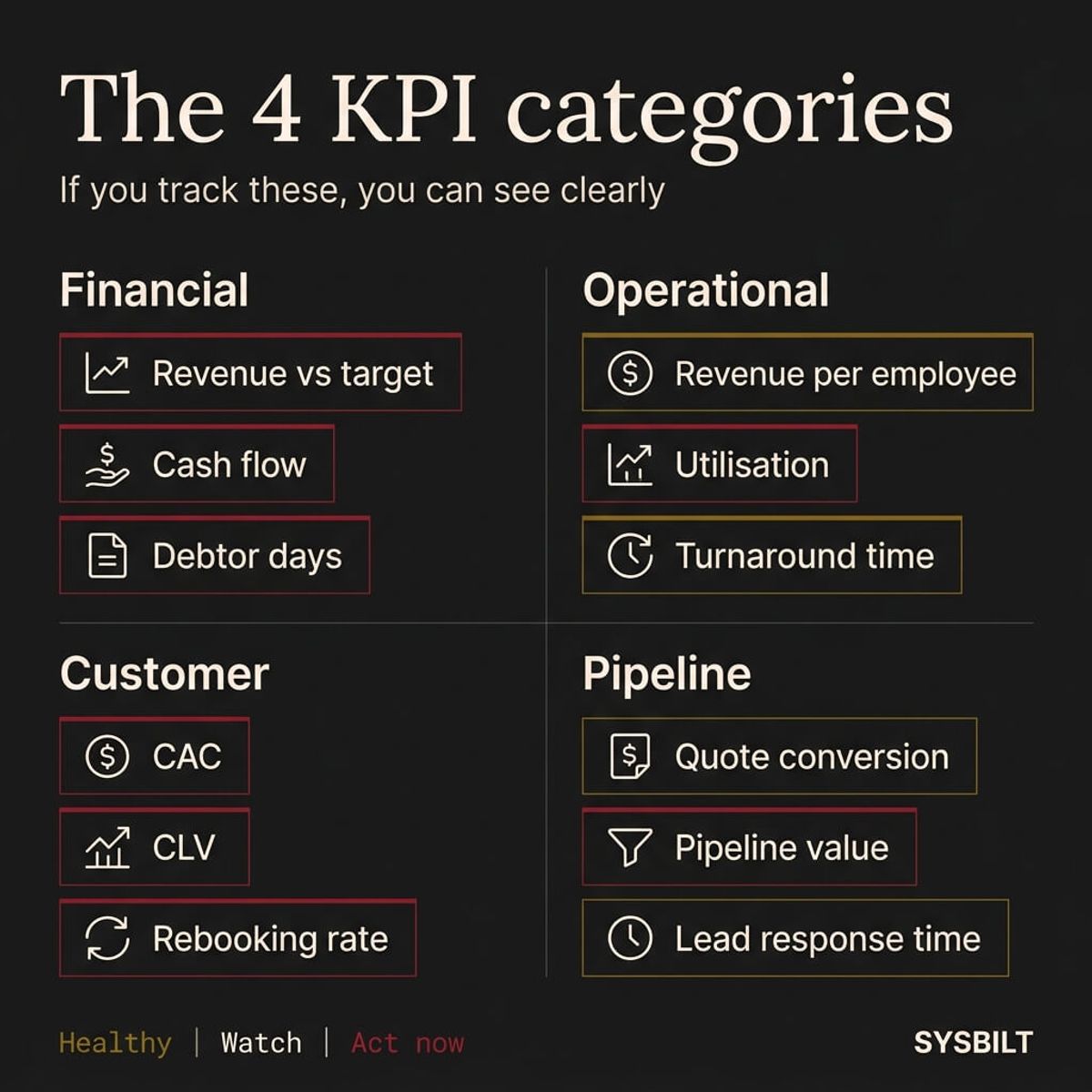
Most KPI guides dump fifteen metrics on you and call it a day. This one is different. We're going to walk through four categories of KPIs that cover the full picture: financial health, operational efficiency, customer strength, and pipeline momentum. Then we'll show you how to set up a dashboard that pulls them together and how to build a weekly review habit that takes less time than your morning coffee order.
Financial KPIs: The Numbers Your Accountant Cares About (And You Should Too)
These are the numbers most business owners think of first, and they matter. But they only tell part of the story. Here are the five financial KPIs that every Australian service business at the growth stage should have on their dashboard.
Revenue vs. target. Not just total revenue, but revenue compared to where you said you'd be. A number without a target is just a number. Set a monthly revenue target and track actual against it weekly, so you have time to act before the month closes.
Gross profit margin. This tells you how much money you keep after direct costs. For most Australian service businesses, a healthy gross margin sits between 50% and 70%. If yours is dropping, your pricing, supplier costs, or job scoping needs attention. Track it monthly and compare quarter over quarter.
Net profit margin. After all expenses, what's left. This is the number that tells you whether growth is actually profitable or just busy. Around 60% of Australian businesses fail within their first five years (ABS & ASIC, 2024), and inadequate financial visibility is a recurring factor.
Operating cash flow. Profit on paper means nothing if you can't pay wages on Friday. Cash flow is the number that kills businesses, not profitability. A quarter of SME insolvencies in Australia were linked to cash flow negativity, often due to inadequate KPI monitoring (ATO, 2024). Check this weekly, and if it's trending down while revenue is flat or growing, you've got a collections problem or an expense problem that needs attention fast.
Debtor days. How long it takes your clients to pay you. The Australian average for service businesses hovers around 35 to 45 days, but best-in-class operators keep it under 30. Every extra day your money sits in someone else's account is a day you're funding their business instead of yours. If debtor days creep above 45, it's time to tighten payment terms or chase overdue invoices before they become bad debts.
Operational KPIs: The Numbers That Tell You If Your Team Is Productive
Financial KPIs tell you whether the business is making money. Operational KPIs tell you whether your team is making the most of their time. These two dashboards aren't the same thing, and most guides skip the second one entirely.
Revenue per employee. Divide your total revenue by headcount. This single number tells you more about scalability than almost anything else. If you're growing revenue but revenue per employee is flat or declining, you're scaling with bodies instead of systems, and that's expensive.
Job completion rate. What percentage of jobs or projects are completed on time and within scope? If this number is below 85%, you've got a process problem somewhere, whether it's in scoping, scheduling, or handoffs between team members. Track it monthly and dig into the outliers.
Utilisation rate. What percentage of your team's available hours are spent on billable or revenue-generating work? For service businesses, a healthy utilisation rate sits between 65% and 80%. Below that, you're carrying too much idle capacity. Above 80%, your team is headed for burnout and quality will slip.
Average job turnaround time. How long does a typical job take from start to finish? Track this by job type, and if turnaround times are growing while the work hasn't changed, something in the process is slowing down. This metric catches bottlenecks early, before they show up as missed deadlines or client complaints.
Customer KPIs: The Numbers That Predict Whether You'll Still Have Revenue Next Quarter
Revenue is a lagging indicator. By the time it drops, the problem started weeks or months ago. Customer KPIs are the leading indicators that tell you whether your revenue is secure before the invoices stop coming.
Customer acquisition cost (CAC). How much does it cost you to win a new client? Add up your marketing spend, sales time, and any tools or platforms involved, then divide by the number of new clients acquired. If CAC is rising while deal sizes stay flat, your marketing or sales process needs attention.
Customer lifetime value (CLV). How much total revenue does an average client generate over the full relationship? It's one of the most important ratios in any service business, and almost nobody tracks it. If your CLV is less than three times your CAC, you're spending too much to acquire clients who don't stick around long enough to be profitable.
Repeat purchase or rebooking rate. What percentage of your clients come back for a second engagement? Repeat clients are cheaper to serve, faster to close, and more likely to refer. If your rebooking rate is below 30%, you've got a retention problem that no amount of marketing will fix.
Client satisfaction (NPS or equivalent). You don't need a formal Net Promoter Score survey. Even a simple post-project rating gives you a leading indicator of whether clients will return and refer. Track the trend, not just the number. A score that's been declining for three months is a warning sign even if the absolute number still looks acceptable.
Pipeline KPIs: The Numbers That Tell You What's Coming
These metrics close the loop between marketing, sales, and revenue. Without them, you're always reacting to what already happened instead of preparing for what's about to happen.
Quote conversion rate. What percentage of quotes or proposals turn into paying jobs? For most Australian service businesses, a healthy conversion rate sits between 25% and 40%. If yours is below 20%, either your pricing is off, your proposals aren't strong enough, or you're quoting the wrong prospects. Track it monthly and break it down by lead source to see where your best clients actually come from.
Average deal size. What's the typical value of a won deal? If this number is shrinking over time, you're either attracting smaller clients or discounting more aggressively, and neither is sustainable. Track it alongside conversion rate to see the full picture.
Pipeline value. What's the total dollar value of all open quotes and proposals right now? This is your forward-looking revenue indicator. If pipeline value drops below three times your monthly revenue target, you don't have enough opportunities in play to hit your numbers next month, and that's a signal to invest in lead generation now rather than after the gap shows up in your bank account.
Lead response time. How quickly do you or your team respond to a new enquiry? Research consistently shows that responding within five minutes dramatically increases conversion compared to responding within an hour. If your average response time is measured in hours or days, you're losing deals to competitors who answer faster.
How Many KPIs Should a Growing Business Track (And How Often)
The answer is fewer than you think, reviewed more often than you'd expect.
Most guides list 15 or 20 metrics and tell you to track them all. That's not a dashboard, it's a wall of numbers. The practical limit for a business owner is 7 to 10 KPIs total, which is enough to cover the full picture across all four categories and few enough to actually review in one sitting.
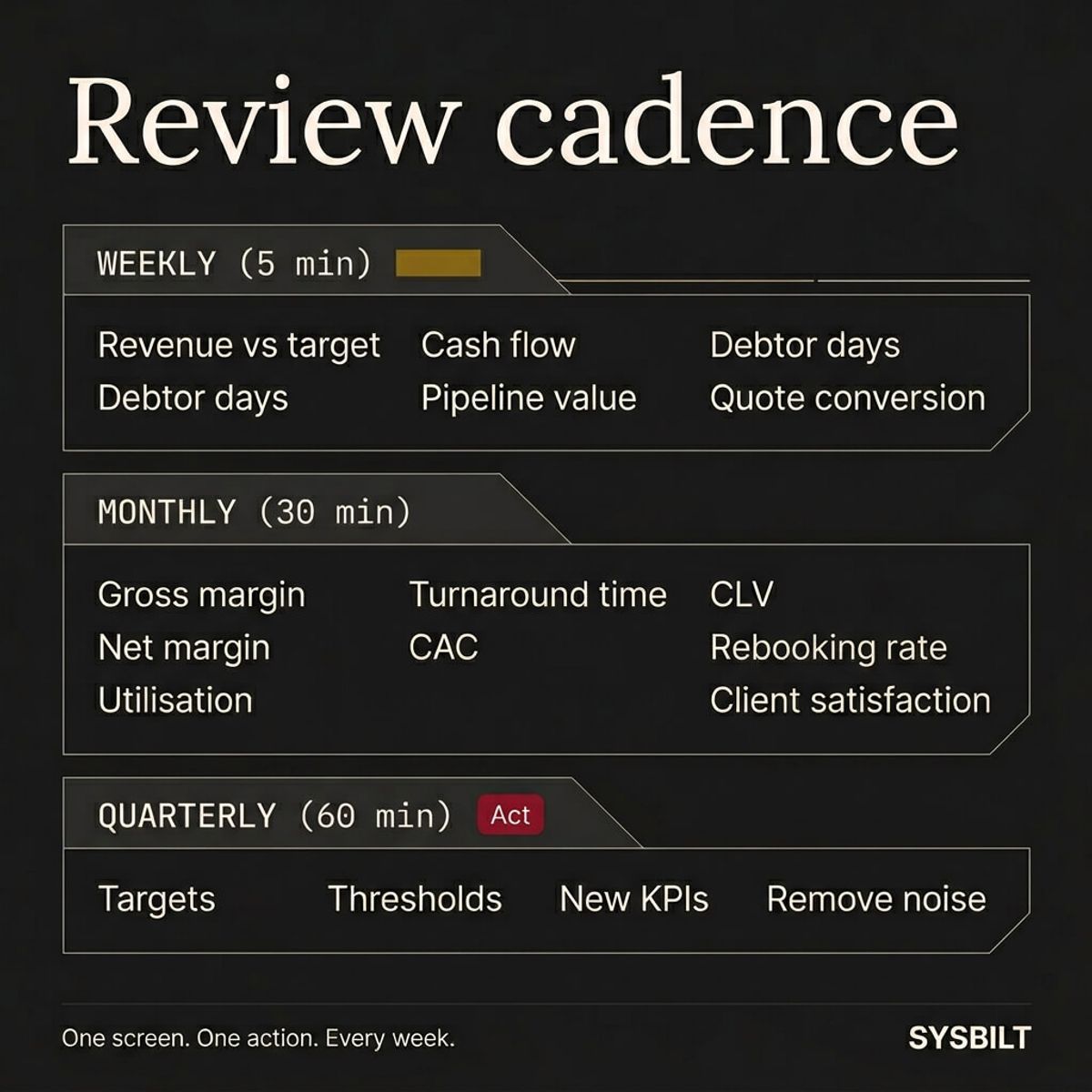
The key is separating what you check weekly from what you review monthly.
Weekly check-in: 5 numbers, 5 minutes.
- Revenue vs. target (are we on track this month?)
- Operating cash flow (can we pay everyone on Friday?)
- Debtor days (is anyone dragging on payment?)
- Pipeline value (do we have enough opportunities open?)
- Quote conversion rate (are we closing the ones we have?)
These five numbers take less than five minutes if they're on a single screen. That's your Monday morning habit.
Monthly deep dive: 30 minutes, full review.
- All financial KPIs (margins, cash flow trends, revenue per employee)
- Operational KPIs (utilisation, turnaround times, completion rates)
- Customer KPIs (CAC, CLV, rebooking rate, satisfaction trends)
- Compare this month to last month and to the same month last year
Quarterly strategy check: are we tracking the right things?
- Review whether your KPIs still reflect the business's current priorities
- Add or remove metrics as the business evolves
- Set targets for the next quarter based on what the data is telling you
How to Build Your KPI Dashboard Without a Data Team
You don't need a data analyst or a six-month implementation project. You need to connect the tools you already have and put the numbers on one screen.
Start with what you've got. Most Australian growing businesses already use Xero or MYOB for accounting, and many have a CRM like HubSpot, Pipedrive, or ServiceM8. Your financial KPIs are already sitting inside your accounting software, and your pipeline KPIs are inside your CRM. The problem isn't missing data. It's that nobody has connected them.
Pick a dashboard tool. For a first multi-source dashboard, Looker Studio (formerly Google Data Studio) is free and handles most growing business needs. If your data is more complex or you need real-time updates across multiple platforms, Power BI is the next step up. Both can pull from Xero, Google Analytics, HubSpot, and most common business tools.
Set traffic-light thresholds. For every metric on your dashboard, define three zones: green (on track), amber (needs attention), and red (act now). This turns your dashboard from a wall of numbers into a decision tool. You open it on Monday morning and the colours tell you where to focus before you've read a single digit.
Build the Monday habit. The dashboard only works if you look at it. Block 10 minutes every Monday morning, open the dashboard, scan the traffic lights, and write down one action for the week based on what you see. Ten minutes, one action, every week. The compound effect of 52 weeks of small, data-driven adjustments is what separates businesses that grow from businesses that guess.
If you'd rather have a dashboard built for you instead of by you, that's exactly what our Dashboards & Reporting service does. We connect your existing tools, set the thresholds, and hand you a single screen with everything you need.
The Monday Morning Test
Here's the vision. You sit down on Monday morning, open one screen, and see seven numbers with traffic-light colours. Green means keep going. Amber means check it this week. Red means act today. You know exactly where the business stands without logging into five different apps or waiting for your accountant's monthly email.
That's not a fantasy. It's what a properly connected dashboard does.
Business failure risk among Australian SMEs rose 4.5% in the June 2025 quarter, growing 50% faster than the 2.9% increase in actively trading businesses over the same period (illion Commercial Risk Barometer, 2025). The businesses that survive aren't necessarily the biggest or the most profitable. They're the ones that see the warning signs early enough to course-correct.
A dashboard isn't a report you read once a month. It's a decision engine you use every week. The difference between a business owner who's guessing and one who's in control comes down to whether they can answer three questions at any moment: are we making money, is the team productive, and is there enough work coming in? If you can answer all three in under five minutes, you're running a business. If you can't, you're just hoping.
If this sounds like your business, book a call and we'll walk you through how this applies to your situation.

WRITTEN BY
Felipe Chaparro
Systems Architect and Founder of SYSBILT. Felipe engineers custom automation, AI workflows, and performance web architectures for scaling Australian service businesses.