
AI content can save time or make your brand feel generic. Here is what actually works, what looks fake, and how to use AI without losing trust.
In this article
AI content creation is not the problem. Dead content is the problem.
That distinction matters because a lot of business owners are looking at AI in two equally unhelpful ways. One side thinks it will solve the entire content problem. The other side thinks everything touched by AI instantly becomes fake.
Both views miss the point. AI can absolutely help a business create more content faster. But it only works when the business knows what the machine is for and what still needs a human brain.
Why AI content feels exciting and risky at the same time
The appeal is obvious. Content is hard to keep up with, and most small teams do not have spare writing hours sitting around.
That is why AI adoption is moving so quickly. The U.S. Chamber of Commerce (2024) reported that almost 60% of businesses say they are using AI for business operations, and a survey of 600 B2C marketers reported about 50% regular use of generative AI for marketing content creation (per recent industry surveys).
So yes, the opportunity is real. The problem is that speed makes it very easy to publish things that sound finished without actually being good.
That is where the discomfort comes from. People can feel when a piece of content is technically polished but emotionally empty. It says the right things, but it does not sound like anyone means them.
That is why the question is not “should we use AI?” The better question is “where should AI sit in the workflow?”
What AI is genuinely good at in a business content system
AI is strongest where structure matters more than originality.
It is good at turning rough notes into a first draft, converting one idea into multiple formats, generating alternative hooks, summarising a transcript, and helping a team get past the blank-page problem.
It is also useful for content operations. If you already know the message, AI can help reshape it into a blog outline, an email draft, a shorter social version, or a list of headline options.
Where people get value is not “the AI wrote our strategy.” The value is that the machine removes some of the mechanical work between idea and publication.
That is why AI works best after you already have source material. A voice note from the founder, a transcript from a client call, a sales objection, a process lesson, a real example from delivery. That is the fuel.
If you want the downstream system side of this built properly, How to Automate Your Social Media Posting and Stop Wasting Time and How to Repurpose One Video Into a Month of Content are the natural follow-ons.
What instantly makes AI content look fake
The fake feeling usually is not caused by AI itself. It is caused by lazy publishing.
Content starts to look fake when it is full of generic phrasing, weak certainty, recycled advice, and no proof that the writer has ever seen the problem in the real world.
Common warning signs:
- it says obvious things in polished language
- it uses broad claims with no examples
- every paragraph sounds equally smooth and equally empty
- it has no point of view
- it could belong to any business in any industry
That is the giveaway. Real content has fingerprints on it. It sounds like someone has handled the problem, argued about it internally, seen where it breaks, and chosen a position.
Fake-feeling AI content usually has none of that. It sounds completed, but not lived.
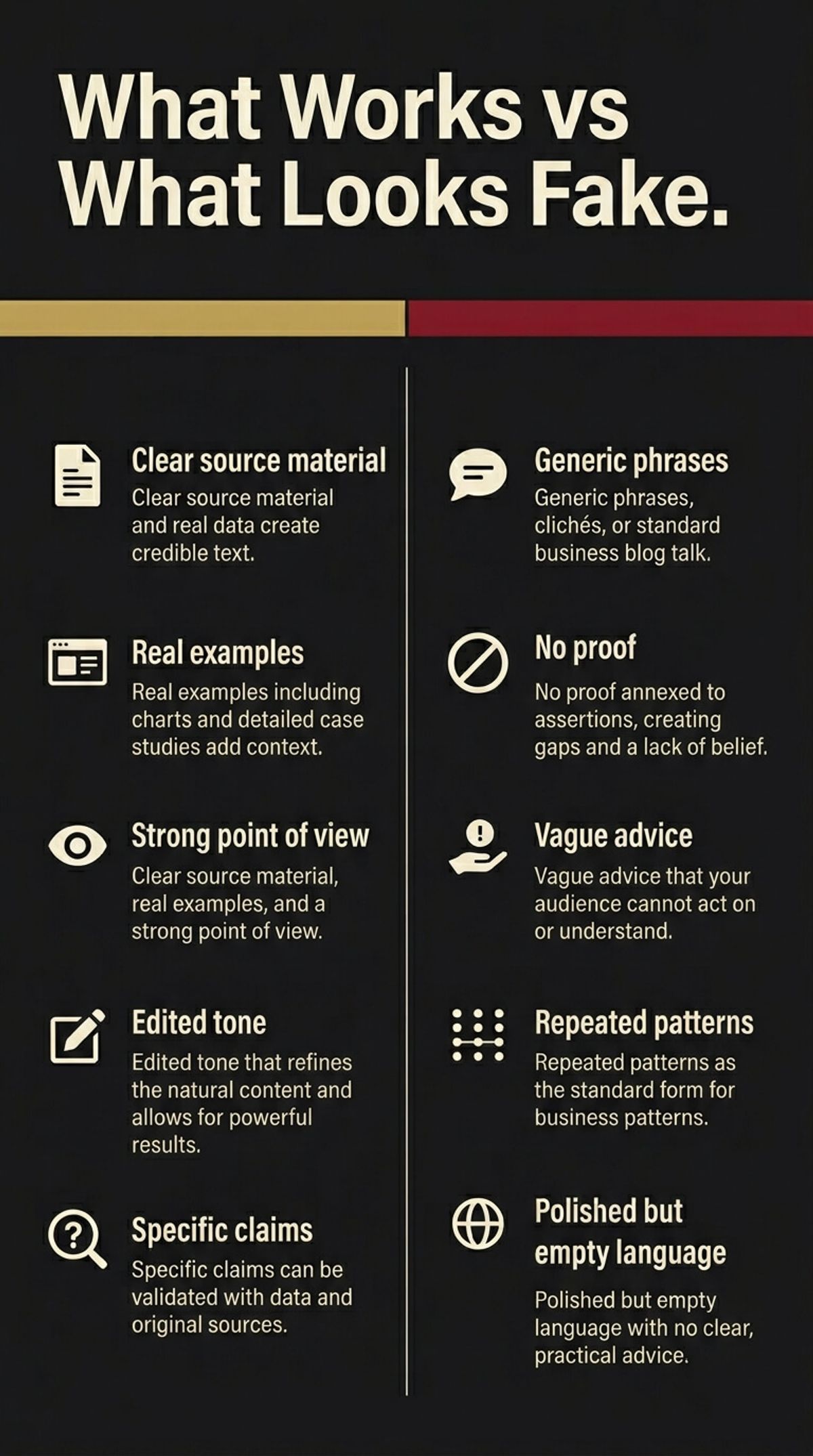
Peer-reviewed guidance on AI-generated content makes the same point in a more formal way: human experts are needed to maintain accuracy, relevance, and ethical soundness.
The practical workflow that keeps quality high
The answer is not to ban AI. The answer is to place it in the right part of the system.
A practical workflow looks like this.
01Source the idea from real business material
Start with something real:
- a question customers keep asking
- a mistake prospects keep making
- a lesson from delivery
- a voice note from the founder or operator
This step matters because it gives the draft something true to work from.
02Capture rough points before asking AI to help
Do not prompt from nothing if you want strong output.
Feed the system bullet points, a transcript, examples, claims you actually believe, and phrases you genuinely use. The better the source material, the less generic the draft.
03Use AI for draft speed, not final authority
Let AI help structure the article, create variants, tighten sections, or generate first-pass drafts.
But do not treat the first clean draft as ready. That is where most teams wreck the result.
04Human edit for proof, voice, and specificity
This is the non-negotiable layer.
A human should add the examples, cut the generic lines, sharpen the claims, remove anything that sounds overconfident or vague, and make sure the final piece actually sounds like the brand.
That is also where judgment lives. AI can draft language. It cannot reliably decide what your business should stand behind.
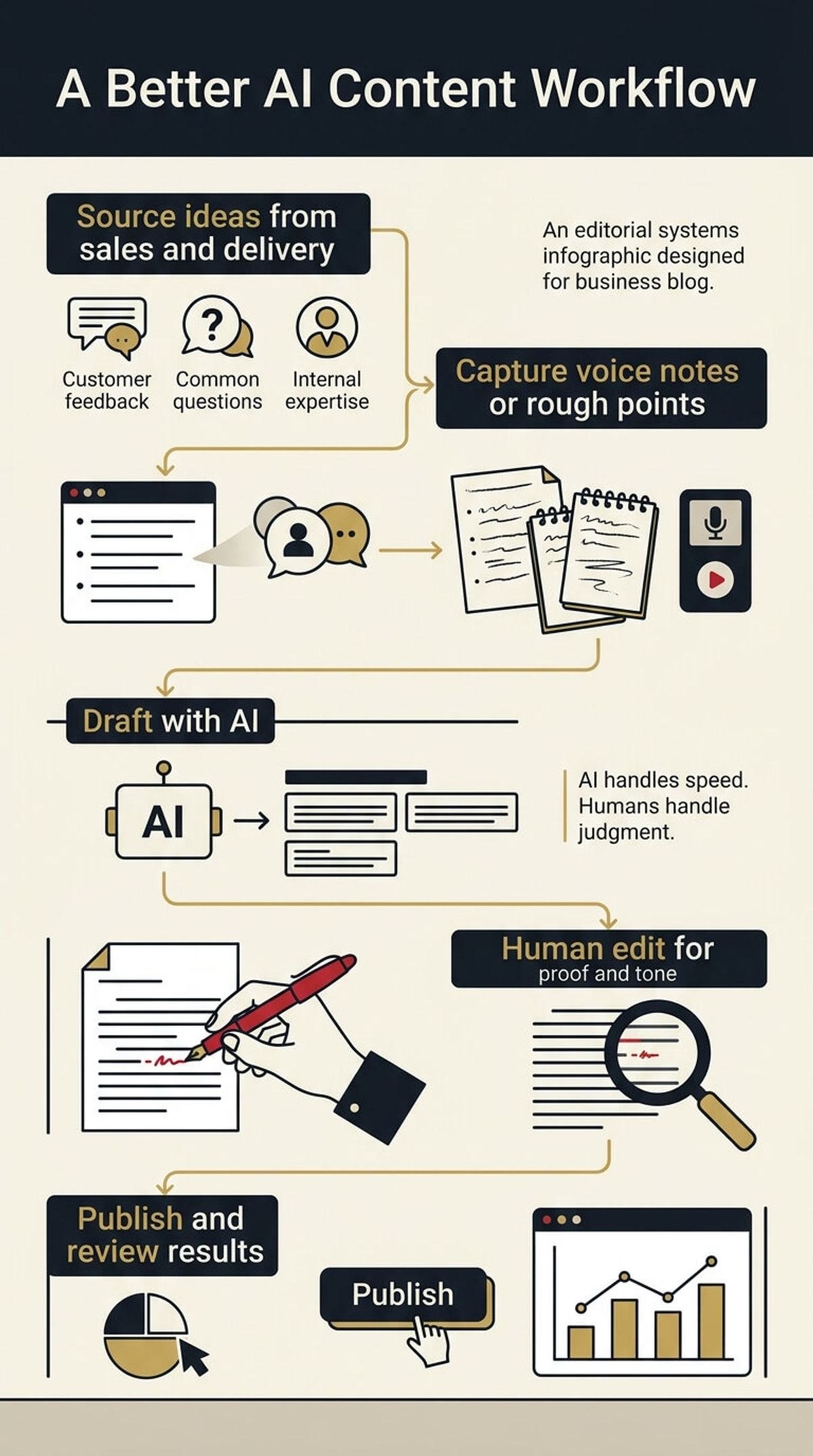
05Review the result against one brutal question
Would this still be believable if the reader knew AI helped write it?
If the answer is no, the problem is not the tool. The problem is the editing standard.
How to use AI without turning your brand into sludge
If you want AI content to work, keep a few rules.
First, never ask AI to invent experience. It should shape your knowledge, not replace it.
Second, keep proof close to every important claim. If you cannot add a real example, a real scenario, or a source, the line probably is not strong enough.
Third, protect point of view. Good content usually has a clear stance. AI is good at balance and fluency, which is exactly why it often sands the edges off strong thinking.
Fourth, build prompts from your own material. Your calls, your notes, your frameworks, your objections, your delivery lessons. That is where brand texture comes from.
Fifth, judge output by trust, not just speed. The point is not “we published more.” The point is “we published more without sounding generic.”
That is the broader reason this matters. Content systems are not just publishing systems. They are trust systems.
If your business wants to use AI well, the win is not replacing the human voice. The win is giving the human voice a faster operating system.
That's the job of content systems: one source, many channels, still in your voice.
See how we fix this
See the exact system we build to fix this
Show me how to build an AI-assisted content system that still sounds like us
WRITTEN BY
Felipe Chaparro
Systems Architect and Founder of SYSBILT. Felipe engineers custom automation, AI workflows, and performance web architectures for scaling Australian service businesses.