Stop repeating yourself every time you hire. Build a training hub with Loom and Notion that gets new staff productive in days, not weeks.
In this article
Every time you hire someone new, the same thing happens. You spend two weeks walking them through every process, every client expectation, every tool, and every shortcut you've built up over years. Then they leave, and you do it all again with the next person.
This post shows you how to build a training hub that does the explaining for you, so the next hire gets up to speed in days instead of weeks.
The Two-Week Trap
In most Australian service businesses, the owner is the training department. There's no HR team, no onboarding coordinator, no learning management system. Just you, sitting next to the new person, explaining the same things you explained to the last three hires.
The problem isn't that you're bad at training. It's that the training lives in your head, and the only way to transfer it is to be physically present for every minute of it. That costs you two weeks of productive work every time you bring someone on.
The data backs this up. According to MYOB's Employee Experience Report, 71% of Australian business employees would not stay with a business if they had a bad onboarding experience (MYOB, 2023). And 60% of Australian managers have had an employee leave during their probation period, with 43% leaving within the first month (HROnboard, 2024). When your training is ad hoc and inconsistent, new hires feel it immediately.
"The only thing worse than training your employees and having them leave is not training them and having them stay."
What a Training Hub Actually Looks Like
A training hub is not a 40-page manual nobody reads. It's a central place where every process, every tool login, and every client protocol lives as a short video or a one-page document. The new hire opens it on day one and works through it at their own pace.
The practical stack for most service businesses:
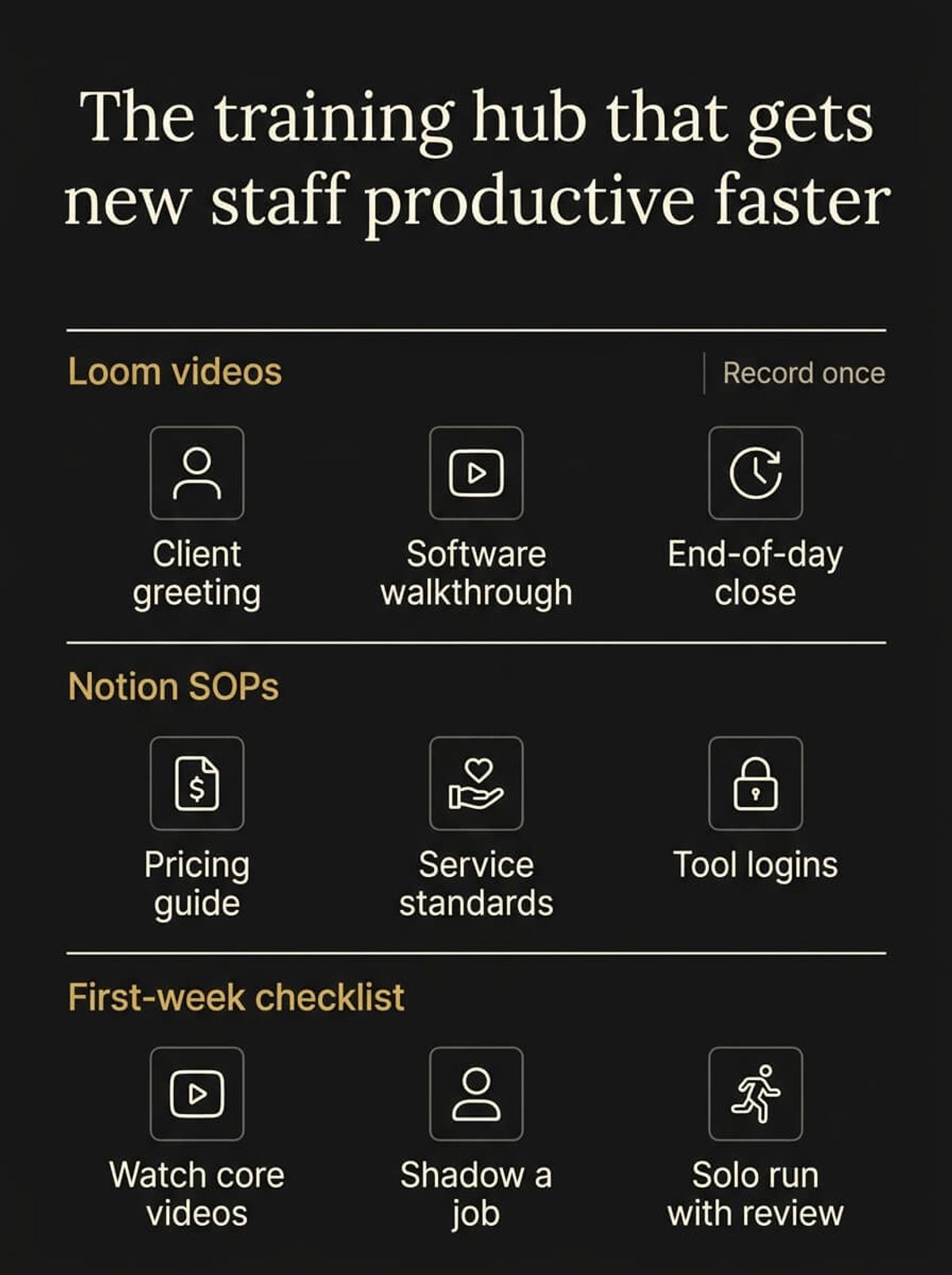
- Loom for recording short walkthrough videos (2–5 minutes each)
- Notion for organising those videos into a structured hub with written SOPs alongside them
- A first-week checklist the new hire follows independently, with each item linking to the relevant video or document
This is what a real team training system looks like. Not a binder on a shelf. A living, searchable hub that updates as your business changes.
Record Once, Train Forever
The biggest shift is realising that you only need to explain something once if you record it. Every process you walk through with a new hire can be a five-minute Loom video that every future hire watches on their own.
Start with the five things you explain every single time:
- How to greet a client and set expectations. The specific words you use, the tone, what to say when things go wrong
- How to use your core software. Whether it's ServiceM8, Xero, HubSpot, or a shared Google Drive, record yourself clicking through the actual workflow
- How to close out a job. What gets documented, what gets invoiced, what gets communicated back to the client
- Where to find answers. Instead of "just ask me," point them to the hub. If the answer isn't there yet, record it after the question comes in and add it
- What the first week looks like. A screen recording of you walking through the checklist itself, explaining the rhythm and what's expected
You can record all five in an afternoon. Each video should be under five minutes. That afternoon of recording replaces weeks of repeated explanations for every future hire.
The First-Week Checklist That Replaces You
The checklist is what turns a pile of videos into a system. Instead of hovering over the new hire all week, you hand them a structured plan and check in at the end of each day.
A practical first-week structure:
- Day 1: Watch the five core training videos. Read the service standards document. Set up all tool logins. End-of-day check-in: any questions the videos didn't cover?
- Day 2: Shadow a senior team member on a live job. Watch the relevant job-specific videos before the shadow. End-of-day check-in: what surprised you?
- Day 3: Handle a straightforward task with a senior team member observing. Review the relevant SOP before starting. End-of-day check-in: where did you need to pause?
- Day 4: Run a job independently with a debrief afterward. The senior team member is available but not hovering. End-of-day check-in: what would you do differently?
- Day 5: Full independent day. The new hire follows the standard workflow from start to finish. End-of-day review: are they ready for week two, or do specific areas need more time?
By day five, you've spent roughly 30 minutes per day on the new hire instead of eight hours. The system did the heavy lifting. If you want a deeper guide on structuring the documents behind this checklist, read How to Document Business Processes Your Team Will Actually Read.
From Two Weeks to Three Days
When the training hub is in place, something changes. New hires stop feeling lost and start feeling prepared. They aren't guessing what's expected because it's all documented. They aren't waiting for you to be free because the answers are in the hub.
The numbers support this. Businesses with strong onboarding practices retain 82% more of their new hires long-term (HROnboard, 2024). Effective onboarding increases new employee performance by up to 70% (MYOB, 2024). And the cost of getting it wrong is staggering: replacing a single team member can cost up to $150,000 when you factor in recruitment, training, and lost productivity (QSuper, 2023).
The investment is one afternoon of recording and one morning of organising. The return is every future hire getting productive in days instead of weeks, and you getting your time back from the moment they walk through the door. If your business is growing faster than your systems can keep up, How to Scale Without Hiring More Staff covers the broader pattern. And if the problem isn't just training but everything else too, What Happens When Your Business Hits $2M Without Systems explains why this stage is where most owners get stuck.
If you're hiring faster than you can train, book a call and we'll map out what your training hub should look like.
See how we fix this
See the exact system we build to fix this
Show me how to build a training system for my team
WRITTEN BY
Felipe Chaparro
Systems Architect and Founder of SYSBILT. Felipe engineers custom automation, AI workflows, and performance web architectures for scaling Australian service businesses.