
Most Australian businesses use AI at the surface. Here's where the real advantage is building and what it means for your operations.
In this article
You've probably seen the headline: 35% of Australian SMEs are now adopting AI (Department of Industry, Science and Resources, 2025). It sounds like a wave of change, and depending on where you sit, it might make you feel like you're falling behind. But when you look at how Australian businesses actually use AI in 2026, the reality is far more nuanced than that single number suggests. Most adoption is shallow, concentrated at the surface, and disconnected from the parts of a business that actually move money. This post breaks down what the data really says, where the genuine advantage is forming, and what it means for the decisions you're making this quarter.
The Headline Number (and Why It's Misleading)
The Department of Industry data paints a mixed picture. Yes, 35% of Australian SMEs are adopting AI, but 42% aren't planning to adopt it at all, and 23% don't know how to start (Department of Industry, Science and Resources, 2025). That's nearly two-thirds of Australian businesses either unaware or uninterested, even as the conversation around AI reaches fever pitch.
Adoption also skews heavily by business size. Companies with 0-4 employees sit at 33% adoption, while those with 200-500 employees reach 82% (Department of Industry, Science and Resources, 2025). If you run a business with 5 to 50 staff, you're in the middle of that curve. Some of your competitors are already using AI in meaningful ways, and others haven't started. The gap is wide enough that early movers still have a real advantage, but narrow enough that waiting another year will make catching up considerably harder.
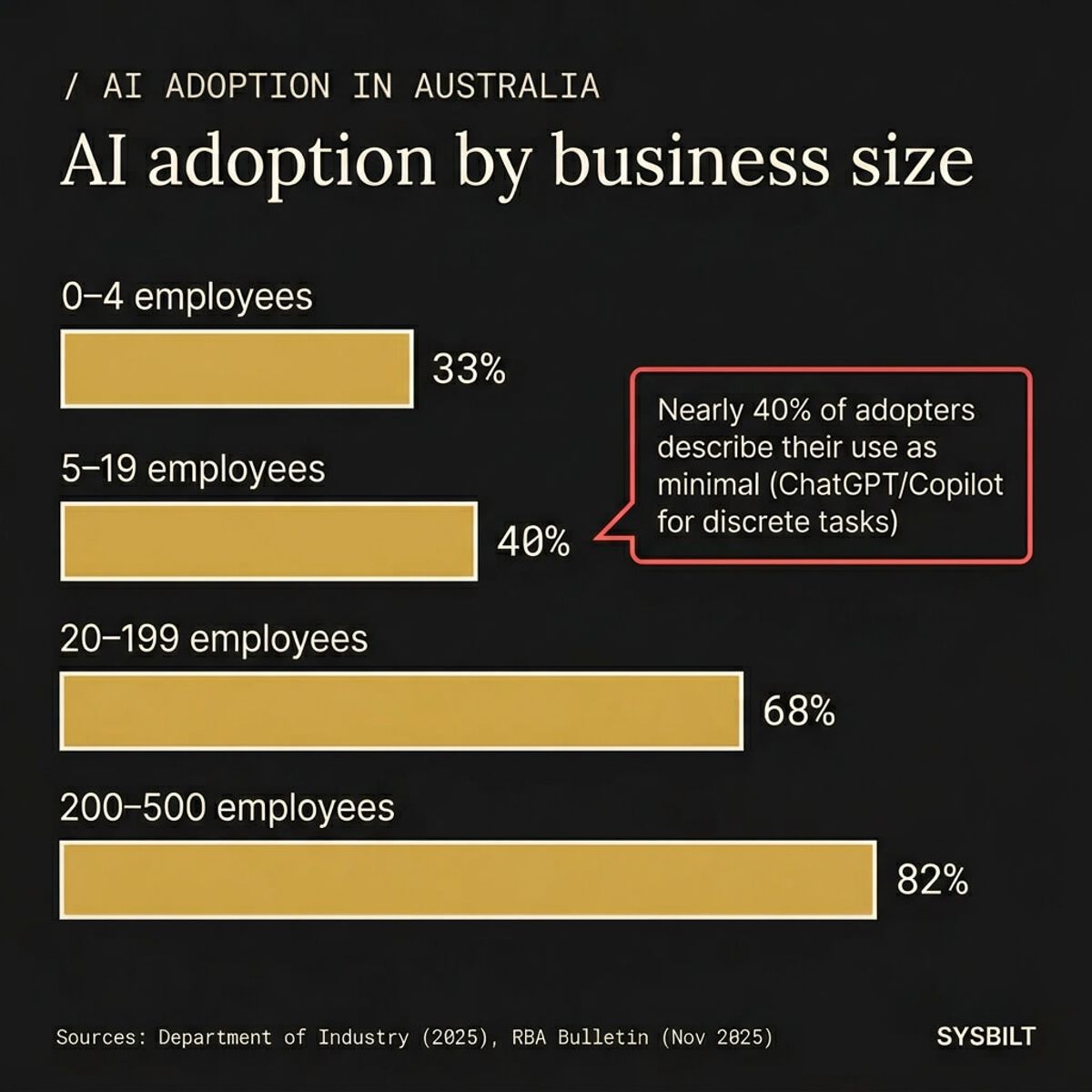
But the most revealing finding comes from the Reserve Bank of Australia. Nearly 40% of businesses that have adopted AI describe their use as minimal, limited to digital assistants like ChatGPT or Microsoft Copilot for summarising emails and doing basic research (Reserve Bank of Australia, 2025). In practical terms, that means the 35% headline includes a large number of businesses whose entire adoption amounts to one person using a chatbot occasionally. There's no workflow connected, no data flowing back into the CRM, and no system running when that person closes their laptop.
Australia is also behind the global pace. Only 12% of Australian leaders say AI is already transforming their business or industry, compared to 25% globally (Deloitte, 2026). The gap isn't about access to tools or awareness. It's about depth of implementation.
What "Using AI" Actually Looks Like in Most Australian Businesses
For most businesses between $1M and $20M in revenue, AI adoption looks like this: someone on the team uses ChatGPT to draft an email, brainstorm a few marketing ideas, or summarise a long document. Maybe one person uses Copilot to catch up on meeting notes. It's useful, and it saves a few minutes here and there. But nobody would call it a competitive advantage.
The core problem is that none of it connects to anything else. The AI doesn't know your clients, your pipeline, or your pricing. It can't follow up on a missed call, send a quote to a warm lead, or tell you which marketing channel drove last month's revenue. It sits alongside a dozen other standalone tools, none of which communicate with each other, and it depends entirely on someone remembering to open it and type the right prompt.
"There's a gap between ambition and investment that companies need to close, particularly when it comes to AI. The winners will be those who deploy value-adding AI, reinvent their business models, make bold boosts to their capabilities, and invest in workforce transformation."
This distinction is the real story behind the adoption numbers. A business that asks ChatGPT to draft a follow-up email saves five minutes. A business with AI built into its lead handling, content workflow, and internal knowledge base reclaims hours every week without anyone having to remember to use it. The first approach is a tool you open when you think of it. The second is infrastructure that runs whether you're at your desk or not. Right now, the vast majority of Australian businesses are stuck at the tool stage, and most of them don't realise there's another level. The good news is that the jump from surface-level use to connected implementation is smaller than most owners expect, especially when you start with the part of your business that's bleeding the most time.
Where the Real Advantage Is Building
The businesses pulling ahead aren't the ones with the fanciest AI tools. They're the ones connecting AI to the specific parts of their operation that leak time, leads, and revenue. Three areas stand out for service businesses in the $1M-$5M range.
Lead handling and follow-up. When a call comes in after hours or while your team is flat out, an AI assistant can respond instantly, qualify the enquiry, and book a meeting in your calendar before the lead moves on. It can also handle customer emails without sounding robotic, giving your team back the capacity they lose to repetitive correspondence every day. This isn't a chatbot that frustrates people with scripted responses. It's a trained assistant that knows your services, your pricing structure, and your availability. The difference between "we use AI" and "AI handles our after-hours enquiries" is the difference between a novelty and a system that works while you sleep.
Content production. If you've spent a weekend trying to create a month of social content, you know the friction is the real enemy. AI connected to a content system can take one video, one blog post, or one client conversation and repurpose it across channels for weeks. It doesn't replace your voice or your expertise, but it removes the production bottleneck that makes consistent content feel impossible. For growing businesses, this is the difference between posting once a month when someone finds the time and maintaining a consistent presence without it consuming someone's entire weekend.
Internal knowledge and team support. Every growing business hits a point where the founder answers the same questions from staff dozens of times a week. An AI assistant trained on your processes, pricing, and policies gives the team a resource that's available around the clock. New staff get up to speed faster because the knowledge isn't locked in one person's head. Experienced staff stop waiting on answers that should already be documented, and the founder finally gets blocks of unbroken focus time, which is the rarest resource in any growing operation.
These aren't hypothetical use cases. They map directly to the areas where growing businesses lose the most time: capturing leads, building visibility, and supporting teams without the owner being involved in every question. If you're curious how these pieces connect for a service business, see how AI assistants fit into a broader business system.
What This Means If You Run a $1M-$5M Business
Research from CEDA, drawing on Deloitte Access Economics modelling, puts a concrete number on the opportunity. If Australian businesses move from basic AI use to an intermediate level of maturity, profitability could rise by roughly 45%. Moving from intermediate to fully enabled could deliver approximately 111% uplift (CEDA citing Deloitte Access Economics, 2025). If just one in ten businesses advanced one step on the AI maturity ladder, annual GDP could increase by around $44 billion (CEDA, 2025).
Those are national-scale numbers, but the principle applies at every level. In practical terms, advancing one step doesn't mean overhauling your entire operation overnight. It might mean connecting an AI assistant to your phone system so after-hours enquiries get a response within seconds, or linking your CRM to an automated follow-up sequence so warm leads don't sit untouched for days. It could mean building a content workflow where one piece of thinking becomes a month of visibility without anyone touching it again. Each of these is a single, bounded improvement that compounds over time.
The cost of staying at the surface isn't dramatic, and it doesn't arrive as a crisis. It's the lead that went to a competitor because nobody responded for two hours. It's the blog post that never got published because the production process took too long. It's the new hire who spent three months becoming productive because the training materials lived in someone's head instead of a system. None of those losses appear on a single line item, but they compound quietly over months and quarters.
The question isn't whether AI matters for Australian businesses. The adoption data already settled that. The real question is whether you're using it at the surface, saving a few minutes on email drafts, or building it into the systems that actually drive your revenue, handle your leads, and support your team. The data says most businesses are still at the starting line. That's not a warning, it's an opportunity.
If this sounds like your business, book a call and we'll walk you through how this applies to your situation.

WRITTEN BY
Felipe Chaparro
Systems Architect and Founder of SYSBILT. Felipe engineers custom automation, AI workflows, and performance web architectures for scaling Australian service businesses.