Australian business owners work 46+ hours a week inside their own operation. Here's how to build a business that runs itself, layer by layer.
In this article
- //The Owner Trap: Why Most Businesses Can't Run Without You
- //What "Runs Without You" Actually Means
- //The Cost of Staying Owner-Dependent
- //The Three Layers Every Self-Running Business Needs
- //The Front Door: How Leads Arrive and Get Handled
- //The Engine: How Work Gets Delivered Consistently
- //The Dashboard: How You See What's Working
- //Where to Start Based on Your Biggest Constraint
You built something real. Revenue is coming in, the team is growing, and clients keep calling. But there's a problem you don't talk about much: none of it works without you in the room.
If you've ever searched for how to build a business that runs itself, you already know the gap between what your business earns and how free you actually feel. This guide is the practical blueprint for closing that gap, written for Australian business owners who are tired of being the single point of failure in their own company.
The Owner Trap: Why Most Businesses Can't Run Without You
Most businesses aren't designed to run without their owner. They're designed around their owner, because that's how the business started and nobody rebuilt the wiring as it grew.
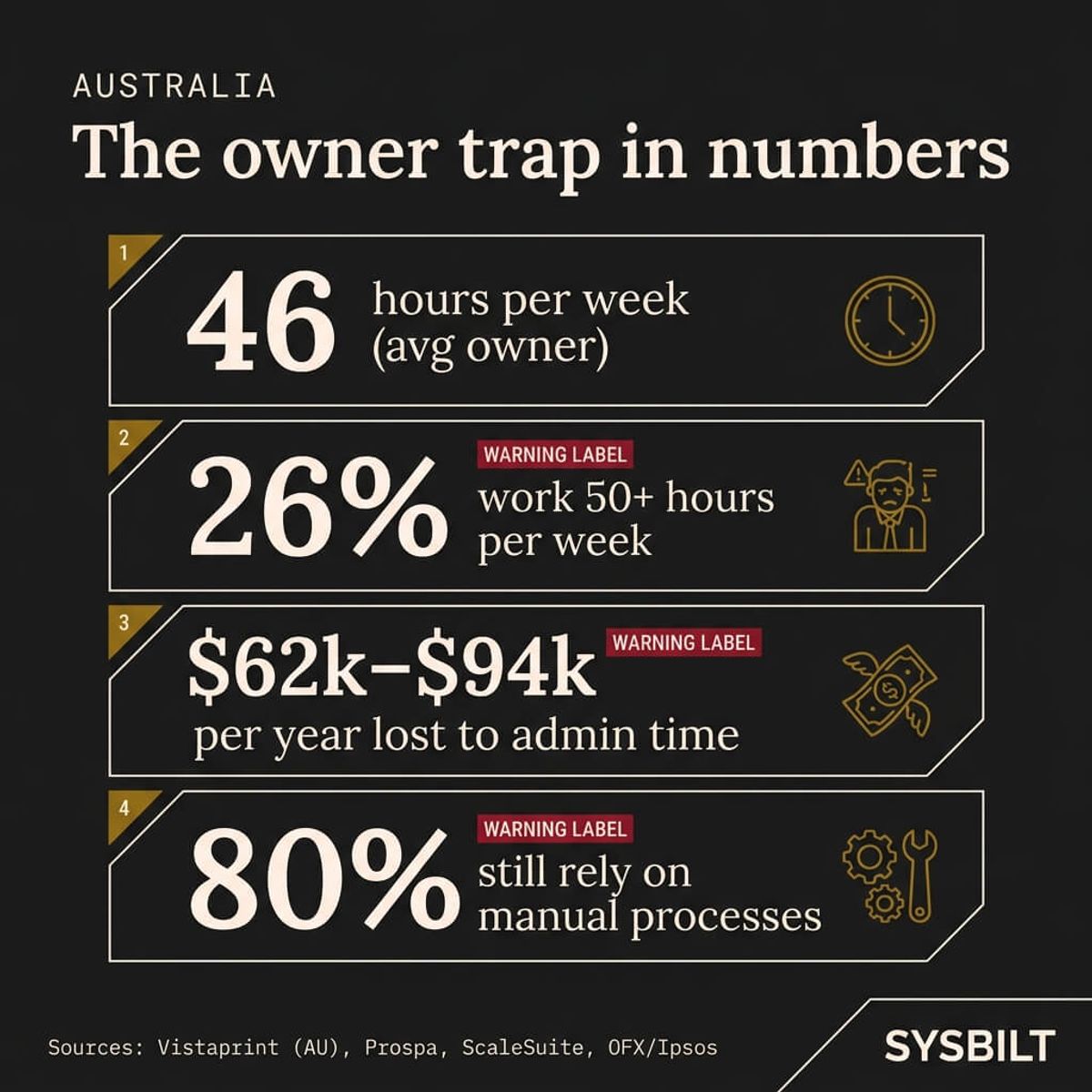
The numbers confirm it. Australian business owners average 46 hours per week, compared to the 38-hour standard for full-time employees (Vistaprint Australia, 2024). More than a quarter work 50-plus hours, and 24% work seven days a week (Prospa, 2024). That isn't a schedule. It's a trap.
"If your business depends on you, you don't own a business, you have a job. And it's the worst job in the world because you're working for a lunatic."
The pattern is the same whether you run a dental clinic, a wholesale distributor, or an electrical contracting firm. The owner becomes the default answer to every question, the backup for every process, and the only person who knows how things actually work. Call it what it is: a bottleneck built out of habit, not leadership.
What "Runs Without You" Actually Means
Let's clear something up. A business that "runs without you" doesn't mean passive income, retirement, or neglect. It means enquiries get handled, work gets delivered, cash comes in, and decisions happen whether you're in the room or not.
Here's a useful diagnostic: if you disappeared for a month, what breaks first? For most owner-dependent businesses, the answer is everything. Leads go cold because nobody follows up. Jobs stall because nobody can approve the next step. Invoices go out late because the owner is the only one who checks them.
A self-running business isn't a fantasy about sitting on a beach. It's a business where the systems handle the repeatable work, the team knows what to do without asking, and you spend your time on the decisions that actually need you.
The Cost of Staying Owner-Dependent
Owner-dependence doesn't just cost you time. It costs real money, and the numbers are harder to ignore than most people think.
The average Australian business owner spends 8 to 12 hours per week on finance and administration alone (ScaleSuite, 2024). At a conservative owner opportunity cost of $150 per hour, that's $62,400 to $93,600 per year in productive time lost to admin work. That's not a minor inefficiency. That's a salary-sized hole in your capacity.
Cash flow takes the next hit. Nearly 80% of Australian businesses experienced significant cash flow impacts in the last 12 months (Small Business Australia / UNSW / CommBank, 2024). A major driver is slow invoicing and manual processes: 58% of Australian businesses spend up to 3 hours per week on payment collection, and one in five devote 6 to 12 working days a year chasing overdue invoices (GoCardless, 2025).
Then there's the growth cost. 65% of growing businesses report concerns about missing opportunities due to slow response times and administrative bottlenecks (Systree, 2026). Meanwhile, approximately 60% of Australian businesses fail within their first five years (AIM Surveyors, 2024). The connection isn't complicated: if you can't respond fast, deliver consistently, and track what's working, growth stalls and risk compounds.
The Three Layers Every Self-Running Business Needs
Every business that runs without its owner has the same three layers in place. The tools and platforms vary, but the structure doesn't.
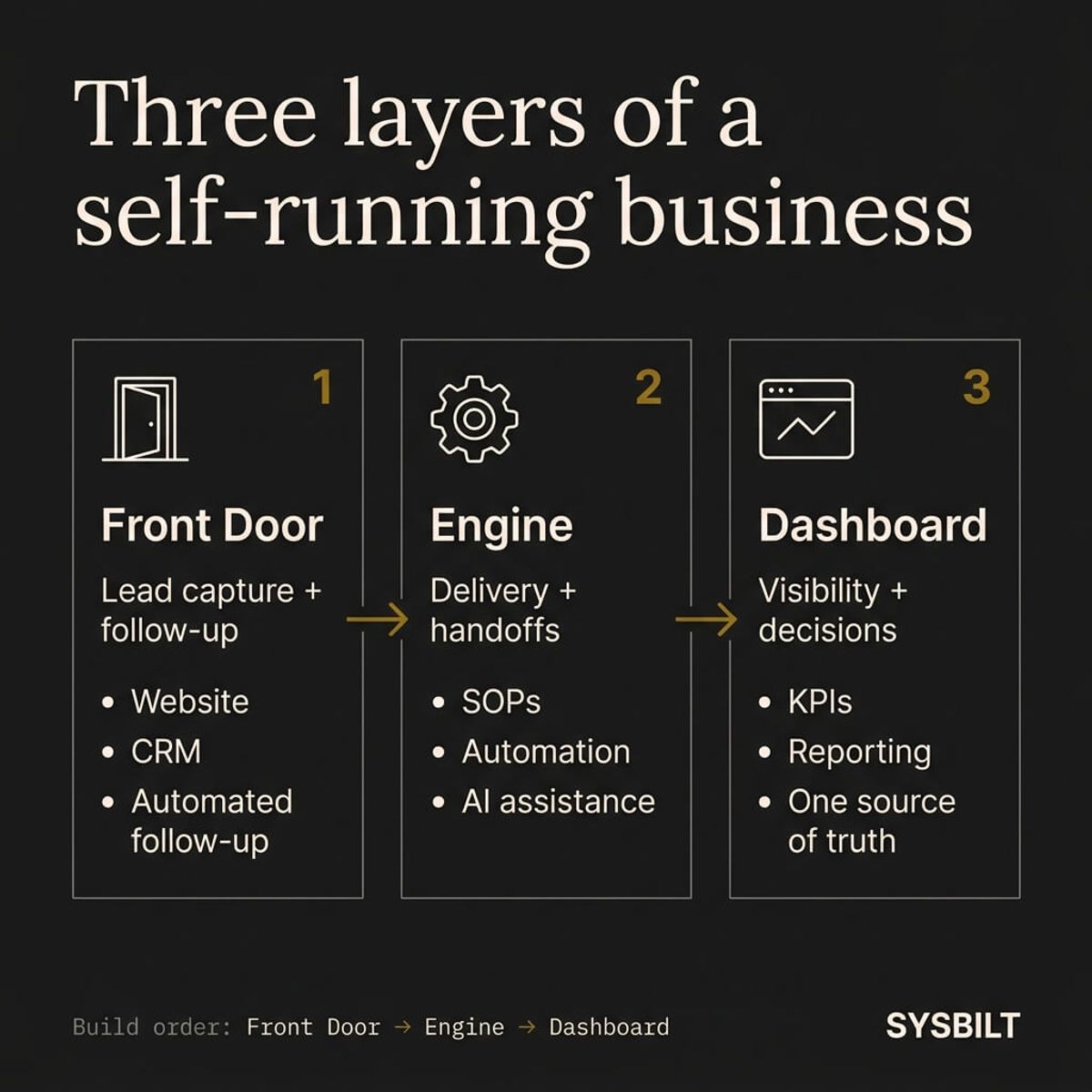
Layer 1: The Front Door. This is how leads arrive, get captured, and get followed up. It covers your website, your CRM, and your automated follow-up sequences. If this layer is weak, you're losing clients before you even know they existed.
Layer 2: The Engine. This is how work gets delivered, handed off, and tracked without the owner in the middle of every step. It covers your processes, your automation, your AI assistance, and the content that keeps your pipeline warm. If this layer is weak, every new client means more hours from you personally.
Layer 3: The Dashboard. This is how you see what's happening and make decisions without digging through five different platforms. It covers your reporting, your KPIs, and your single source of truth. If this layer is weak, you're guessing instead of leading.
These three layers work together as a system. The Front Door feeds leads into the Engine, which delivers the work and generates the data that flows into the Dashboard. Break one layer and the others compensate poorly, if at all.
The Front Door: How Leads Arrive and Get Handled
The first layer to build is the one that captures and converts leads without you. For most Australian businesses, this is where the biggest revenue leaks are hiding.
It starts with your website. Not a brochure site that sits there looking presentable, but a site that actively captures enquiries, books calls, and tells you exactly where each lead came from. If your website doesn't have a clear call to action, a working contact form, and tracking that connects visits to phone calls, it's costing you money instead of making it.
Next is your CRM. If client details live in your head, your inbox, or a spreadsheet, you don't have a pipeline. You have a memory test that fails more often than you'd like to admit. A proper CRM logs every enquiry automatically, assigns follow-up tasks, and makes sure nothing falls through even on your busiest days.
The final piece is automated follow-up. 80% of Australian businesses still use entirely or partially manual processes for basic operational tasks like expense reconciliation (OFX / Ipsos, 2025). The same pattern applies to lead follow-up: when it depends on a person remembering, it doesn't happen consistently. An automated sequence that sends a text within 60 seconds of a missed call converts more leads than any sales technique.
The Engine: How Work Gets Delivered Consistently
Once leads are coming in reliably, the next bottleneck is delivery. If every job requires your personal involvement to move from one step to the next, you can't scale. You can only work harder.
The Engine layer is built on three things: documented processes, automation that moves work between steps, and AI that handles the repetitive tasks your team shouldn't be spending time on.
Documented processes aren't just for large companies. If your team asks you the same question more than twice a week, that's a process waiting to be written down. It doesn't need to be a 40-page manual. A checklist in a shared workspace, updated as the process changes, is enough to remove you as the default answer.
Automation connects the gaps between your tools. When a new client signs a proposal, the project should be created in your delivery system, the welcome email should go out, and the invoice should be queued without anyone doing it manually. Tools like Make.com handle this reliably for a fraction of what it costs to hire someone for data entry.
AI fills the layer above automation. It handles the questions your team gets asked every day, qualifies leads while you're asleep, and drafts responses that would otherwise eat an hour of someone's morning. It isn't about replacing people. It's about freeing your people to do the work that actually requires their judgment.
The Dashboard: How You See What's Working
The final layer is the one most businesses build last, if they build it at all. And it's the one that changes how you feel about your business overnight.
When your data lives in five different platforms and none of them agree, you end up checking numbers every morning without actually learning anything. You wait for the accountant to tell you whether last month was good. You make expensive decisions based on gut feeling because the real numbers are buried in a spreadsheet nobody updates.
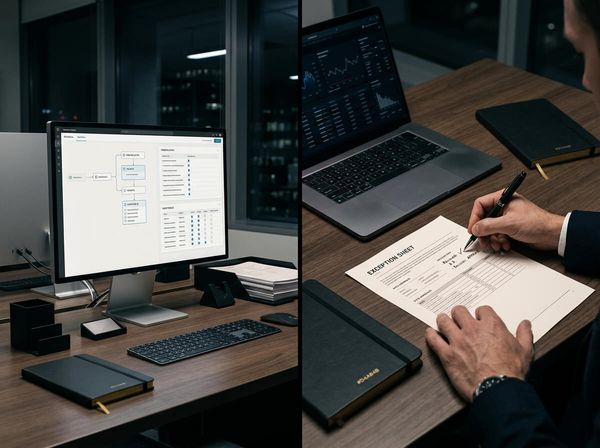
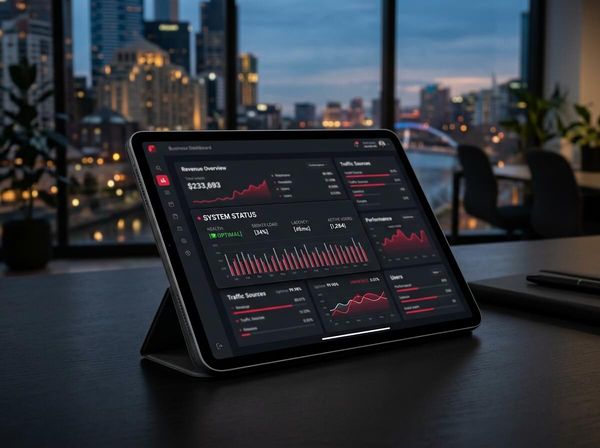
A proper dashboard pulls data from your website, your CRM, your accounting software, and your delivery tools into one screen. You see leads coming in, jobs in progress, revenue collected, and margins per job type, all without logging into four different platforms.
The shift is psychological as much as practical. When you can see what's working and what isn't, you stop reacting to problems that already happened and start making decisions about what to do next. That's the difference between managing and leading, and it's what lets you step back from the day-to-day without feeling like you're flying blind.
Where to Start Based on Your Biggest Constraint
You don't need to build all three layers at once. The most common mistake owners make when they decide to systemise is trying to fix everything simultaneously and finishing nothing.
Start with the layer that's costing you the most right now.
If you're losing leads or missing calls, start with the Front Door. Get a website that captures, a CRM that logs, and an automated follow-up sequence. This is usually the highest-return investment for businesses under $3M in revenue, because the leads are already there and you're just not catching them.
If your team can't deliver without you in every decision, start with the Engine. Document your top five processes, automate the handoffs between steps, and set up an internal knowledge base so people stop asking you the same questions. This is the priority for businesses between $2M and $10M where the owner's time is the binding constraint on growth.
If you have systems but can't see what's working, start with the Dashboard. Connect your data sources, build a weekly KPI review, and stop relying on gut feeling for decisions that deserve real numbers. This is the priority for businesses above $5M where the data exists but nobody's using it.
The first 90 days should focus on one layer. Get it working, get the team using it, and then move to the next. A business that builds one layer properly will outperform a business that half-builds all three every time.
Once one layer is running, the others become easier. The Front Door feeds data into the Engine, which generates the numbers for the Dashboard. Each layer you add makes the previous one more valuable. The timeline depends on where you start and how much manual work you're willing to let go of, but the outcome is always the same: a business where leads get handled, work gets delivered, cash comes in, and you spend your time on the things that actually need your brain.
Here's how the full system fits together: see our complete system overview.

WRITTEN BY
Felipe Chaparro
Systems Architect and Founder of SYSBILT. Felipe engineers custom automation, AI workflows, and performance web architectures for scaling Australian service businesses.