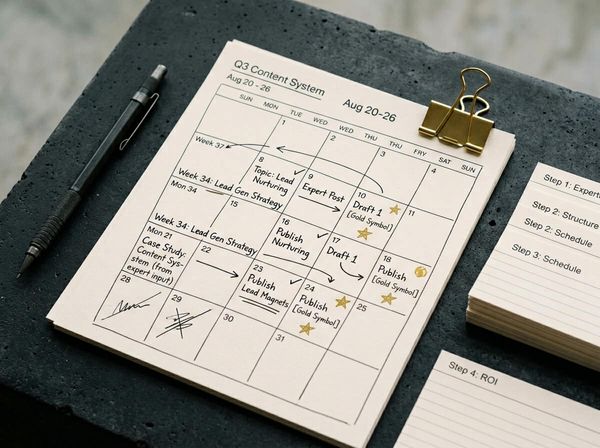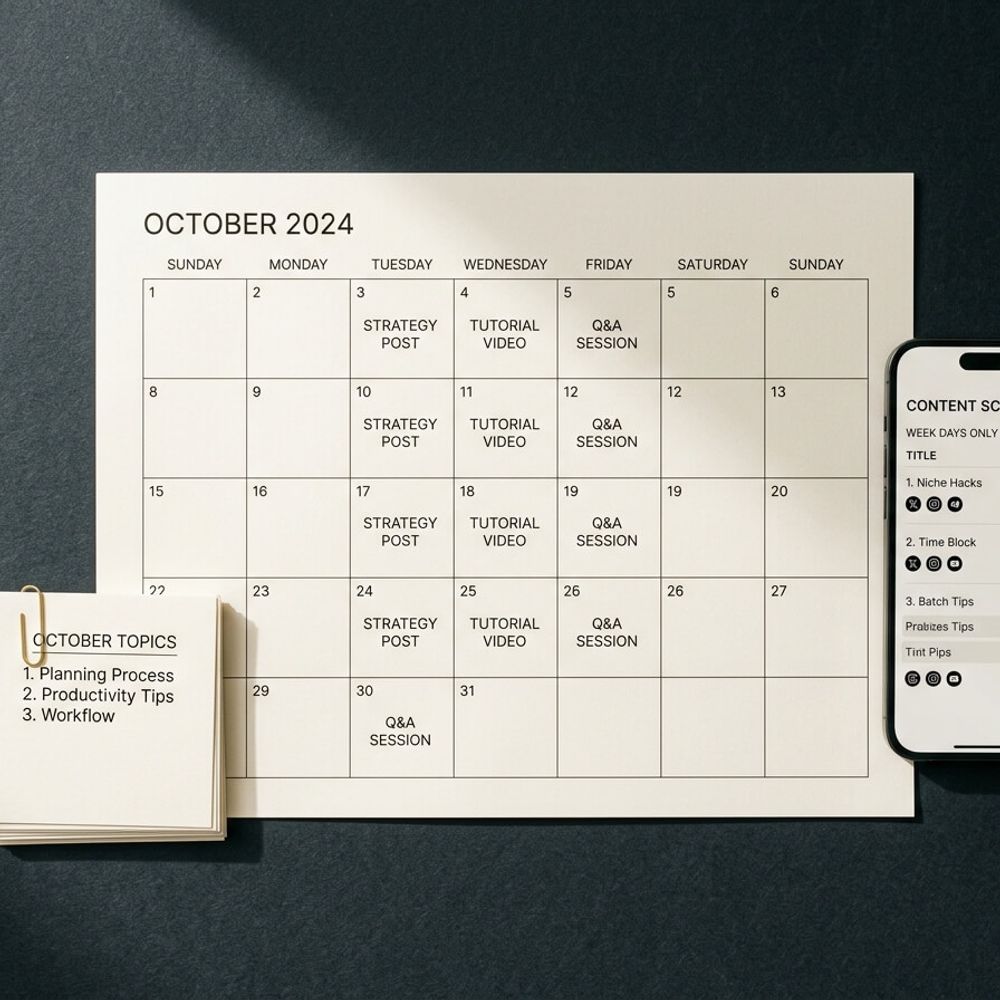
You're too busy to post consistently. Learn how to create 30 days of content in one afternoon, using a system you can repeat every month.
In this article
- //Why posting consistently feels impossible when you're the bottleneck
- //The batching rule that changes the whole process
- //Pick 3 to 5 content pillars that match how your buyers actually decide
- //The one-afternoon sprint to create 30 days of content
- //How to make this repeatable without it becoming another job
- //Where content connects to the rest of your business
You're not bad at content. You're stuck rebuilding the plan from scratch every week, and by the time you've decided what to post, something urgent has already pulled you away. That's why most business owners post in bursts and then go quiet for months.
This post walks you through how to create 30 days of content in one afternoon using a repeatable batching content system. It's built for people who run businesses, not people who create content for a living, and you can repeat it every month even when client work is relentless.
Why posting consistently feels impossible when you're the bottleneck
Content sounds simple until you actually try to fit it into a day that's already full of client calls, team questions, and delivery. You sit down to write something, realise you haven't planned anything, and spend twenty minutes staring at a blank screen before an email or a phone call pulls you out of it. The half-finished draft sits in your notes, and the whole cycle starts again next week.
The real barrier isn't creativity or even time. It's the sheer number of decisions you're making every time you try to post. In a single sitting, you're choosing what topic to cover, what angle to take, what proof to include, and what you want the reader to do afterwards. When you make all of those decisions in the moment, content becomes a stress tax on top of an already packed day, and it becomes inconsistent because the plan shifts depending on how busy you feel that week.
The goal here isn't thirty perfect posts ready to publish. It's a consistent visibility system that doesn't require your weekends or a flash of inspiration to work.
The batching rule that changes the whole process
Most people try to create a post from start to finish, then repeat that thirty times, and they burn out before the first week is done. The fix is surprisingly simple: separate the stages and batch each one individually. Planning is its own job. Writing is its own job. Filming and scheduling are their own jobs. When you keep them apart, you move faster, make better decisions, and stop rewriting posts because you changed your mind halfway through something that was supposed to take ten minutes.
"You do not rise to the level of your goals. You fall to the level of your systems."
Before you start your sprint, choose a minimum posting cadence that fits a real business week. For most service businesses, three posts a week is more than enough, and that's only twelve posts a month rather than thirty. Twelve consistent posts will do more for your pipeline than thirty sporadic ones scattered across half a year. If you still want to aim for thirty, treat them as assets in a content bank rather than finished, scheduled pieces. That way, when you inevitably miss a week, you've got material to pull from instead of starting over.
Pick 3 to 5 content pillars that match how your buyers actually decide
A content pillar is a repeatable category that removes the "what should I post today" question entirely. Instead of staring at a blank screen, you pick from a short list of angles you've already locked in, and the ideas follow from there.
A set that works for most service businesses looks something like this: education covers the questions clients ask before they buy, proof covers results and before-and-after examples, behind the scenes shows how you work and how you make decisions, offer explains what you do and what the next step looks like, and people highlights your team, your partners, or what you believe about the work. You don't need all five, but you need at least three, and each one should map to a real question your buyer is asking. If a pillar doesn't connect to something a potential client actually thinks about before hiring you, it's content for content's sake and you should replace it with one that does.
The one-afternoon sprint to create 30 days of content
This is the full sprint that turns a single afternoon into a month of content. Run it once, learn the rhythm, and then repeat it every four weeks.
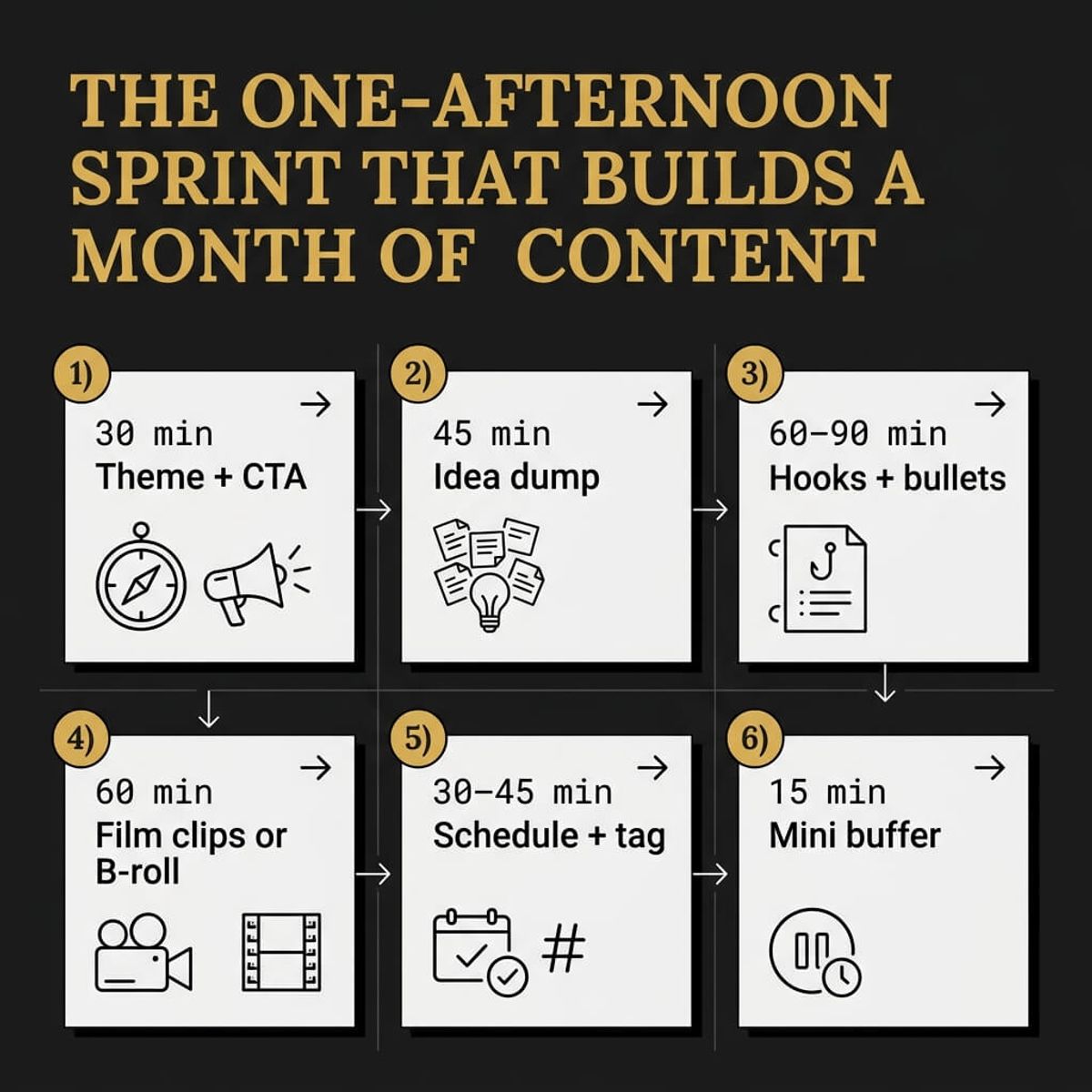
01Pick the month's theme and CTA (30 minutes)
Start by choosing one theme that ties the whole month together, something like "how to stop being the bottleneck" or "what a good process looks like." Think of it as a month-long conversation with your audience rather than a grab bag of random tips. Then pick one CTA for the entire month, not a different one on every post. For most businesses, that CTA is "Book a call," and having a single destination makes planning faster because every idea already has somewhere to go.
02Dump 30 to 45 post ideas (45 minutes)
Set a timer and write hooks or one-line titles, not full captions. Use your pillars as prompts to keep the ideas moving: an education post might be "The 3 questions you should ask before you hire anyone for this," a proof post could be "What changed after we fixed the handover," and a behind-the-scenes post might cover "What we check before we recommend a tool." If you hit fifteen ideas and stall, go back to your last two weeks of real client conversations. Every question, every objection, and every "can you just" request is a post waiting to happen.
03Write hooks and bullet drafts (60 to 90 minutes)
For each idea, write a hook line, three to five supporting bullets, and one closing sentence. You're not writing polished captions here. You're building drafts that your future self can finish in ten minutes flat. A reliable structure for almost any topic is to open with the pain or the mistake in the hook, explain what to do or what to avoid in the bullets, and tie it back to your CTA in the close. The same structure works for video scripts too, because if you can explain it to a client over the phone, you can say it on camera.
04Film quick clips or capture B-roll (60 minutes)
This step is where most people lose the entire afternoon because they try to create one perfect video. Resist that urge and film six to ten short clips instead, each thirty to sixty seconds long, with one idea per clip and clarity as the priority rather than production quality. If you'd rather not be on camera, record your screen while you talk over it, or capture a quick behind-the-scenes clip that pairs with your written captions. Your audience wants to understand how you think and work, not watch a polished production.
05Load, schedule, and tag (30 to 45 minutes)
Switch into pure admin mode for this step. Upload your drafts into your scheduling tool, spread them across the month, and tag each one by its pillar so you can see the balance at a glance. If your tool allows notes, add a short line about what each post is designed to do, something like "Education, handles the pricing objection" rather than just "random tip." That context makes reviewing and adjusting the calendar much easier when you come back to it later.
06Build a mini buffer (15 minutes)
Finish by adding three to five low-effort backup posts you can publish when a week goes sideways. These could be a lesson you learned recently, a quick behind-the-scenes photo with a short caption, or a proof screenshot with a single line of context. They're insurance against the inevitable busy week, and they stop a missed day from snowballing into a two-month silence.
How to make this repeatable without it becoming another job
Running one sprint is useful, but the real payoff comes when it becomes a monthly rhythm rather than a one-off rescue mission. Here's how to make the system stick.
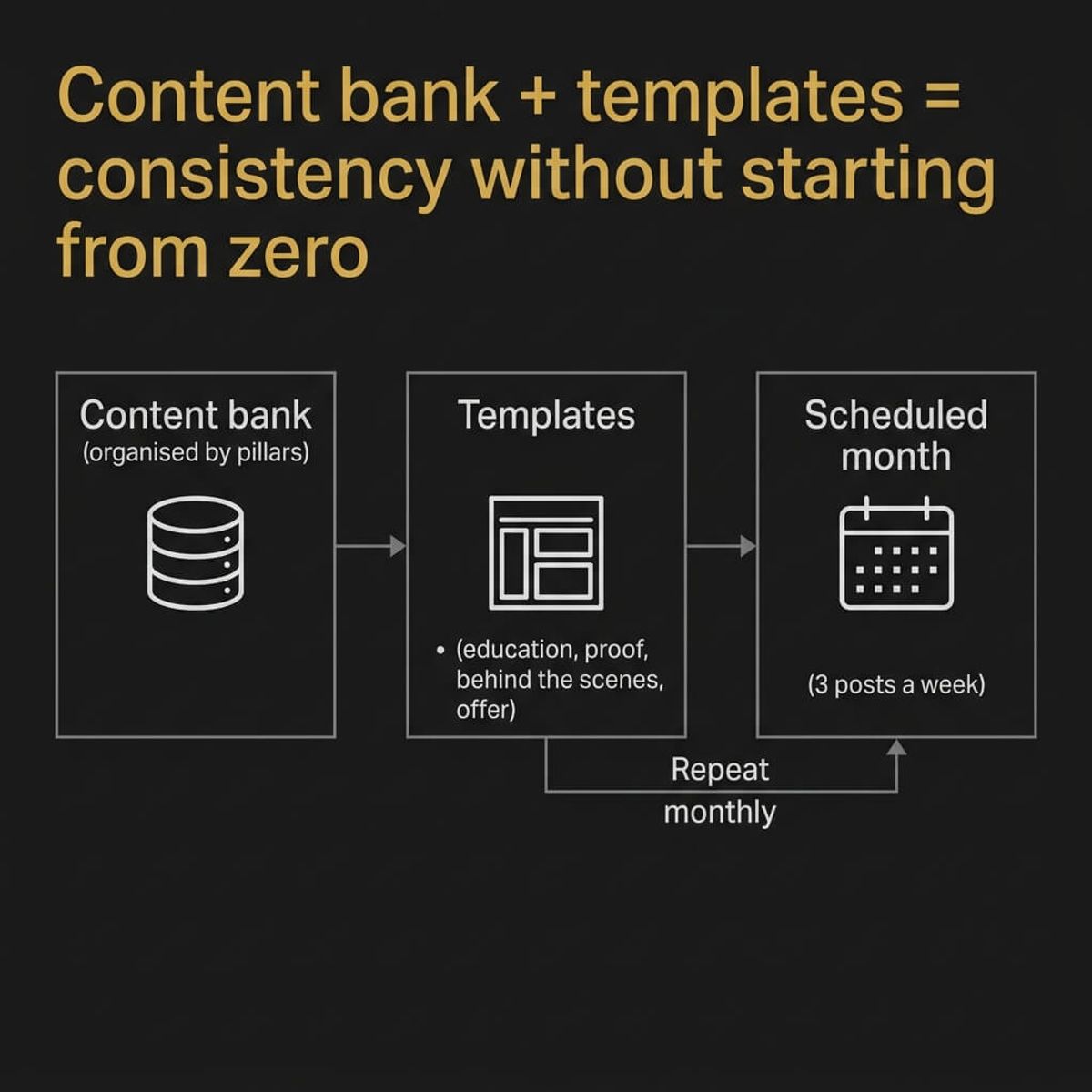
Build a content bank that survives your busiest weeks
Keep all your hooks, bullet drafts, and half-finished ideas in one central place rather than scattered across notes, messages, and random documents. It can be a folder, a database, or a shared doc, as long as everything is organised by pillar so you can find what you need quickly. Every time you run a sprint, you should be doing two things at once: scheduling posts for the coming month and adding surplus drafts into the bank. That's how each sprint gets faster than the last, because you're never truly starting from zero.
Use a handful of templates so you never face a blank page
You don't need fifty templates. Four or five reusable structures will cover almost everything: an education post follows a hook, bullets, example, and CTA pattern; a proof post follows context, what changed, why it matters, and CTA; a behind-the-scenes post covers what you did, what you noticed, and what you'd do differently; and an offer post lays out who it's for, what the outcome is, and the next step. Templates don't just speed up your own writing. They also make it possible for your team to contribute, because the structure is already there and nobody has to figure out the format from scratch.
Add a 15-minute weekly check-in to keep things fresh
Pick one slot each week and use it to check three things: what's already scheduled, what performed well last week, and what new questions you've heard from clients. Then add two or three fresh ideas into the content bank based on those conversations. This small habit keeps your content grounded in real interactions rather than guesses, and it means you're constantly feeding the system without needing to carve out another full afternoon.
What to do when you miss your batching day
You'll miss it sometimes, and that's fine as long as you've planned for it. Pull from your buffer posts to cover the week, write one quick education post in ten minutes if you need to, and move the full sprint to the following week rather than cancelling it entirely. The mark of a real system is that a missed day doesn't collapse the whole month. If skipping one afternoon wipes out your content for four weeks, you've built a fragile routine rather than something sustainable.
Where content connects to the rest of your business
If you're the bottleneck for content, that pattern usually shows up in other parts of the business too. Everything runs through you, and the whole operation slows down whenever you try to step back from the day-to-day.
A content system gives you a repeatable way to stay visible without spending every spare hour creating from scratch. When that system is connected to your website and your CRM, the content you produce doesn't just build your reputation. It feeds your pipeline directly, turning consistent posting into consistent enquiries.
If this sounds like your business, book a call and we'll walk you through how this applies to your situation.
See how we fix this
See the exact system we build to fix this
Book a call to build a repeatable content system
WRITTEN BY
Felipe Chaparro
Systems Architect and Founder of SYSBILT. Felipe engineers custom automation, AI workflows, and performance web architectures for scaling Australian service businesses.