Your slow site is losing leads and wasting ad spend. Learn how fast a business website should load, what it costs you, and what to do next.
In this article
If your website takes longer than a couple of seconds to load, you're losing visitors before they ever see what you offer. Most business owners don't realise how fast a business website should load, or how much a slow one quietly drains from their pipeline every month. This post breaks down the benchmarks that actually matter, translates them into dollars and missed enquiries, and gives you a clear action plan based on what your site scores today.
What "Fast Enough" Actually Means for a Business Website
Google measures website speed using a set of metrics called Core Web Vitals. They sound technical, but here's what they mean in plain English:
- LCP (Largest Contentful Paint): How quickly your visitor sees the main content on the page. Google says under 2.5 seconds is "Good."
- INP (Interaction to Next Paint): How fast the page responds when someone taps or clicks something. Under 200 milliseconds is the target.
- CLS (Cumulative Layout Shift): Whether the page jumps around while it's loading. Lower is better.
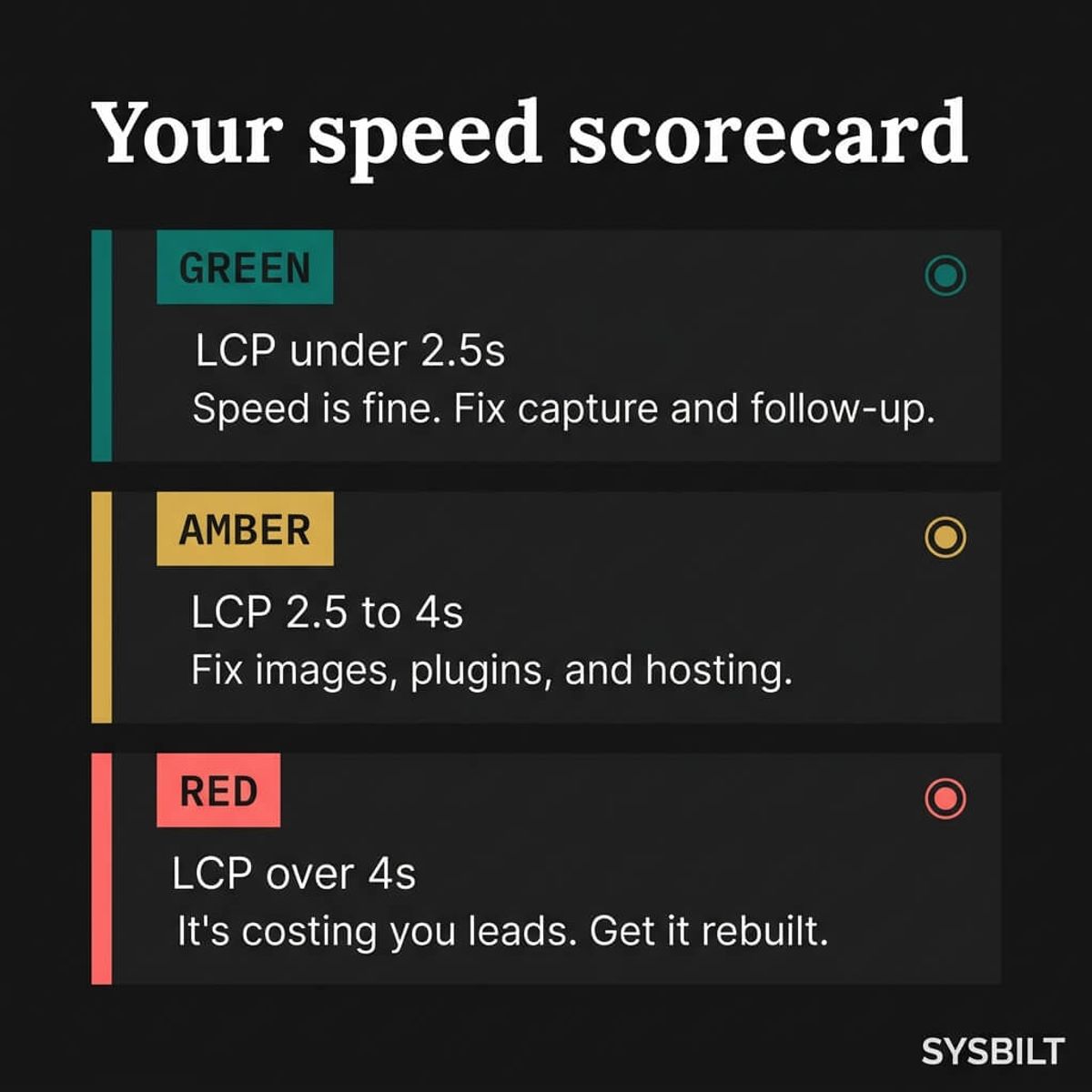
For most business owners, LCP is the only number that matters day to day. It's the metric that directly correlates with whether visitors stay or leave. If your site loads its main content in under 2.5 seconds, you're in the green zone. If it takes longer than 4 seconds, you're actively losing people.
The average desktop page loads in about 2.5 seconds, but mobile averages sit closer to 8.6 seconds (Tooltester, 2026). Since most of your visitors are on their phones, that gap is where the real damage happens.
What a Slow Website Is Actually Costing You
This is where the numbers stop being technical and start being financial.
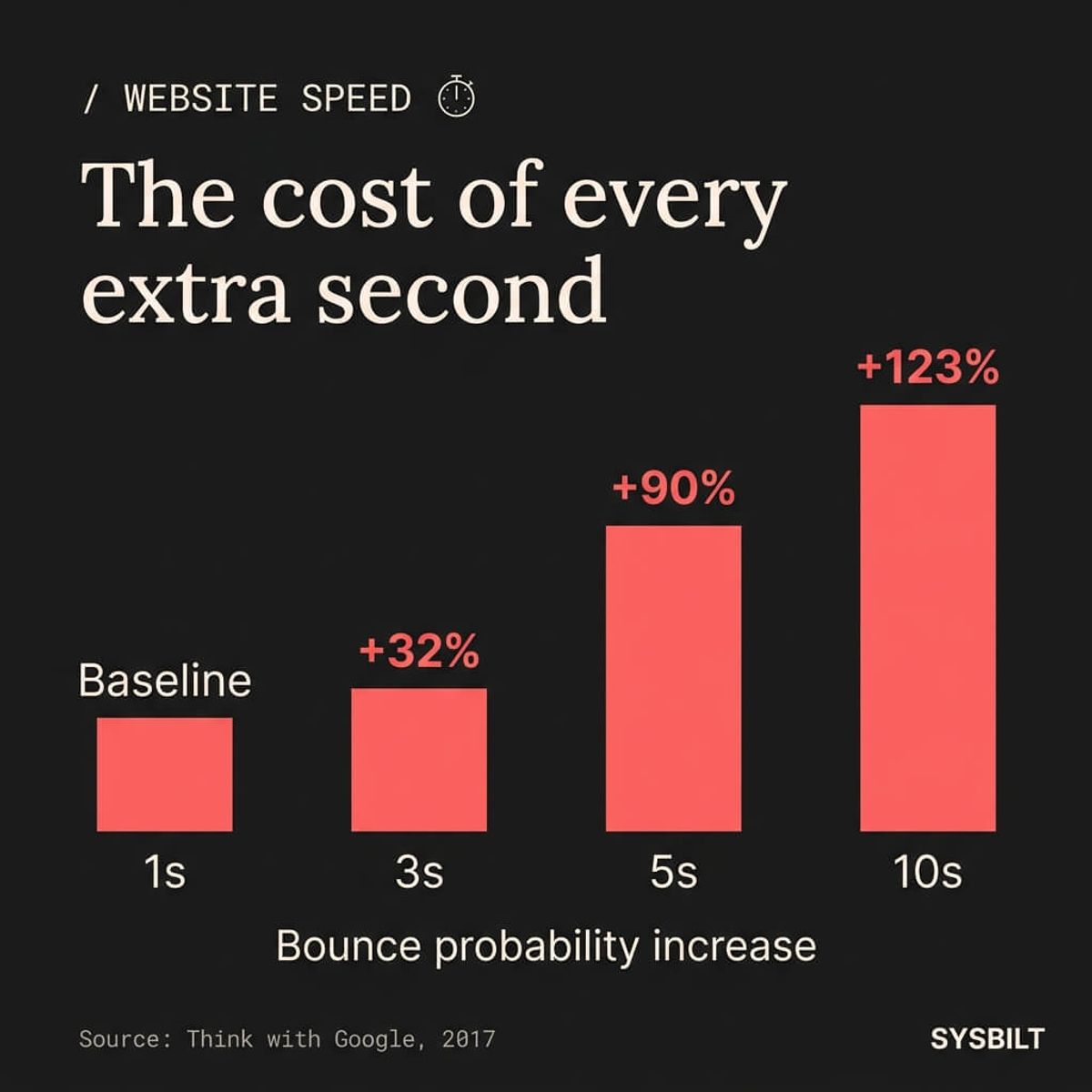
The probability of a visitor bouncing increases 32% when page load time goes from 1 second to 3 seconds. At 5 seconds, bounce probability jumps by 90% (Think with Google, 2017). That's not a rounding error. That's nearly double your visitors leaving before they even see your phone number or enquiry form.
Website conversion rates drop by an average of 4.42% with each additional second of load time between 0 and 5 seconds (Portent, 2019). Let's put a number on that. If your site gets 2,000 visitors a month and converts 3% of them into enquiries, that's 60 leads. Add 2 extra seconds of load time and your conversion rate could drop to around 2.1%, giving you roughly 42 leads instead. Over 12 months, that's 216 enquiries your website never gave you a chance to win. If your average job is worth $2,000, that's over $430,000 in potential revenue leaking through a slow front door.
If you're paying for Google Ads or social media campaigns, the maths gets worse. 53% of mobile site visitors leave a page that takes longer than 3 seconds to load (Think with Google, 2016). You're paying to send traffic to a front door that's stuck half-shut, and the ad spend doesn't refund itself when the visitor bounces.
47% of users expect a website to load in two seconds or less (Kissmetrics, 2011). That expectation hasn't softened since it was first measured, and if anything, it's gotten sharper as mobile browsing has become the default.
"Speed is the most important feature. If your site is slow, you are losing customers."
How the Biggest Companies Learned This the Hard Way
If you think speed only matters for enterprise websites, look at what the world's largest companies discovered when they measured it properly.
Amazon found that every 100 milliseconds of added page load latency cost them 1% in revenue (Greg Linden, 2006). For a company processing billions, that's millions evaporating from a delay most people can't even perceive. Google ran an experiment where a half-second delay caused a 20% drop in search traffic (Greg Linden, 2006). The BBC measured it directly and lost 10% of users for every additional second their pages took to load (web.dev, 2020).
On the positive side, Vodafone improved their Largest Contentful Paint by 31% and saw an 8% increase in sales, a 15% increase in their lead-to-visit rate, and an 11% increase in their cart-to-visit rate (web.dev, 2020). Faster pages translated directly into more leads and more revenue, with no change to their product or pricing.
These companies employ teams of engineers dedicated to shaving milliseconds off load times. Your business doesn't need that level of precision, but it does need to clear the 2.5-second bar. If Amazon and Google still lose money to fractions of a second, a growing business site loading in 5 or 6 seconds is haemorrhaging opportunity.
How to Check Your Website Speed in 60 Seconds
You don't need a developer to find out if your site has a speed problem. Here's how to check it right now:
- 01Open your browser and go to Google PageSpeed Insights
- 02Type in your website address
- 03Wait about 30 seconds for the results
- 04Look for the LCP number under the "Core Web Vitals Assessment" heading
Here's how to read your result:
- Green (under 2.5 seconds): Your speed is fine. The problem, if there is one, is elsewhere in your system.
- Amber (2.5 to 4 seconds): You're losing some visitors. There's low-hanging fruit worth fixing.
- Red (over 4 seconds): This is costing you real money every single month.
One important step most people skip: test your mobile score, not just desktop. Most of your visitors are browsing on their phones, and mobile scores are almost always worse. If your desktop result looks healthy but your mobile score is red, your customers are having a completely different experience from the one you see on your office computer.
What Is Actually Making Your Site Slow
Most slow business websites share the same handful of problems. None of them are mysterious.
Oversized images are the most common offender. A single uncompressed photograph can add several seconds to your load time. If your web designer uploaded full-resolution camera images without compressing them, that's likely your biggest and easiest win.
Too many plugins and scripts slow things down quickly. Every plugin adds code the browser needs to download and run before the page is ready. Analytics trackers, chat widgets, social media feeds, and booking tools all compete for loading time, and they stack up faster than most people realise.
Cheap shared hosting puts your website on a server alongside hundreds of others. When those servers get busy, your site slows down. It's the digital equivalent of sharing a phone line with an entire building.
Template builders are a hidden problem that's harder to fix piecemeal. Drag-and-drop website platforms generate bloated code underneath the surface, loading scripts and features for every possible design option, including the ones you're not using. This is why a custom-coded site almost always loads faster than a template-built one. If you're weighing up the difference, we've covered why code-built sites outperform templates.
What to Do Next Based on What You Find
Now that you've tested your site, here's your action path.
If You Scored Green (LCP Under 2.5 Seconds)
Your speed isn't the bottleneck. But a fast website that sends enquiries to an unmonitored email inbox still leaks leads. Make sure the rest of the system is working: your forms should feed into a CRM, your follow-up should be automated, and your tracking should tell you where every enquiry came from. Speed gets visitors through the door, but the system behind your website is what turns them into customers.
If You Scored Amber (LCP 2.5 to 4 Seconds)
Start with the basics. Compress your images, remove any plugins you aren't actively using, and check whether your hosting plan is up to the job. These fixes are often enough to push you into the green zone without a major investment. If you've tackled the basics and the score hasn't moved, the issue is likely structural, meaning the way the site was built is creating the bottleneck rather than the content on it.
If You Scored Red (LCP Over 4 Seconds)
This is actively costing you enquiries and revenue every month you leave it. At this speed, more than a third of your visitors are leaving before they even see your offer (Pingdom, 2019). Patching individual issues might help at the margins, but if the site was built on a heavy template platform with budget hosting, the fastest path forward is usually a purpose-built replacement rather than an endless series of incremental fixes.
Your website's speed isn't a developer metric buried in a dashboard somewhere. It's the first impression your business makes online, and it plays out in less time than it takes to blink. Every second over the benchmark is costing you visitors who'll never come back and enquiries that go straight to the next name on Google.
If this sounds like your business, book a call and we'll walk you through how this applies to your situation.

WRITTEN BY
Felipe Chaparro
Systems Architect and Founder of SYSBILT. Felipe engineers custom automation, AI workflows, and performance web architectures for scaling Australian service businesses.