Sending quotes into silence? Learn how to measure your sales conversion rate for quotes, see real benchmarks, and start closing more jobs.
In this article
You send 15 quotes a month. Maybe three or four come back signed. The rest disappear into inboxes you'll never hear from again, and you've got no way to tell whether that hit rate is normal or a sign that something in your process is costing you work.
Most business owners don't track their quote conversion rate at all. They know roughly how busy they are, but they can't say what percentage of quotes actually turn into jobs. This post breaks down how to measure your sales conversion rate for quotes and what a healthy number looks like. It also covers the three most common reasons your rate might be lower than it should be, and what to do about each one.
You're Probably Losing More Quotes Than You Think
Every quote you send carries a cost, whether it comes back signed or not. You drove to the site, spent time assessing the job, wrote up the scope, and put a price on it. When that quote disappears into silence, you don't just miss the revenue. You lose the hours you invested in earning it.
The painful part is that most business owners have no visibility on this. Quotes live in email threads, text messages, or scribbled notes. There's no central place showing what's been sent, what's been followed up, and what's gone cold. Without that picture, you're making decisions about pricing, marketing, and hiring based on a feeling rather than facts.
Here's the reframe that matters: you probably don't need more leads. You need to know what's happening to the quotes you're already sending. The answer is almost always sitting in the gap between "sent" and "signed."
How to Calculate Your Quote-to-Close Ratio
The formula itself takes ten seconds:
(Quotes Won ÷ Quotes Sent) × 100 = Quote Conversion Rate
If you sent 20 quotes last month and won 5 of them, your conversion rate is 25%. That single number tells you more about your sales health than almost any other metric in the business.
But there's a mistake most guides make here. They treat "sales conversion rate" as one number when there are actually two stages worth measuring separately.
Lead-to-quote conversion measures how many enquiries turn into formal quotes. If you're fielding 50 calls a month but only quoting 12, your lead qualification might be the issue, not your pricing.
Quote-to-close conversion measures how many of those quotes become paying work. If you're quoting 20 and winning 3, the problem is likely your follow-up speed or quote presentation. It could also mean you're quoting the wrong leads entirely.
These two numbers point to completely different fixes. Lumping them together means you'll chase the wrong solution. A dentist sending treatment plans will have a different lead-to-quote pattern than a commercial cleaner quoting office contracts. But the quote-to-close formula works identically for both.
What a Good Sales Conversion Rate Looks Like for a Service Business
There's no single "good" number. Your conversion rate depends on where the leads come from, the size of the job, and how fast you respond. But there are benchmarks that help you figure out whether your rate is healthy or whether something needs fixing.
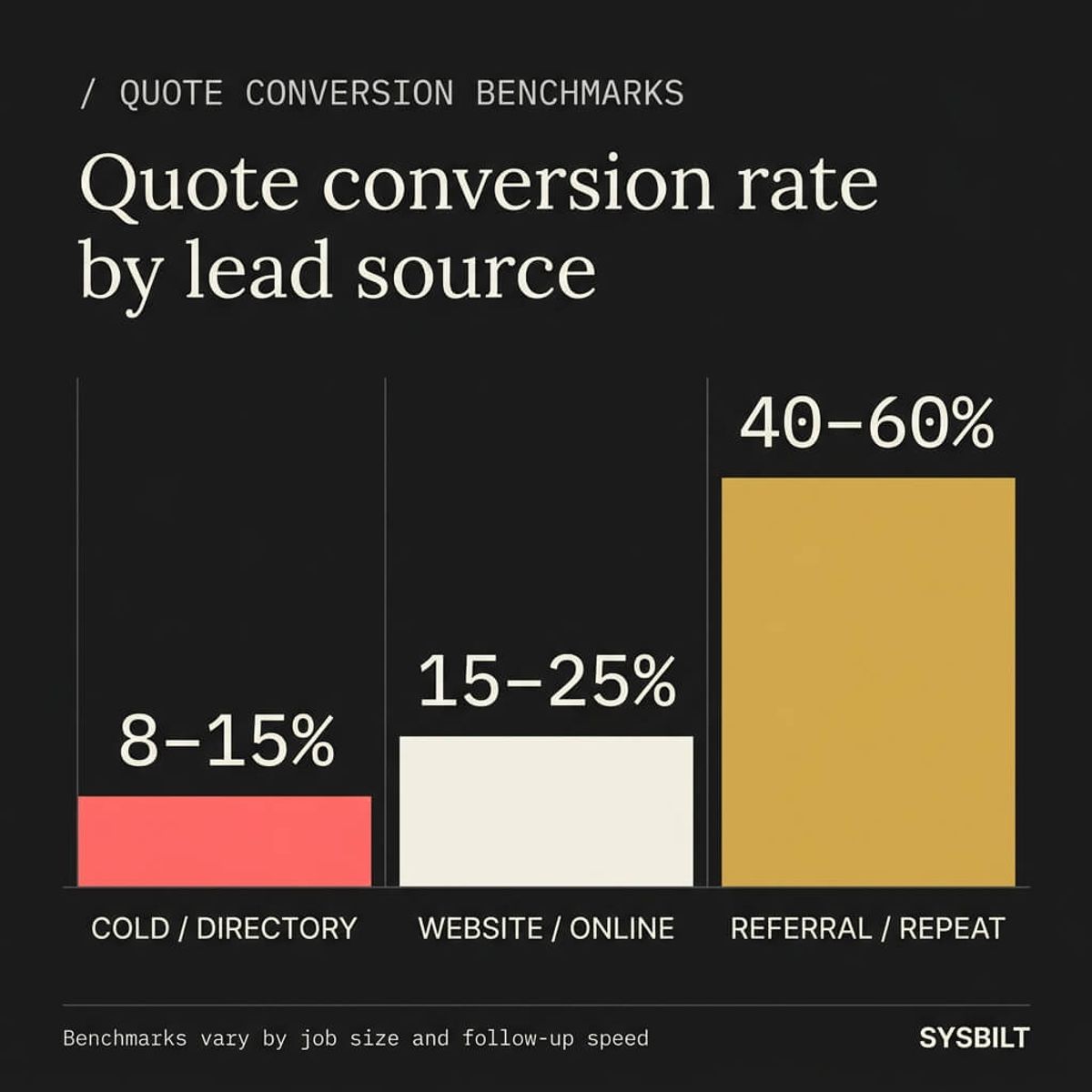
For service businesses quoting lower-value jobs, here's what the data shows by lead source:
- Referral and repeat clients: 40–60% conversion is typical. These people already trust you before the conversation starts
- Website and online enquiries: 15–25% is a solid range. They've found you online and they're comparing you to at least two or three competitors
- Cold or directory leads: 8–15% is common. Low commitment, high comparison shopping
Across all sources, deals under $10,000 convert at roughly 25% on average. Referrals outperform cold outreach by a significant margin (Focus Digital, 2025). If your blended number sits below 15% consistently, something in the process needs attention.
The other factor that moves the needle is speed. Proposals sent within 24 hours of the initial enquiry see up to a 25% higher win rate than proposals sent three or four days later (Better Proposals, 2025). Every day between the site visit and the quote arriving in their inbox is a day your competitor could send theirs first.
Three Reasons Your Conversion Rate Is Lower Than It Should Be
If your number sits below the benchmarks above, the cause usually lives in one of three places. The good news is that all three are fixable without spending more on marketing.
You're too slow getting the quote out
You visit the site on Monday, write the quote on Wednesday night, and send it Thursday. By then the customer has two other prices in hand and has probably already made a decision. In most service industries, the first clear and professional response wins the job. Not the cheapest, the fastest.
You can't see what's sitting unanswered
Right now you've probably got five or six open quotes that haven't come back yet. You can picture the big one, the high-value fit-out or the ongoing maintenance contract. But the three smaller jobs have slipped out of your head entirely. Without a system showing you what's pending, the follow-up doesn't happen. Those jobs quietly go to someone who did pick up the phone.
You're quoting jobs you should be filtering out
Not every phone call deserves a two-hour site visit and a detailed proposal. If you're quoting everyone who enquires, you're spending significant time on people who were never going to say yes. A five-minute qualifying conversation before the visit saves hours each week and lifts your conversion rate naturally, because you're only quoting people who are genuinely likely to proceed.
How to Start Tracking It Without Losing Your Mind
You don't need expensive software to get started. You need a system simple enough that you'll actually use it.
The minimum version is a spreadsheet with four columns: Client Name, Date Sent, Date Followed Up, and Won/Lost. Spend two minutes at the end of each day updating it. Even this basic setup gives you a monthly conversion rate and a clear list of quotes that need chasing tomorrow morning.
The better version is a CRM pipeline where every quote lives as a card on a board. You open one screen and see what's been sent, what's been followed up, what's gone cold, and what's been won. When a quote has been sitting for three days without a reply, the system nudges you to follow up. Nothing depends on your memory, and nothing slips through because you got busy on a job.
The gap between guessing and knowing is usually one afternoon of setup. See how a CRM pipeline works for tracking quotes.
Most business owners believe they need more enquiries to grow. What they actually need is a system that converts the enquiries they've already got. Measuring your quote-to-close rate is the first step toward keeping more of the jobs you've already earned.
If this sounds like your business, book a call and we'll walk you through how this applies to your situation.
WRITTEN BY
Felipe Chaparro
Systems Architect and Founder of SYSBILT. Felipe engineers custom automation, AI workflows, and performance web architectures for scaling Australian service businesses.