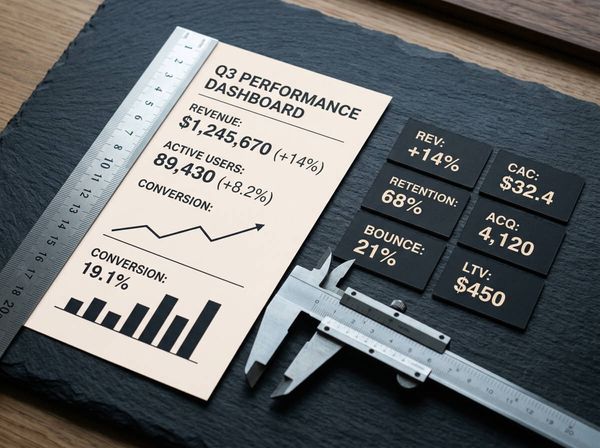
Most owners check their bank balance and hope. Learn how to project cash flow 90 days out and make decisions based on real numbers.
IN THIS ARTICLE
You know your revenue is strong, but you can't tell whether you'll have enough cash to cover payroll, BAS, and supplier invoices twelve weeks from now. That gap between what you've earned and what's actually sitting in your account is where expensive mistakes happen. This post shows you how to project cash flow 90 days out using real Australian payment data, and what to do when the numbers tell you something you don't want to hear.
Why 90 Days Is the Right Window
Most cash flow guides either look 30 days ahead or try to forecast a full year. Neither is useful for a business turning over $1M to $5M. Thirty days is reactive. By the time you spot a shortfall four weeks out, your options are limited to chasing invoices and delaying payments. You're managing a crisis, not preventing one. Twelve months is speculative at this business size, because revenue assumptions, staffing changes, and market conditions shift too much over that horizon to produce numbers you can trust.
Ninety days works because it matches the rhythm of how Australian businesses actually operate. BAS is due quarterly, superannuation is due quarterly, and PAYG instalments land quarterly. Your lease renewals, insurance premiums, and annual software subscriptions often cluster around the same quarterly cycles too. If you can see where your cash position will be at each of those checkpoints, you can make decisions with enough time to act rather than scrambling after the fact.
The need is real. Nearly 80% of Australian businesses experienced cash flow impact in the last 12 months (CommBank & UNSW, 2025). And 27% of owners dipped into personal savings or didn't pay themselves just to keep the business running (CommBank & UNSW, 2025). A 90-day projection won't guarantee you avoid those situations, but it gives you the lead time to see them coming and respond before they become emergencies.
"Never take your eyes off the cash flow because it's the life blood of business."
What Goes Into a 90-Day Cash Flow Projection
A useful projection has five categories, and the order matters because each one carries a different level of certainty.
- Confirmed receivables: invoices already issued with known due dates. These are your most reliable inflow numbers, but only if you adjust for how your clients actually pay rather than how your terms say they should
- Expected new revenue: sales you're confident will close based on your pipeline, signed proposals, or booked work. Be conservative here. If you're 70% sure a deal will close, record 70% of the value
- Committed costs: rent, salaries, subscriptions, loan repayments, and any other fixed obligations. These don't move, and they're the easiest to forecast accurately
- Variable costs: materials, subcontractors, ad spend, and project-specific expenses. These shift with workload, so use a three-month trailing average as your baseline rather than guessing week to week
- Quarterly obligations: BAS, super, PAYG, and insurance premiums. These hit hardest because they arrive in lumps, and they're the payments most likely to catch you off guard if you haven't planned for them
The debtor days reality
The critical mistake most projections make is treating invoiced revenue as cash received. Average debtor days across Australian businesses sit between 45 and 65 days (Xero Small Business Insights, 2026). That means an invoice you send today might not land in your account for two months.
If your projection assumes 14-day payment terms, you're forecasting a version of reality that doesn't exist. The gap between revenue on paper and cash in the bank is the single biggest reason profitable businesses run out of money. If you've felt that disconnect, this post on why growth doesn't always mean cash breaks it down further.
How to Build It Step by Step
You don't need special software to start. You need your accounting platform (Xero, MYOB, or QuickBooks), a spreadsheet, and 90 minutes of honest thinking.
- 01Set up 13 weekly columns. Each column is one week, starting from next Monday. Row one is your opening bank balance as of today
- 02Fill in confirmed inflows. Pull your outstanding invoices from Xero and place each one in the week you realistically expect payment, not the week it's due. If a client typically pays 15 days late, adjust for that
- 03Add expected new revenue. Use your pipeline or booking schedule. Apply a confidence discount and multiply each expected deal by the probability you'll actually close it
- 04Map committed outflows. Salaries, rent, subscriptions, and loan repayments go into the exact week they're debited. Don't forget the smaller recurring costs that add up, such as software licences, phone plans, and fleet expenses
- 05Add variable costs. Estimate weekly based on current workload and booked jobs. Check the last three months for a realistic average rather than estimating from memory
- 06Drop in quarterly obligations. BAS, super, PAYG, and any annual premiums that fall within the 90-day window. Place them in the exact week they're due and treat them as non-negotiable outflows
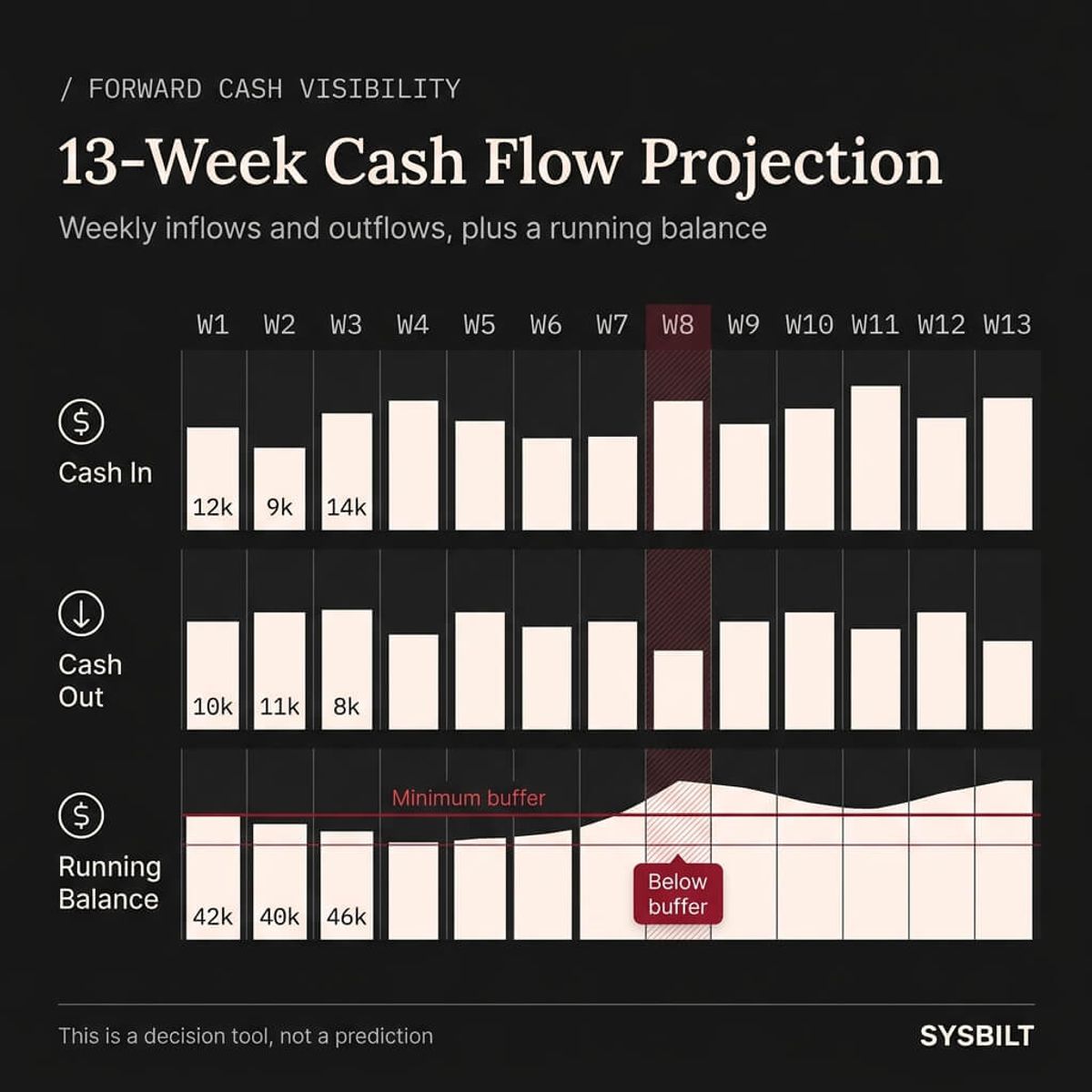
- 07Calculate the running balance. Each week's closing balance is the previous week's close plus inflows minus outflows. Watch for any week where the balance dips below your minimum comfortable threshold
The assumption that breaks everything
Australian businesses were paid on average in 23.9 days, with late payments averaging an additional 6.6 days beyond terms (Xero, 2026). That gap between agreed terms and actual payment behaviour is the assumption that ruins most forecasts.
Build your projection around how your clients actually pay, not what the invoice says. If you don't know your actual debtor days, pull a receivables ageing report from your accounting platform and calculate the average across your top ten clients. That number is your real inflow timing, and using anything more optimistic will give you a projection that looks healthy right up until the moment it isn't.
[VISUAL 2 HERE — Caption: ]
What to Do When the Numbers Look Bad
The whole point of projecting forward is to see problems before they become emergencies. When your projection shows a shortfall, your response depends entirely on how far away it is. The more lead time you have, the more options are available and the less each one costs.
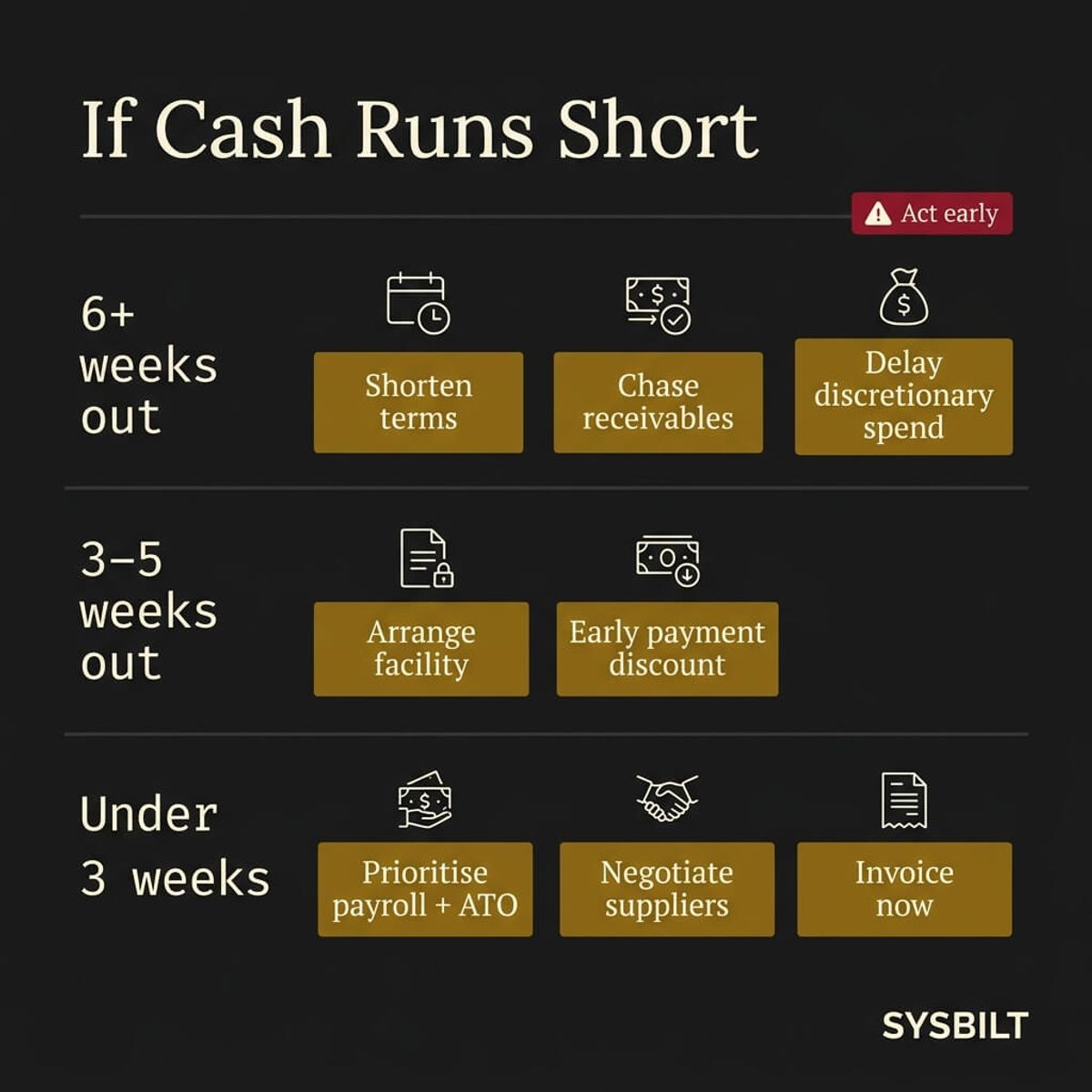
If the shortfall is 6 or more weeks away:
- Shorten payment terms on new invoices from 30 days to 14 days
- Chase overdue receivables now, before they age further. Every week an invoice ages past 60 days, the likelihood of collection drops significantly
- Delay discretionary spending such as new equipment, non-urgent hires, and optional upgrades. Anything that can wait a quarter without damaging operations should wait
If the shortfall is 3 to 5 weeks away:
- Contact your bank or broker about a short-term facility or overdraft before you need it. Arranging credit while you're still cash-positive gives you better terms and faster approval
- Offer early payment discounts to your biggest debtors. A 2% discount for payment within 7 days can unlock cash quickly, and the cost is often less than the interest on emergency borrowing
If the shortfall is under 3 weeks:
- Prioritise outflows by paying staff and ATO obligations first, then negotiate extended terms with suppliers who can absorb a short delay
- Accelerate any invoicing you've been sitting on. If work is complete but you haven't billed yet, send the invoice today
The projection isn't a prediction. It's a decision-making tool that gives you choices. When you can see the shortfall six weeks out instead of discovering it when a direct debit bounces, you have room to respond calmly rather than reactively. That visibility is exactly what a dashboards and reporting system is designed to provide, and it's why we build it as the control layer that sits across every other system in the business.
Turn It Into a Dashboard That Updates Itself
A spreadsheet gets you started, but it only stays accurate if someone updates it every week. For most business owners, that discipline lasts about three weeks before the spreadsheet joins the graveyard of tools that were going to change everything.
The better approach is to connect your accounting platform directly to a dashboard tool like Looker Studio or Power BI. Xero's API can push receivables, payables, and bank balances into a live view that refreshes automatically. Instead of rebuilding your projection from scratch each week, you open one screen and the numbers are already current.
The 15-minute Monday review
The review itself takes about 15 minutes. You open the dashboard, look at the 13-week forward view, and confirm that the numbers match your expectations. You're looking for two things: weeks where the running balance drops below your buffer, and any material change in your receivables pipeline that shifts the timing of expected inflows.
If something has moved, you act on it that morning while you still have time. If nothing has moved, you close the dashboard and get on with your week knowing exactly where the business stands. That rhythm of checking once and knowing completely is the difference between managing by gut and managing by data.
If you're already tracking weekly KPIs, the cash flow projection is a natural addition to the same review. One screen, one Monday morning ritual, and you know where the business stands for the next quarter.
This is what we build for clients through our Predictive Oracle service under Dashboards and Reporting. It connects your accounting data, your CRM pipeline, and your operational metrics into a single forward-looking view. You stop reacting to what happened last month and start planning based on where you'll actually be in 90 days.

WRITTEN BY
Felipe Chaparro
Systems Architect and Founder of SYSBILT. Felipe engineers custom automation, AI workflows, and performance web architectures for scaling Australian service businesses.