You're losing local jobs to competitors who show up first on Google. Fix your local SEO for service businesses in Sydney with three proven actions.
In this article
72% of people use Google to find products and services in their local area (Marketing Charts, 2025). That means someone in your suburb is looking for exactly what you do right now, and if your service business doesn't show up, the job goes to whoever does. This post covers local SEO for service businesses in Sydney, and it skips the 15-step agency checklists to focus on the three things that actually move the needle, plus what to do once people find you so the lead doesn't die in a missed call.
Why Your Service Business Is Invisible to Half of Google
Here's what happens every day. A homeowner in Parramatta searches "plumber near me" at 7pm. A dental patient in Bondi googles "emergency dentist open now." A restaurant owner in Surry Hills types "commercial electrician Sydney CBD." If your business doesn't appear in those results, you don't exist to that customer. They won't scroll to page two, and they won't try a different search with your name in it. They'll call the first result that looks credible.
76% of people who run a "near me" search visit a related business within 24 hours, and 28% of those searches end in a purchase (Google, 2022). That's not abstract traffic data. That's real customers with real money ready to act today, and they're choosing from whoever Google shows them first.
The frustrating part is that most service business owners know they should be doing something about this. But between running jobs, managing staff, and answering the phone, local SEO gets pushed to the bottom of the list. The guides that do exist are written by SEO agencies for other marketers, not for someone running a business with their hands full. So the checklist gets bookmarked and forgotten, and the leads keep going to whoever showed up first.
The Three Things That Actually Move the Needle for Local SEO
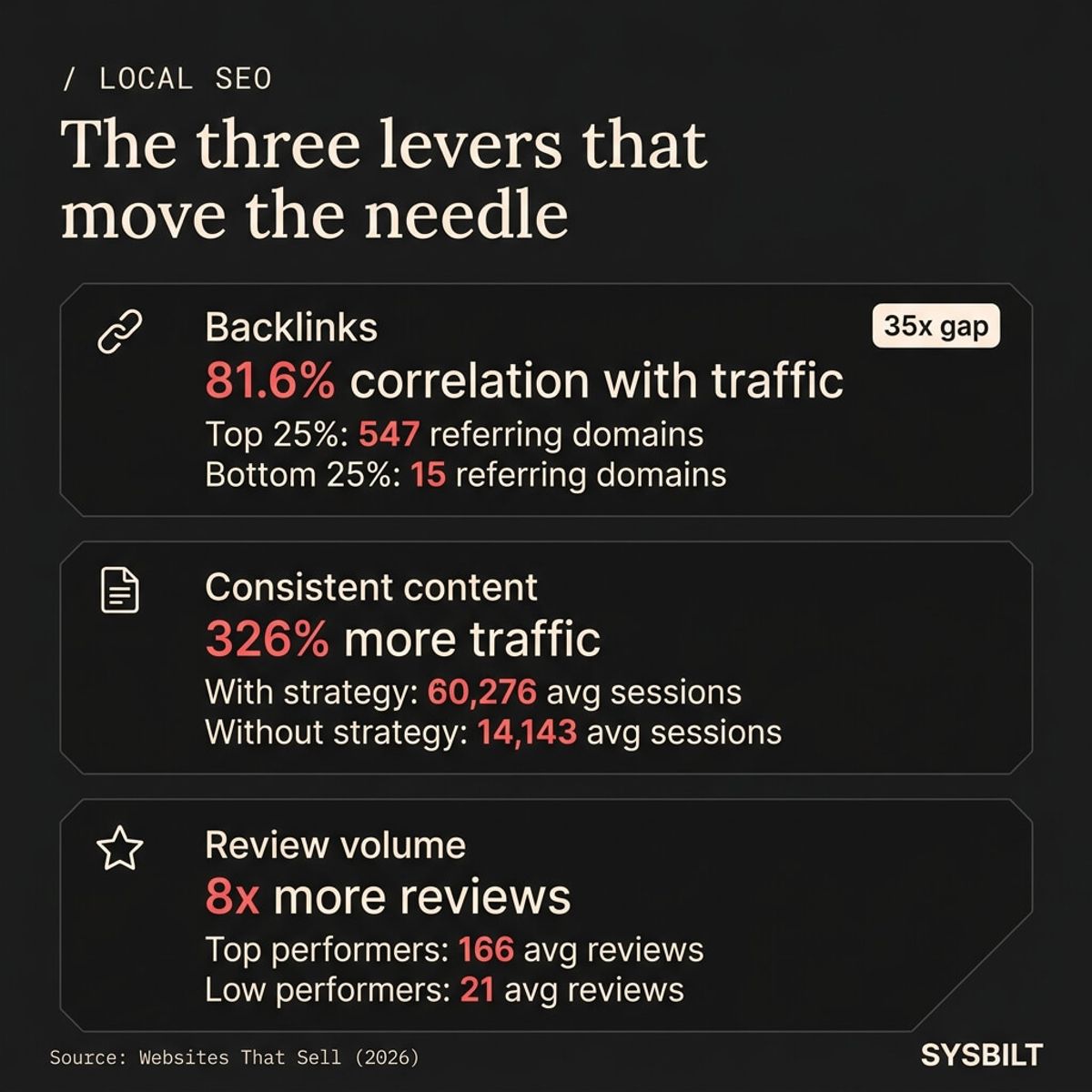
Not everything matters equally. A 2026 Australian study tracking 36 businesses across 28 industries found three factors that separate the businesses getting found from the ones that aren't (Websites That Sell, 2026).
Backlinks matter most. The study found an 81.6% correlation between referring domains and organic traffic. The top 25% of businesses had an average of 547 referring domains. The bottom 25% had 15. That's a 35x gap. For a service business, backlinks come from directory listings, local business associations, supplier partnerships, and being mentioned on community pages.
Consistent content compounds. Businesses publishing two or more pages per month averaged 326% more traffic than those without a content strategy. You don't need to write every day, but showing up regularly with something useful, like answering the questions your customers actually ask, tells Google your business is active and relevant to local searchers.
Review volume beats perfection. Top-performing local businesses averaged 166 reviews compared to 21 for low performers, an 8x difference. A perfect 5.0 rating wasn't required. Quantity and recency mattered far more than a flawless score.
What's surprising is what didn't matter as much as people think. Perfect page speed scores and a spotless technical audit are nice to have, but they won't overcome a business with no reviews, no content, and no external links pointing to it. If you've got 30 minutes a week, spend it on reviews and content before you spend it on technical tweaks.
Your Google Business Profile Is Your New Homepage
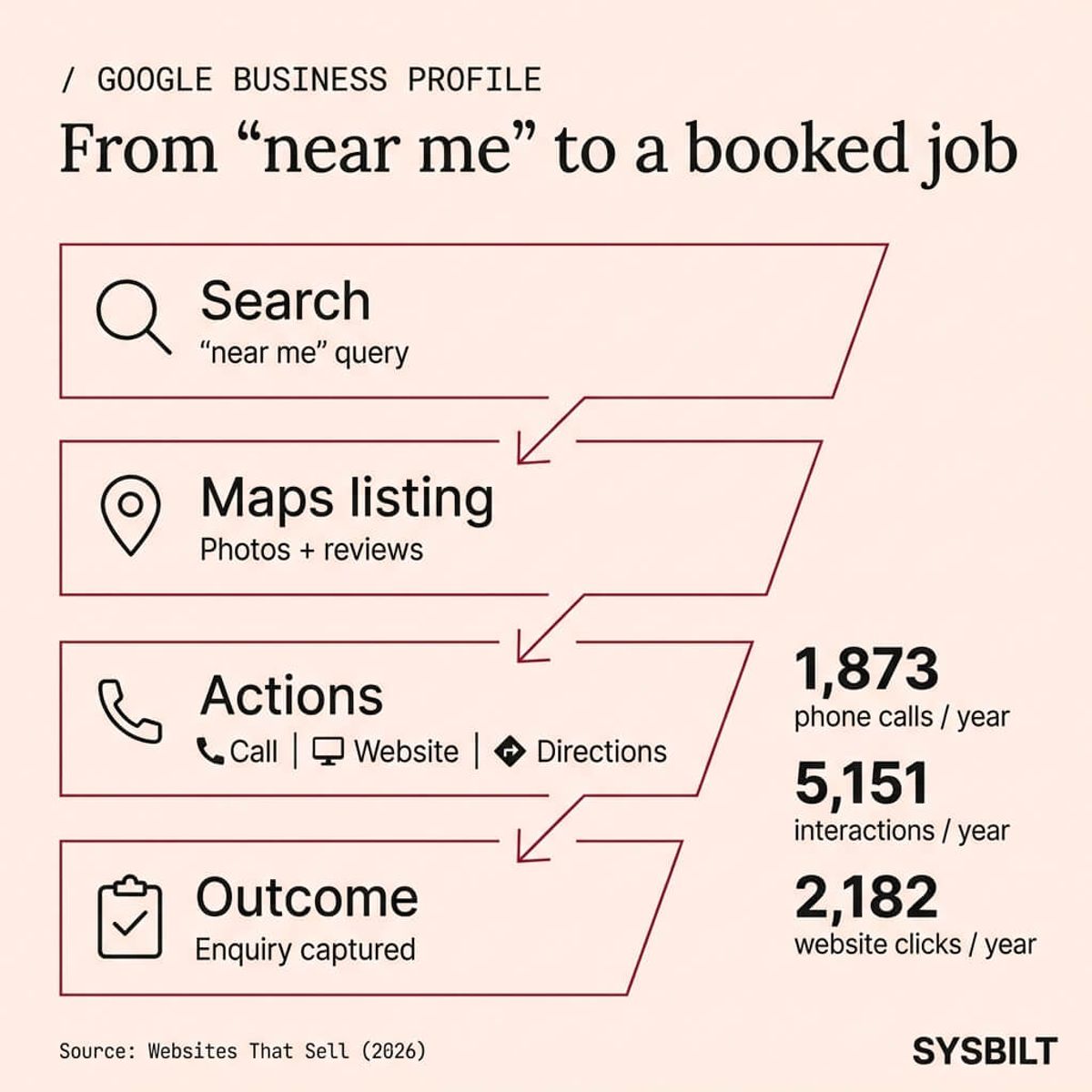
Many of your potential customers will never visit your website. They'll find you on Google Maps, check your reviews, look at your photos, and call you directly from the listing. Your Google Business Profile is the first impression for local search, and for many service businesses in Sydney, it's the only impression that matters.
The numbers back this up. The average Australian local business generates 1,873 phone calls, 5,151 interactions, and 2,182 website clicks per year from their Google Business Profile alone (Websites That Sell, 2026). Customers are 2.7x more likely to view a business as reputable when the profile is complete, and 70% more likely to visit (Google/BrightLocal, 2024).
Here's what "complete" actually means:
- Claim and verify your listing. If you haven't done this, nothing else matters. Go to Google Business Profile and claim your business today
- Fill every field. Business name, address, phone number, hours, service area, categories, and a clear description of what you do. Leave nothing blank
- Add photos regularly. Real photos of your work, your team, and your location. Not stock images. Google rewards profiles that get updated consistently
- Choose the right categories. Your primary category should be the most specific match for your main service. Add secondary categories for anything else you offer
- List on Australian directories. TrueLocal, Localsearch, StartLocal, and Hotfrog all help build citation consistency, which tells Google your business information is legitimate
The key with all of this is consistency. Your business name, address, and phone number need to be identical everywhere they appear online. One wrong digit in a phone number or a slightly different spelling of your business name across directories confuses Google and pushes you down the rankings. Check your details on every platform and fix any mismatches.
Reviews: Volume Beats Perfection
You don't need a perfect rating. You need enough reviews that potential customers trust you're real, active, and good at what you do.
The 8x gap between top and bottom performers in the Australian study wasn't about star quality. It was about volume and recency (Websites That Sell, 2026). A business with 100 reviews at 4.3 stars will outperform a business with 10 reviews at 5.0 stars, both in Google's algorithm and in the customer's mind. More reviews signal a real business with a track record, and that's what people trust when they're choosing between two listings.
Getting reviews doesn't require a complicated system. Ask at the right moment, which is immediately after you've delivered a good result. Send a quick SMS with a direct link to your Google review page. If you're face to face with a happy client, ask them while the experience is fresh. Most people are willing to help when you make it easy and timely.
Responding to every review matters too. Thank positive reviewers briefly and specifically. For negative reviews, respond professionally and offer to resolve the issue offline. Google's algorithm considers review responses as a signal of active business engagement, and potential customers read those responses before they call.
What Happens After They Find You
This is where every other guide about local SEO stops, and it's where the real money gets lost.
You've optimised your profile. You're showing up in searches. Someone finds your listing at 8pm on a Tuesday and calls. But you're at dinner with your family, and the call goes to voicemail. By the time you see the missed call the next morning, that customer has already booked with the competitor who answered.
58% of businesses don't optimise for local search at all (BrightLocal research). But even among those that do, most have no system for what happens after the click or the call. Getting found is step one. Capturing and following up with that lead is what actually turns visibility into revenue. Google now shows AI Overviews for over 40% of local business queries (SOCi Local Visibility Index, 2026), meaning appearing in both organic results and Google Business Profile is more important than ever.
This is where your website needs to do more than look professional. It needs to capture enquiries automatically, whether that's a contact form that sends an instant confirmation, a booking widget that lets customers lock in a time without waiting for a callback, or an automated text response to missed calls. A CRM organises every lead so nothing falls through the cracks, and automation handles the follow-up without you needing to remember. The front door gets them in, but the system behind it is what converts them into paying clients.
If your website catches leads but nothing happens next, see how we connect your front door to a system that follows up automatically.
The 30-Minute Weekly Routine That Compounds
You don't need to become an SEO expert. You need a consistent routine that builds results over time, the same way regular client follow-ups build a full pipeline.
Here's a realistic monthly cycle that fits around actually running your business:
- Week 1: Claim and complete your Google Business Profile if you haven't already. If it's set up, update your photos and check your hours are accurate
- Week 2: Ask three happy clients from the past fortnight to leave a Google review. Send them a direct link via SMS
- Week 3: Publish one piece of local content on your website. Answer a question your customers actually ask, like "How much does [your service] cost in Sydney?" or "How to choose a [your service] provider in [your suburb]"
- Week 4: Check your business name, address, and phone number on your top five directory listings. Fix any inconsistencies
Each of these tasks takes less than 30 minutes. None of them requires technical knowledge or a marketing agency. The compounding effect comes from doing them consistently, not from doing them perfectly once.
The businesses that dominate local search in Sydney aren't running sophisticated SEO campaigns. They're claiming their profiles, asking for reviews after every job, publishing answers to real questions, and making sure their details match everywhere online. That consistency, week after week, is what puts them in the map pack while their competitors stay invisible.

WRITTEN BY
Felipe Chaparro
Systems Architect and Founder of SYSBILT. Felipe engineers custom automation, AI workflows, and performance web architectures for scaling Australian service businesses.