Manual work drains wages, margin, and cash flow. Learn the cost of not automating your business tasks, and what to automate first.
In this article
If your business is growing, manual work isn't just an inconvenience. It's a hidden tax that compounds every week, and it shows up in three places: wages spent on copy-paste admin, margin lost to preventable errors, and cash stuck in unpaid invoices.
This post breaks down the real cost of not automating your business workflows in 2026, then shows the three automations that usually make the biggest difference first.
The real cost isn't the software
Most automation articles start with tools. That's backwards.
Automation isn't a tech decision. It's a profit decision. You're already paying for the work, you're just paying for it in labour, rework, and delays instead of a system that handles it consistently.
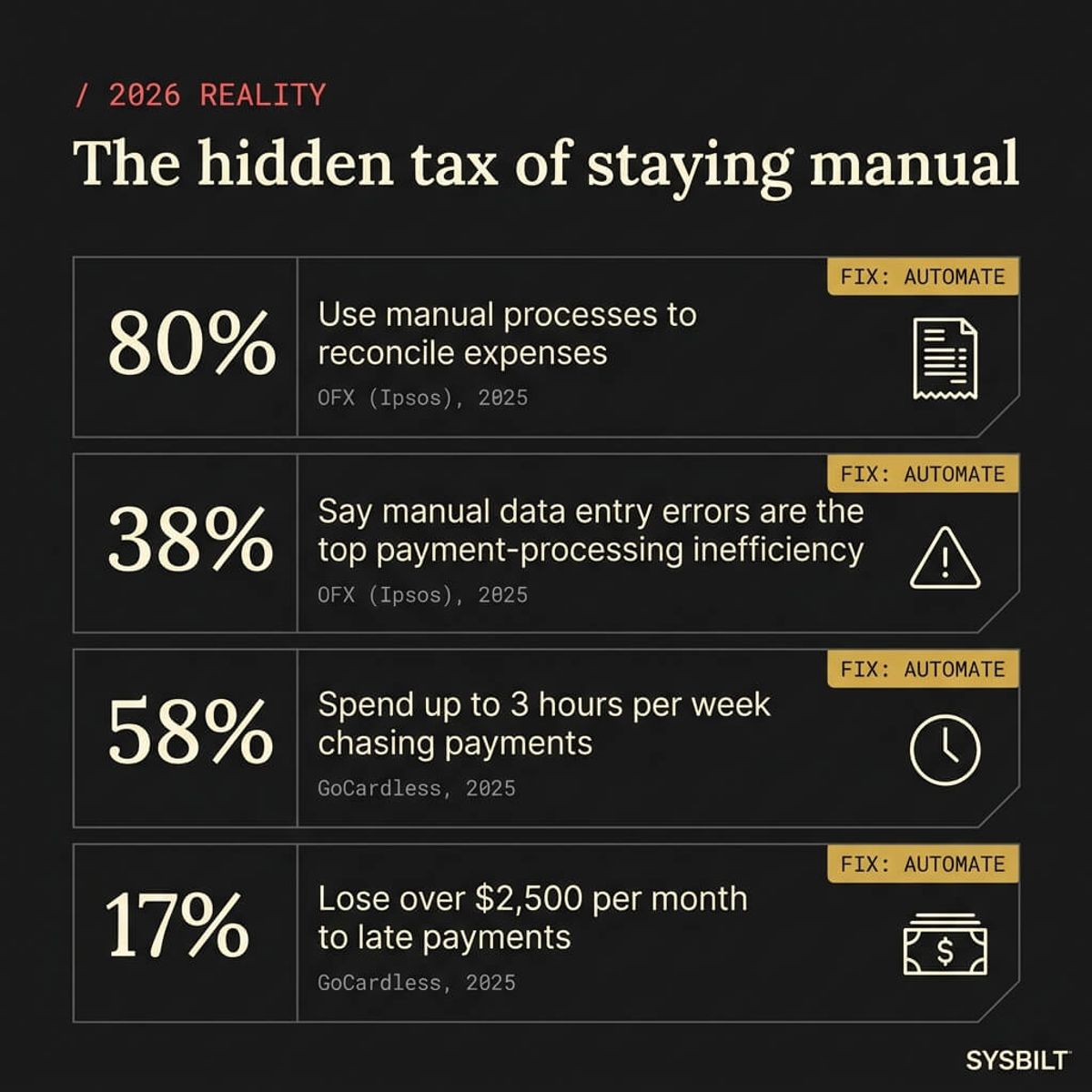
The data shows how common manual processes still are. In a 2025 Australian SME survey, 80% of businesses said they use entirely or partially manual processes to reconcile out-of-pocket expenses (OFX (Ipsos), 2025). That's finance alone.
If it's happening there, it's usually happening in sales, operations, and client management too. Leads sit in inboxes, quotes get chased when someone remembers, and invoicing happens at the end of the week if there's time. None of these are broken individually, but together they create a drag on the business that doesn't show up on any single line item.
"The way to get started is to quit talking and begin doing."
You're paying wages for copy-paste work
This is the most visible cost, and it's the easiest to ignore because it hides inside "just admin".
Think about the tasks that repeat every week:
- Copying details from emails into a CRM
- Chasing missing information before you can send a quote
- Entering supplier bills and matching receipts
- Following up on invoices, then following up again
- Updating a spreadsheet so you can work out what's actually happening
Each task takes minutes. Across a week, they add up to hours you're paying for that don't move the business forward.
A GoCardless report summary found that 58% of Australian SMBs spend up to 3 hours per week on payment collection alone (GoCardless, 2025). That's one task, in one department. Multiply it across every manual touchpoint in the business and the real weekly cost becomes much clearer.
The Australian Industry Group documented a business spending 15 hours per week on manual supplier invoice entry before automating the process (Australian Industry Group, 2025). That's nearly two full working days, every week, on work a system could handle in minutes.
Manual errors leak margin quietly
Manual work isn't just slower. It's less reliable, and the cost of errors rarely shows up on a report until the damage is done.
In the same OFX survey, 38% of businesses identified errors from manual data entry as the most common inefficiency in payment processing (OFX (Ipsos), 2025). These aren't dramatic failures. They're small, persistent mistakes that erode margin over time:
- An invoice sent with the wrong figure
- A payment allocated to the wrong client
- A quote that never got followed up because it wasn't logged properly
- A job booked with incomplete details, then reworked on the day
- A supplier bill approved twice, or not approved at all
Each one costs time, some cost trust, and a few cost real money.
The deeper problem is what happens when errors become routine. Your team starts building "fixing" time into every process, checking and double-checking work that shouldn't need correction. You end up paying twice: once to do the task, and again to clean up after it.
Slow cash is a growth blocker
Cash flow problems don't always mean your business isn't profitable. Sometimes it just means the system between delivering the work and collecting the money is too slow.
Accountants Daily's coverage of GoCardless research found that 17% of Australian SMBs are losing over $2,500 per month to late payments, up from 11% in 2024 (GoCardless, 2025). The same report found that 1 in 5 businesses devote 6 to 12 working days a year to chasing overdue invoices (GoCardless, 2025).
That has a direct impact on decisions you make every week. You delay hiring because you don't trust the cash position, you hesitate to invest in marketing because last month's invoices still aren't paid, and you spend your sharpest attention on chasing money instead of running the business.
Automated invoicing and payment reminders don't fix bad clients, but they do make the follow-up consistent. You find out sooner when something's overdue and you stop relying on memory to keep cash moving.
Start with these 3 automations first
If you're wondering where to begin, don't start with "AI" or a giant platform rollout. Start with the workflows that keep repeating and keep leaking value.
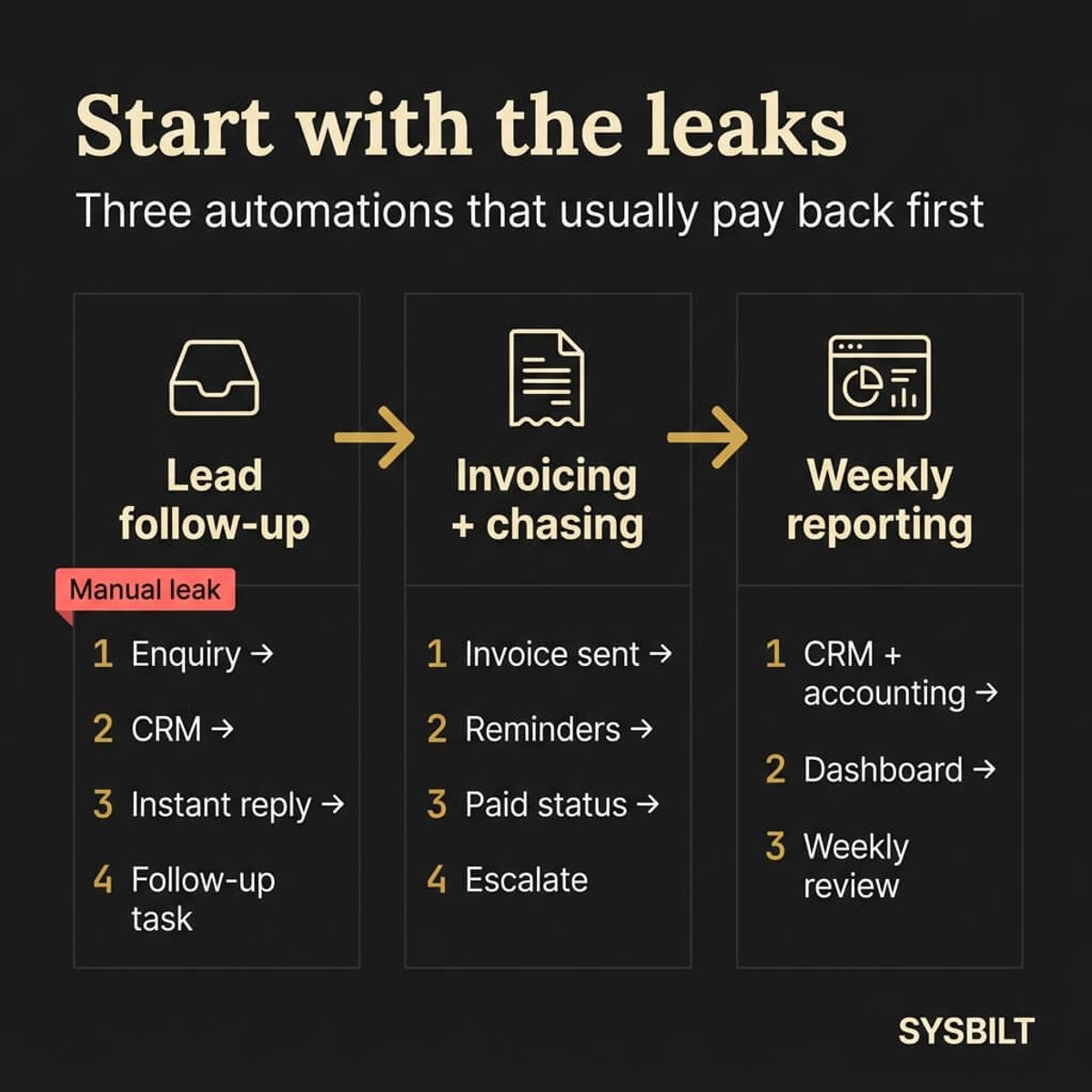
Here are three that usually make a visible difference fast.
01Lead follow-up that runs without you
Goal: every enquiry gets a response, even when you're busy.
A simple automation can handle this end to end:
- A website form submission or missed call comes in
- The lead is created in your CRM automatically
- The person receives an instant acknowledgement message
- A follow-up task is created if there's no reply within a set window
- A second follow-up goes out at a scheduled time
This stops leads going cold because someone forgot, or because the day got away from you. It's not about speed for the sake of it. It's about making sure no enquiry falls through the gap between "busy" and "forgotten."
02Invoicing and payment chasing that's consistent
Goal: you don't wait weeks to find out who's overdue.
Basic flow:
- Invoice is sent the moment the work is complete
- Reminder emails or SMS go out on a set schedule
- Payments are tracked automatically as they come in
- Overdue invoices trigger an escalation step
It doesn't need to be aggressive. It just needs to be predictable. The consistency alone usually improves collection times because clients know the follow-up is coming.
03Weekly reporting that shows the leak early
Goal: you see problems while you can still fix them.
This can be as simple as a weekly dashboard that pulls together:
- New leads and follow-ups due
- Quotes sent and conversion rate
- Invoices overdue and total outstanding
- Cash collected this week
When you can see these numbers every week, you catch problems early. When you can't, you find out about them at the end of the quarter, after the damage is done.
If you want to build this properly, start here: Business automation.
If this sounds like your business, book a call and we'll walk you through how this applies to your situation.

WRITTEN BY
Felipe Chaparro
Systems Architect and Founder of SYSBILT. Felipe engineers custom automation, AI workflows, and performance web architectures for scaling Australian service businesses.