
Your team answers the same questions every day. Learn when an AI chatbot on your service website actually helps and when it wastes your money.
In this article
Your team answers the same five questions every day, covering pricing, availability, service areas, and turnaround times. They spend hours repeating themselves instead of doing the work that actually grows the business. If you're weighing up whether you should put an AI chatbot on your service website, the honest answer is that it depends entirely on what's already working and what isn't.
This post walks through when a chatbot makes sense, when it's a waste of money, and how to get it right if you decide to go ahead.
What a Chatbot Actually Does on a Business Website
Strip away the marketing and a chatbot does three things. It answers common questions without a human being involved. It captures enquiry details from visitors who land on your site outside business hours, and it routes conversations to the right person when the question needs a real answer.
That's the core job. It isn't a replacement for your receptionist or your sales team. It's a filter that handles the repetitive volume so your people can focus on the conversations that actually need them.
The difference between old rule-based bots and modern AI chatbots matters here. Rule-based bots follow rigid scripts and break the moment someone asks a question that wasn't pre-programmed. AI chatbots trained on your business data can understand context, handle variations in how people phrase things, and provide genuinely useful responses. The technology has moved well past the "press 1 for sales" experience that made everyone avoid bots in the first place.
It's also worth being clear about what a chatbot can't do well. Complex negotiations, emotionally sensitive conversations, and situations that require genuine judgement still need a real person. The goal isn't to remove humans from the equation. It's to make sure humans only get involved when they're actually needed, and that the routine questions get handled instantly without anyone's time being wasted.
When an AI Chatbot Makes Sense for Your Business (and When It Doesn't)
This is where most articles fall apart. They either tell you chatbots are essential or they list vague pros and cons. Neither approach helps you make an actual decision, so here are the criteria that matter.
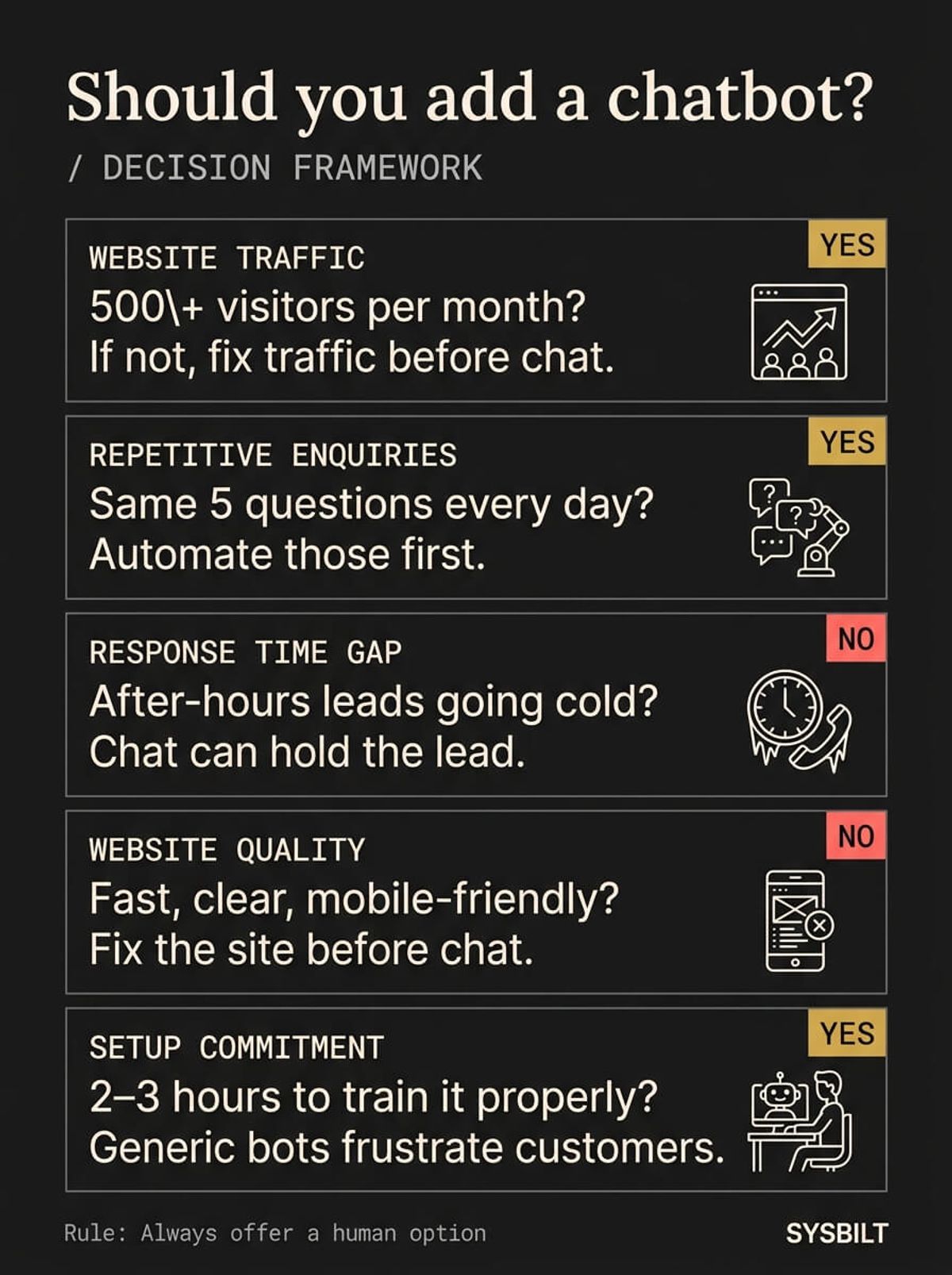
Your website needs traffic first. If your site gets fewer than 500 visitors a month, a chatbot is a solution without a problem. Nobody's there to talk to it, so fix your traffic before you add a chat layer. A chatbot on a quiet site is like hiring a receptionist for an empty waiting room.
You need a pattern of repetitive enquiries. If your team answers the same five questions every day, those questions are prime candidates for automation. If every enquiry is unique and complex, a chatbot won't help much. The sweet spot is businesses where 60 to 80 percent of incoming questions fall into a small number of predictable categories.
You have a response time gap. If leads come in after hours or during peak periods when your team can't respond quickly, that gap is costing you work. A chatbot closes it by engaging the visitor while they're still on your site and interested. For service businesses, this is often the strongest reason to add one, because the enquiry that comes in at 8 PM on a Tuesday isn't going to wait until Wednesday morning.
Your website has to work first. A chatbot on a slow, confusing, or mobile-unfriendly site won't fix the underlying problem. It just adds another layer of friction to an experience that's already broken. If visitors are bouncing before they even see the chat widget, you've got a bigger problem that a bot can't solve.
You need to commit to proper setup. A generic, untrained chatbot will frustrate your customers. Half of all Australians are already frustrated by bots that can't resolve their issues (Zoom/Morning Consult, 2025). Rushing the setup makes that problem worse, not better. Plan for two to three hours of initial training, and expect to refine the responses over the first few weeks based on real conversations.
If you tick most of these boxes, a chatbot can genuinely give you leverage. If you don't, you're better off fixing the foundations first.
What Australian Customers Actually Think About AI Chatbots
The data here tells a different story to the one most chatbot vendors are selling.
51% of Australians say they're frustrated by customer service bots that fail to resolve their issues (Zoom/Morning Consult, 2025). Even more telling, 86% of Australian respondents said they'd likely stop purchasing from a brand if customer support didn't resolve their concerns (Zoom/Morning Consult, 2025). That's not an anti-chatbot stat. It's a pro-good-chatbot stat, because the frustration comes from bots that can't do the job, not from bots that can.
"The future isn't AI versus humans. It's AI plus humans."
At the same time, 80% of Australian businesses are either using or planning to adopt AI (BizCover, 2025), and 40% of businesses with 5 to 19 employees have already done so (Australian Government Department of Industry, Science and Resources, 2025). The market is moving. The question isn't whether to use AI. It's whether a website chatbot is the right place to start for your business.
The takeaway is straightforward. Customers don't care whether they're talking to a person or a bot. They care whether their problem gets solved quickly and clearly. If your chatbot resolves the issue, they'll prefer it to waiting on hold or filling out a form. If it doesn't, you've just given them a reason to call your competitor instead.
The pattern in the data is clear. A chatbot that answers the question in 10 seconds beats a contact form that gets a reply in 10 hours. But a chatbot that loops customers through irrelevant options and can't hand off to a human is worse than having no chatbot at all. The bar isn't whether the chatbot exists on your site. The bar is whether it actually resolves the problem faster than the alternative.
How to Get It Right If You Decide to Add One
If you've looked at the criteria above and a chatbot makes sense for your situation, here's how to avoid becoming part of the 51% frustration statistic.
- Train it on your actual business data. Feed it your FAQs, your service descriptions, your pricing structure, and your booking process. A chatbot that gives generic answers is worse than no chatbot at all. The more specific your training data, the more useful the responses. If a customer asks "do you service the Northern Beaches" and your bot can answer with confidence, that's a lead you've kept warm instead of losing to a competitor
- Always provide a clear path to a real person. Every conversation should have an obvious "talk to a human" option visible at all times. The moment a customer feels trapped in a loop with a bot, you've lost them. This isn't a failure of the chatbot. It's a design choice that builds trust and shows customers you value their time
- Start with the five questions your team answers most often. Don't try to automate everything on day one. Get those five right, measure the results, and expand from there. Ask your team to write down every question they answer more than once this week, and you'll have your starting list by Friday
- Review conversation logs weekly. Look at what customers are actually asking, where the bot is failing, and what answers need updating. The businesses that get the most out of chatbots treat them as living systems that improve over time, not as set-and-forget installations
- Measure what matters. Track how many conversations the bot resolves without human help, how many leads it captures after hours, and how many visitors drop off mid-conversation. These three numbers tell you whether the chatbot is earning its place or just creating noise
The initial setup is the beginning, not the finish line. A chatbot that gets better every week will outperform a perfectly launched one that nobody maintains.
Where a Chatbot Fits in Your Business System
A chatbot on its own is a conversation that goes nowhere. Someone visits your site at 9 PM, asks about your services, gets a helpful answer, and then what? If there's no system behind the chatbot, that lead disappears by morning.
The real value shows up when the chatbot is connected to the rest of your operations. The chatbot captures the enquiry and the visitor's contact details. That information flows into your CRM automatically, creating a record of who asked what and when. Automation picks it up from there, sending a follow-up email or notifying your team to call back first thing in the morning. Nothing falls through because the system handles the handoff, not a person trying to remember.
That's the difference between a chatbot as a novelty and a chatbot as part of a revenue-generating system. The bot captures, the CRM stores, and automation follows up.
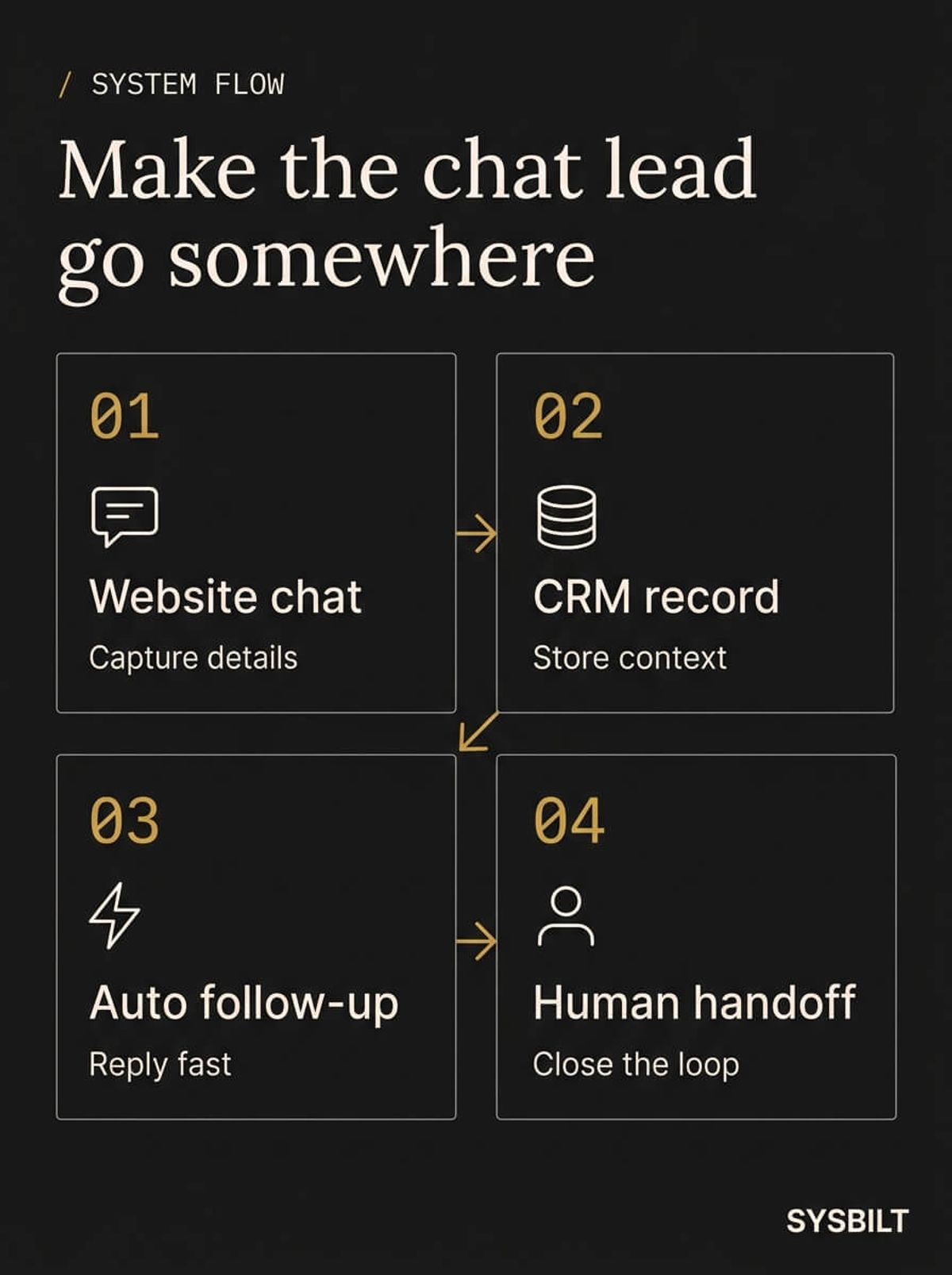
Without that connection, you're just adding a new place for conversations to get lost. The customer chats, gets a helpful answer, and leaves. You have no record of who they were, what they asked, or how to follow up. It's the same problem as a missed phone call, just dressed up with a chat widget.
If you're already running a CRM and some basic automation, adding a well-trained chatbot to your website becomes a natural extension of what's already working. If you don't have those foundations yet, building them first will give you a much better return than jumping straight to a chatbot. You can start where your biggest pain is and build from there.
See how AI assistants connect to your broader business system.
If this sounds like your business, book a call and we'll walk you through how this applies to your situation.
See how we fix this
See the exact system we build to fix this
See how an AI assistant fits your business system
WRITTEN BY
Felipe Chaparro
Systems Architect and Founder of SYSBILT. Felipe engineers custom automation, AI workflows, and performance web architectures for scaling Australian service businesses.