
One resignation shouldn't break your business. Learn why key person risk is a systems problem and how to fix it before someone leaves.
In this article
Every growing business has one person who holds it all together. The client relationships, the process knowledge, the answers to every question the team can't figure out alone. If your best employee quits tomorrow, the question isn't whether it'll hurt. It's whether your business can keep running without them.
This isn't a post about retention tactics or counter-offers. It's about why one resignation can cripple a growing business, what it actually costs when it happens, and how to build the systems that protect you before you ever get that conversation.
What Happens When Your Best Employee Walks Out
When a key person leaves a 15-person business, the damage goes far beyond one empty desk. It's the client relationships they managed personally, the processes they ran from memory, and the tribal knowledge they carried that nobody ever wrote down.
In a larger company, there's a bench. Someone steps in, picks up the playbook, and keeps things moving. In a growing service business, there's no playbook and there's no bench. There's just the gap.
The team feels it within days. Work slows because nobody knows where to find the templates, how to run the monthly invoicing, or what the client agreed to three weeks ago. Decisions that used to take five minutes now take a week because everyone's looking for the person who used to just know.
Clients feel it too. Response times drop, quality wobbles, and relationships that took years to build start fraying at the edges. If the departing employee was the primary contact for key accounts, some of those clients may follow them out the door.
The Real Cost Nobody Warns You About
The emotional disruption is immediate. The financial cost is worse than most owners realise.
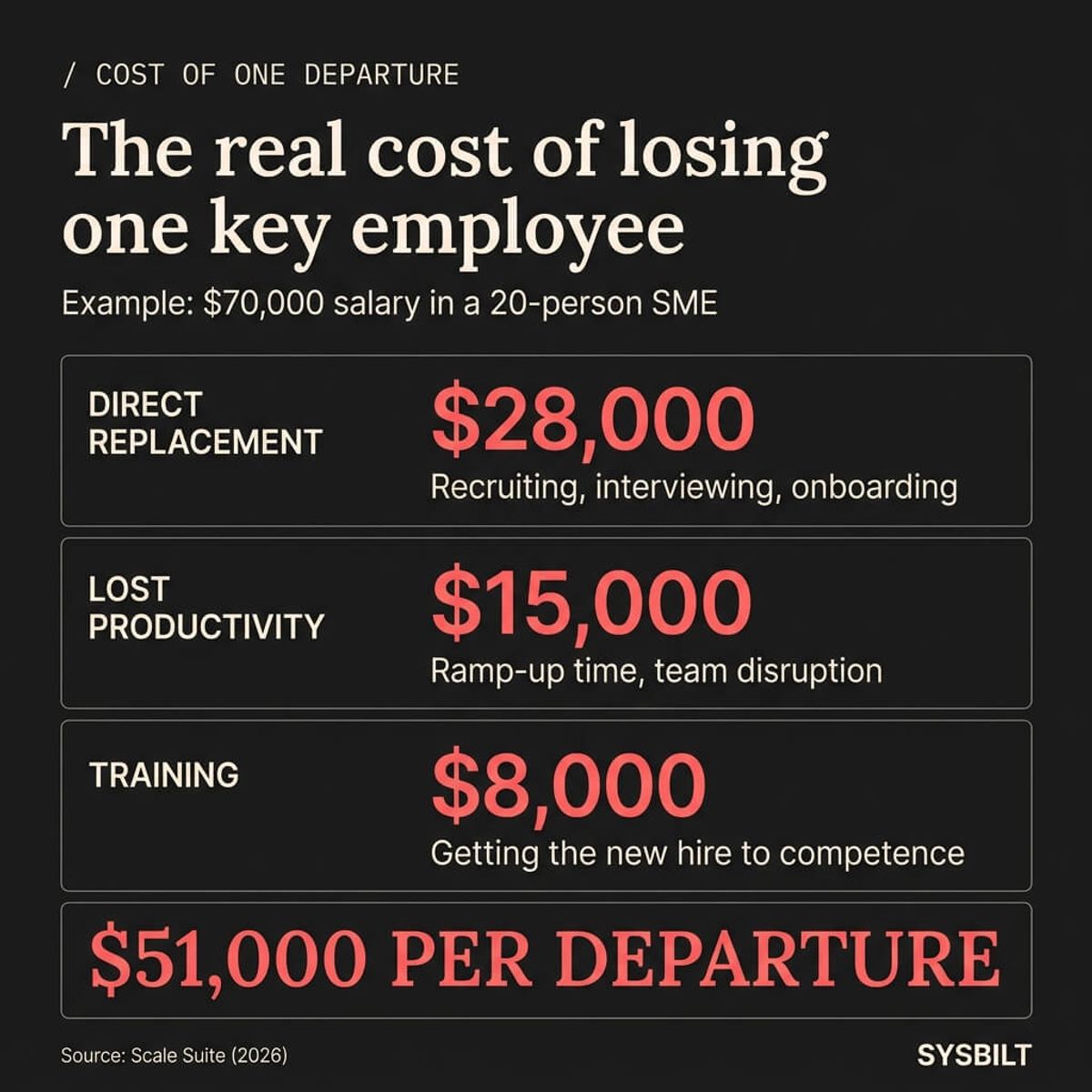
For a mid-level salary employee in a 20-person service business, the numbers add up fast. Direct replacement runs about $28,000, lost productivity adds roughly $15,000, and training the new hire costs another $8,000. That's approximately $51,000 for a single departure (Scale Suite, 2026).
And that's just the operational cost. If you're planning to sell or bring on investors, key person dependency can trigger a 10–25% discount on your business valuation (William Buck Australia). Buyers pay a premium for businesses that run without any single individual. When your operations depend on one person's memory, you're not just losing a team member, you're losing enterprise value.
This isn't a rare event either. 34% of Australian organisations now report turnover rates above 20%, up from 20% in mid-2023 (Scale Suite, 2026). The odds of this happening in the next 12 months aren't small, and the cost of being unprepared compounds with every year you put it off.
Why Your Best People Are the Most Likely to Leave
Here's the part that stings. The person you're most worried about losing is probably the one closest to the door.
Research shows that the employees carrying the heaviest load, solving the toughest problems, and driving organisational success are often the most likely to be looking for the exit. As noted by Mark Murphy, New York Times bestselling author and founder of Leadership IQ, a research firm that has studied over 200,000 employees on engagement, performance, and retention
High performers carry more of the operational load than anyone else on the team. They answer more questions, solve more problems, and absorb more of the complexity that would otherwise fall on you. That's exactly what burns them out.
When your business depends on one person for answers, that person becomes the bottleneck for every decision. They can't take leave without the phone ringing, and they can't focus on their own work because the team constantly needs them. The more they deliver, the more the business leans on them, and the faster they reach their ceiling.
This isn't a loyalty problem. It's a systems problem. If the only way to get an answer is to ask one person, you haven't built a resilient business. You've built a dependency.
The Systems Fix — Building a Business That Survives Losing Anyone
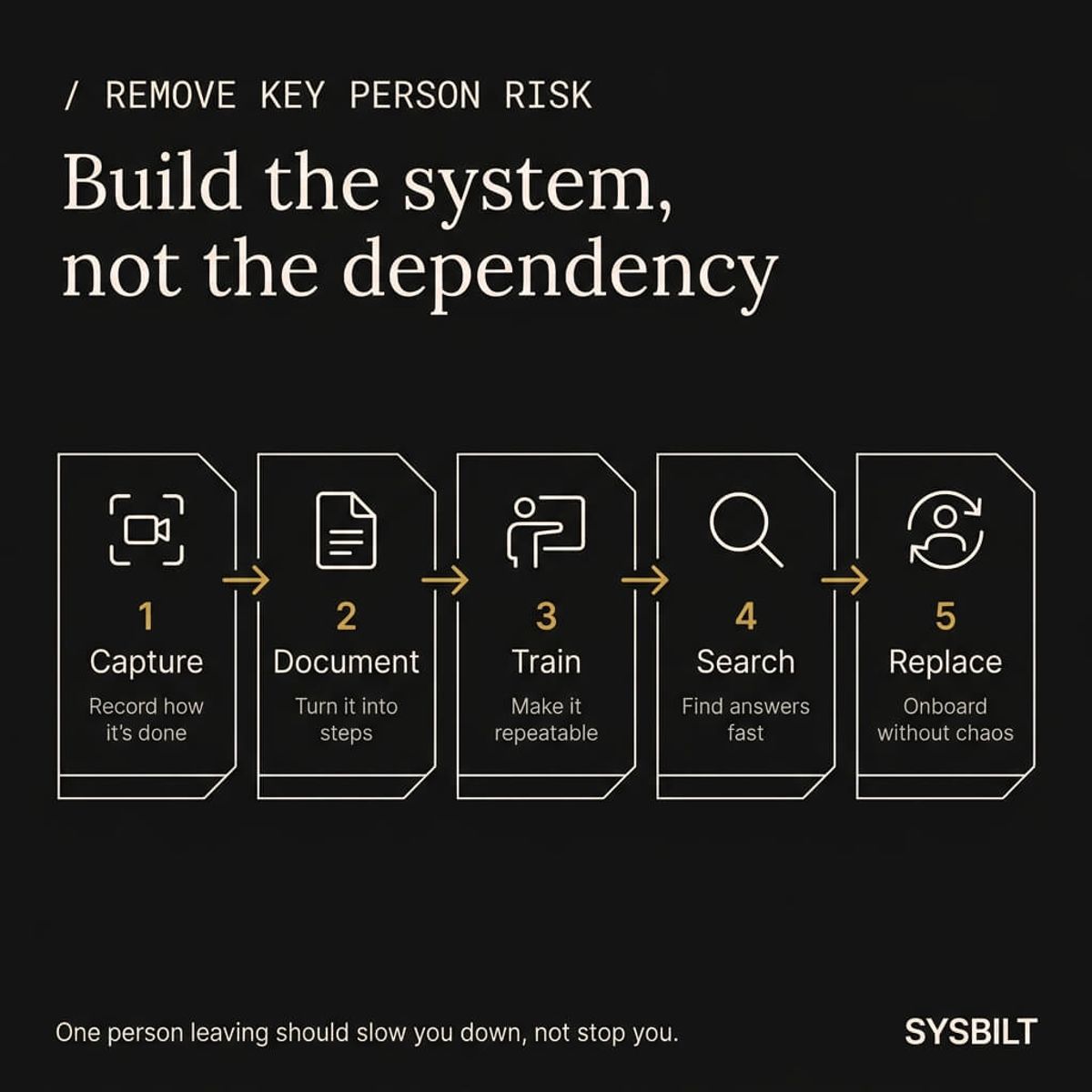
The fix isn't a better retention strategy. It's building systems that hold the knowledge instead of relying on any one person to carry it. Retention matters, but it's a hope strategy. Systems are the safety net for when hope doesn't work.
Process documentation that actually gets used. Not a 40-page PDF buried in a shared drive that nobody opens. Short, visual, step-by-step guides stored where your team already works. Recorded walkthroughs using tools like Loom, so the process is captured exactly as it's done, not as someone remembers it weeks later.
The key is capturing the process while the person who knows it is still around. A five-minute screen recording of how your best person handles a complex client request is worth more than a hundred pages of written instructions created after they've left. If you're unsure where to start, the same principle applies to stopping your team from answering the same questions every day.
Internal knowledge systems your team can search. When someone needs to know how to handle a refund, chase an overdue invoice, or onboard a new client, the answer should live in a searchable system, not in someone's head. That might be an internal wiki built in a tool like Notion, an AI assistant trained on your documented processes, or both working together.
The difference between a knowledge system and a shared folder is structure. A shared folder is where documents go to disappear. A proper knowledge base is organised by task, searchable by keyword, and updated when processes change. When your team can find the answer in 30 seconds without asking anyone, you've removed the dependency.
Training that onboards without the departing employee. A new hire shouldn't need three weeks of shadowing the person who just resigned. A proper training library means they can get up to speed from recorded walkthroughs, documented workflows, and structured checklists, without pulling your remaining team off their own work.
This also protects you from the slower, quieter version of key person risk: the gradual knowledge drain that happens when experienced staff move on over time and nobody captures what they knew. The same thinking applies to automating your first critical tasks, removing the dependency on one person's time and attention.
Automation that removes the single point of failure. Some of what your best employee does every day isn't expertise at all. It's routine admin that they've just always handled. Invoice follow-ups, appointment reminders, data entry between systems. When that person leaves, nobody picks up those tasks because nobody knew they were happening. Automating these workflows means the work continues regardless of who's on the team.
This is what team training systems are designed to do. They capture what your best people know, store it where everyone can find it, and make sure the next hire doesn't need a three-month handover that might never happen.
What to Do Right Now, Before It Happens
You don't need a six-month project to start reducing your key person risk. Start with three things this week.
Identify your single points of failure. Write down every process, client relationship, or system that depends entirely on one person. If that list has more than three items, you've found both the problem and the priority.
Record one critical process. Pick the task that would cause the most damage if nobody knew how to do it tomorrow. Record a screen walkthrough, write the steps, and save it somewhere the whole team can access. One process captured is more valuable than a plan to capture fifty.
Build a 90-day knowledge capture plan. You won't document everything overnight, but one process per week gives you twelve in three months. That's a real foundation for a training system, built without pulling anyone off their normal work.
The goal isn't to create a perfect operations manual overnight. It's to make sure that when someone does leave, and eventually someone will, your business keeps moving while you find the right replacement.
If this sounds like your business, book a call and we'll walk you through how this applies to your situation.

WRITTEN BY
Felipe Chaparro
Systems Architect and Founder of SYSBILT. Felipe engineers custom automation, AI workflows, and performance web architectures for scaling Australian service businesses.