Growth feels harder even as revenue rises, learn what happens when business grows without systems and how to fix it before it hits cash and delivery.
In this article
Hitting seven figures can feel like proof you did the hard part, because the market clearly wants what you sell. Then growth gets weird. What used to work starts breaking in ways you can't fix by staying later.
If you're searching what happens when business grows without systems, it usually means you're living it already. This post covers what tends to break first, why it shows up around this stage, and what to build so growth feels lighter again.
Why that revenue level is where the cracks show
At the start, you can hold the whole business in your head. A few clients, a small team, and the work gets done because you personally catch the gaps. Around that revenue level, the number of moving parts multiplies, with more leads coming in, more jobs in flight, more staff, and more edge cases.
Each handoff becomes a risk, and each missed follow up costs more than it did last year. This is also when tech gets added in a messy way: a new tool here, a spreadsheet there, a shared inbox that becomes a dumping ground.
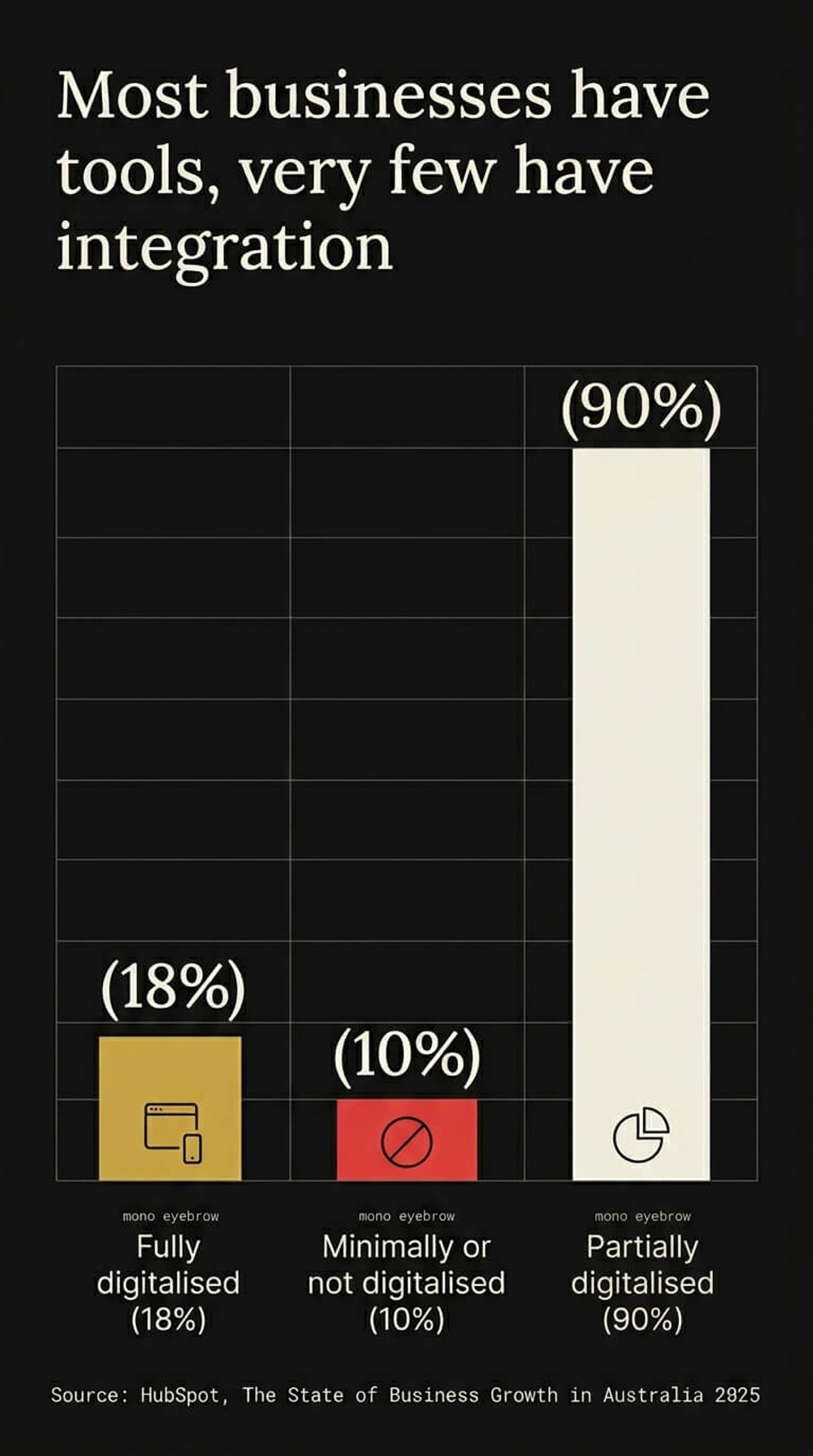
HubSpot's 2025 Australian growth research found that 90% of businesses have digitalised to some extent, but only 18% are fully digitalised (HubSpot, 2025). That gap is where the pain lives, because tools without integration just create more places for work to hide.
The 5 things that break first when you grow without systems
You don't usually lose the whole business at once, you lose it in small leaks that compound. Here are the five we see most often.
01Leads go cold
The phone rings while you're in another call, a form comes through after hours, and someone emails asking for a quote that sits until tomorrow. Without a capture and follow up system, leads disappear without a trace, and you can't fix what you can't see.
02Delivery becomes a handoff mess
When delivery is in your head, quality looks consistent. When it's spread across people, tools, and messages, it becomes uneven. You get:
- Rework because the brief was incomplete
- Missed steps because nobody owned the checklist
- Slower delivery because everyone is waiting on answers
03Cash and margin become a guessing game
Revenue can be up and cash can still be tight, and that's common in Australia right now. Nearly 80 per cent of Australian small to medium businesses have experienced an impact to cash flow in the last 12 months (UNSW / CommBank, 2025).
If invoicing, follow up, and job profitability live in disconnected places, you end up reacting late. You also spend far too much time doing admin just to feel in control, with over one in five business owners spending between 21 and 40 plus hours a month on financial admin alone (Dext, 2025).
04Everything routes through you
You become the human glue. Approvals, decisions, exceptions, and "where is that file" questions all land in the same place. It feels like leadership, but it's usually just unowned process, and the business can't move faster than your calendar allows.
05You end up with five truths
The CRM says one thing, the accounting tool says another, and the team tracker says something else. Someone has a spreadsheet that "is the real one," and eventually you stop trusting any number, which means decisions get delayed. This is why integration matters more than adoption.
"Tech adoption is a great first step, but it's integration that truly unlocks growth. Integration is the bridge between potential and performance."
The pub test diagnostic for a systems problem
If three or more of these feel familiar, you don't have a motivation problem, you have a systems problem.
- You can’t tell which leads became paying clients without digging
- Follow ups happen “when we remember”
- New staff learn by asking questions, not by following a clear process
- Invoices and payments get chased late
- You have tools, but you still copy and paste data between them
- Decisions stall because the numbers don’t match
What to build first so growth stops feeling heavy
The fix isn't "more software." It's a simple operating system, built in a sensible order.
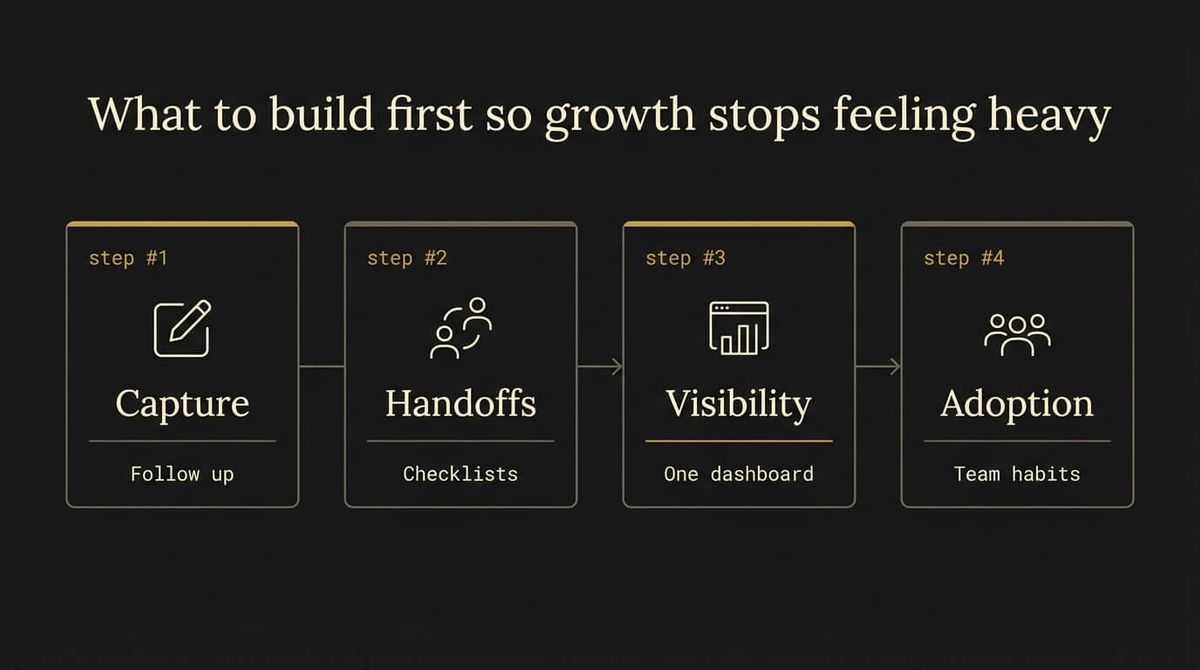
- 01Capture and follow up
- Make sure every enquiry is logged, assigned, and followed up automatically
- Keep it simple, one place where leads live
- 02Handoffs and automation
- Turn the repeatable steps into checklists and automations
- Reduce the need for people to remember
- 03Visibility you actually trust
- Pull the key numbers into one view
- Aim for a small set of metrics you can act on weekly
HubSpot's report also found that businesses with fully integrated systems are almost 4x more likely to realise ROI from new technology within a month (HubSpot, 2025). That's what integration buys you: faster confidence that the change is working.
If you want to see how the full SYSBILT system fits together, and where to start based on your biggest bottleneck, start here: SYSBILT system
A simple 14 day start here plan
You don't need a big ops team to make progress, you need one focused sprint.
Days 1 to 2: Map the flow
Pick one core flow and write it down in plain English. For most businesses at this stage it's the basics:
- Lead comes in
- Lead gets followed up
- Work gets delivered
- Invoice goes out
- Payment arrives
Days 3 to 7: Fix one leak
Choose the most expensive leak. If leads are disappearing, fix capture and follow up first. If delivery is messy, fix the handoff checklist. If cash is tight, fix invoicing and payment follow up.
Days 8 to 14: Measure one number
Pick one metric you can check weekly and act on:
- Response time to new enquiries
- Quote to win rate
- Time from job complete to invoice sent
- Days to get paid
Once you can measure it, you can improve it, and once it's stable, you build the next layer.
Where SYSBILT fits
This is the point where "working harder" stops being a growth strategy. You need a system that captures leads, keeps delivery clean, and gives you numbers you trust, and that's exactly what we build. We build it in a sequence so it sticks.
If this sounds like your business, book a call and we'll walk you through how this applies to your situation.
See how we fix this
See the exact system we build to fix this

WRITTEN BY
Felipe Chaparro
Systems Architect and Founder of SYSBILT. Felipe engineers custom automation, AI workflows, and performance web architectures for scaling Australian service businesses.