Your website gets traffic but the phone stays quiet. Here's what makes a business website generate leads and what to fix first.
In this article
- //Your Website Gets Visitors, So Why Isn't the Phone Ringing
- //Five Things That Make a Business Website Generate Leads
- //Why Most Business Websites Fail at Generating Leads
- //What Happens After the Form Submission Matters More Than the Form Itself
- //How to Audit Your Website in 15 Minutes
- //What to Fix First Based on Where You Are
Your website gets visitors, but the phone isn't ringing and the inbox stays empty. The problem isn't traffic. This post covers what makes a business website generate leads, what yours is probably missing, and what it's costing you every month.
Your Website Gets Visitors, So Why Isn't the Phone Ringing
Here's the maths most business owners never do. The average conversion rate for a service business website sits between 2% and 5% (Ruler Analytics, 2025). That means for every 100 visitors, somewhere between 2 and 5 should be reaching out.
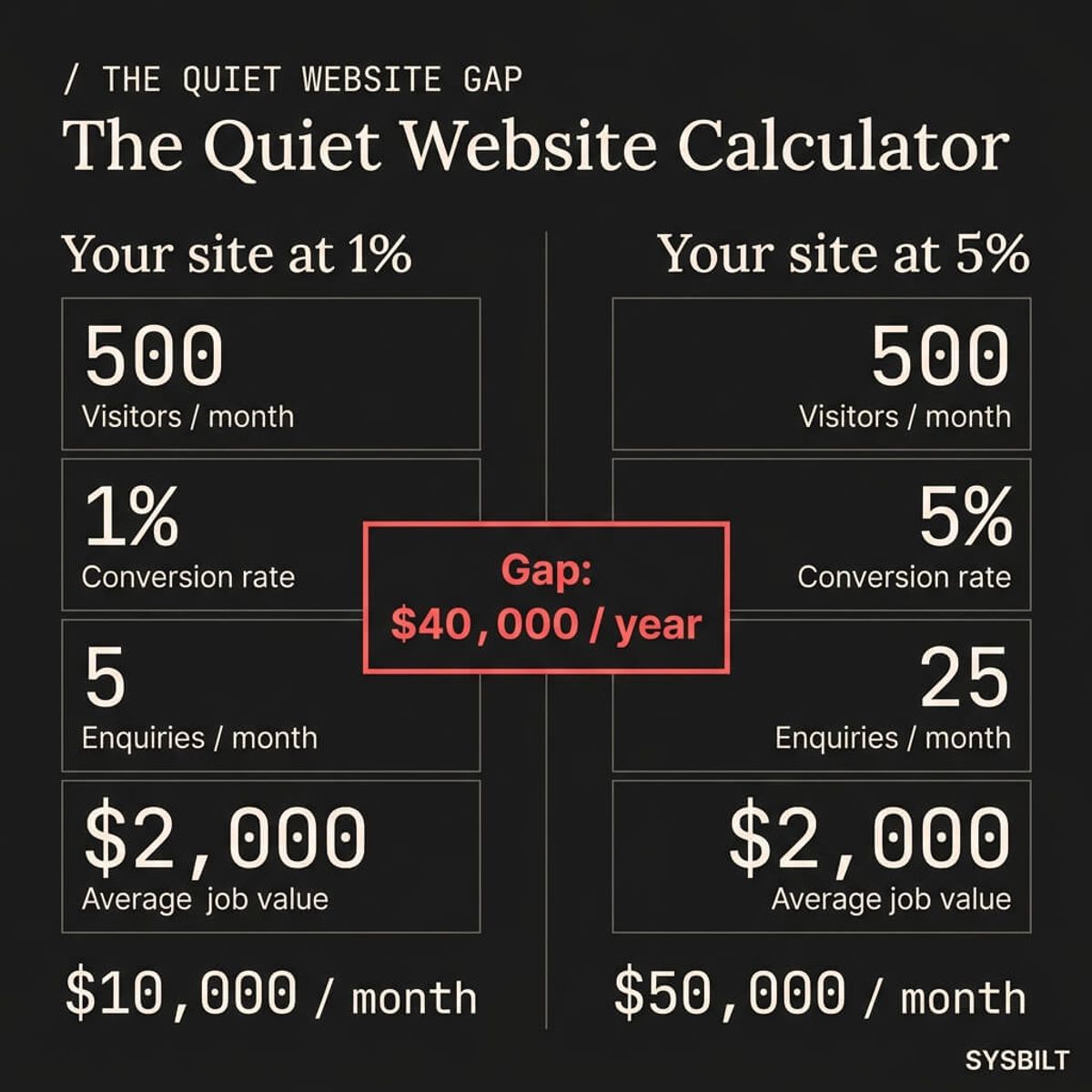
If you're getting 500 visitors a month and converting at 1%, that's 5 enquiries. At 5%, that's 25. If your average job is worth $2,000, the gap between those two numbers is $40,000 a year in revenue that walked past your front door and kept going. That's not a marketing budget problem. That's a missed opportunity you can actually measure.
And here's the wider context: 59% of Australian businesses still don't have a website at all (RockingWeb, 2024). If you've got one, you're already ahead of more than half the market. But having a website and having one that converts are two very different things.
Five Things That Make a Business Website Generate Leads
A lead-generating website isn't complicated, but it is deliberate. These are the five things that separate a site that generates enquiries from one that sits there looking professional.
A clear value proposition above the fold. When someone lands on your homepage, they should know what you do, who you help, and why they should contact you within five seconds. If they have to scroll or guess, they won't stick around long enough to find out.
One obvious call to action per page. Not three buttons competing for attention, not a "Contact Us" link buried in the footer. One clear next step on every page: call, book, or fill in a form.
Speed that doesn't punish mobile visitors. 53% of mobile visitors leave a page that takes more than three seconds to load, and conversion rates drop by 4.42% with each additional second of load time (Unbounce, 2025). Your customers are searching on their phone at 8 PM. If your site is slow on mobile, that lead is gone before it starts.
Social proof placed where it matters. Reviews and testimonials belong near your call to action, not buried on a separate testimonials page nobody visits. When a visitor is deciding whether to contact you, a real review from someone like them is the nudge that tips the balance.
Forms that feed a pipeline, not just an inbox. If your enquiry form sends an email to your personal Gmail and that's where it stops, you don't have a lead capture system. You have a suggestion box with no follow-up.
Why Most Business Websites Fail at Generating Leads
The problem usually isn't the owner's fault. Most websites are built by designers who optimise for looks, not for conversion. Nobody asks the critical question during the build: what is the visitor supposed to do on this page?
The result is a site that looks professional but doesn't convert. There's no tracking, so the owner has no idea which pages generate enquiries and which ones waste ad spend. There's no system behind the form, so leads come in and sit untouched until someone remembers to check. By that point, the prospect has already called someone else.
48% of Australian businesses have abandoned growth opportunities in the past year because they didn't have the time, resources, or operational bandwidth to pursue them (Intuit, 2025). Your website should be picking up that slack automatically. If it isn't, it's costing you more than the hosting fee.
What Happens After the Form Submission Matters More Than the Form Itself
This is the part nobody talks about. Every article about lead generation websites stops at the capture: get a form on your site, write a compelling CTA, add social proof. That's useful, but it's only step one.
What happens in the five minutes after someone fills out your form determines whether that lead becomes revenue or disappears. If the enquiry lands in a CRM, gets tagged by service type, and triggers an automatic follow-up within minutes, your chances of converting multiply. If it lands in a Gmail inbox and waits until you finish the job you're on, the prospect has already moved on.
The same applies to missed calls. If someone rings after hours and gets voicemail, that's a lost lead unless your system sends an instant SMS: "Thanks for calling, we'll get back to you first thing tomorrow." That one automated message can recover thousands in missed work over a year.
"In today's age, the companies that are willing to be the best teachers in their industry, the ones that say we will answer any question that a prospect or customer could possibly have, those are the businesses that will earn the most trust and ultimately earn the most business."
This is where a website stops being a standalone asset and starts working as part of a system. The site captures the lead. A CRM organises and tracks it. Automation follows up before you've put your phone down. The website is the front door, but the machinery behind it is what turns visitors into paying clients.
How to Audit Your Website in 15 Minutes
You don't need to hire anyone to find out whether your site is working. Pull out your phone and run through this right now.
- Load your site on your phone. Count the seconds. If it takes more than three, you're losing visitors before they see your content
- Find your main call to action. Is it visible without scrolling? Can you tell exactly what to do next within five seconds of landing on the page?
- Fill out your own enquiry form. Where does the submission go? Who follows up, and how long does it take? If the answer is "my personal email" and "whenever I check it," you've found your biggest leak
- Check your analytics. Do you know how many visitors you got last month? How many became leads? If you can't answer that, you're running blind
- Search your own business on Google, on your phone. Is your site in the top results? Does it look credible compared to whoever else shows up? Local SEO plays a bigger role here than most owners realise
If you can't answer most of these confidently, your website isn't generating leads. It's a brochure with a domain name.
What to Fix First Based on Where You Are
Not every website needs a full rebuild. Where you start depends on where the biggest leak is.
If you're just starting, fix your offer and your CTA first. Make it immediately clear what you do, who you help, and what the visitor should do next. Everything else is secondary until that's right.
If you're getting traffic but no leads, fix speed, forms, and tracking. You're already paying for those visitors through ads or SEO, and every one that leaves without acting is money wasted.
If you're getting leads but losing them, the problem isn't your website. It's what happens after. Connect your forms to a CRM, automate the follow-up, and track where every enquiry goes. The website did its job. The system behind it didn't.
The businesses that get this right don't just have a better website. They have a website that feeds into everything else: lead capture, follow-up automation, and real measurement. That's what turns a quiet site into a reliable source of new work.
If this sounds like your business, book a call and we'll walk you through how this applies to your situation.

WRITTEN BY
Felipe Chaparro
Systems Architect and Founder of SYSBILT. Felipe engineers custom automation, AI workflows, and performance web architectures for scaling Australian service businesses.