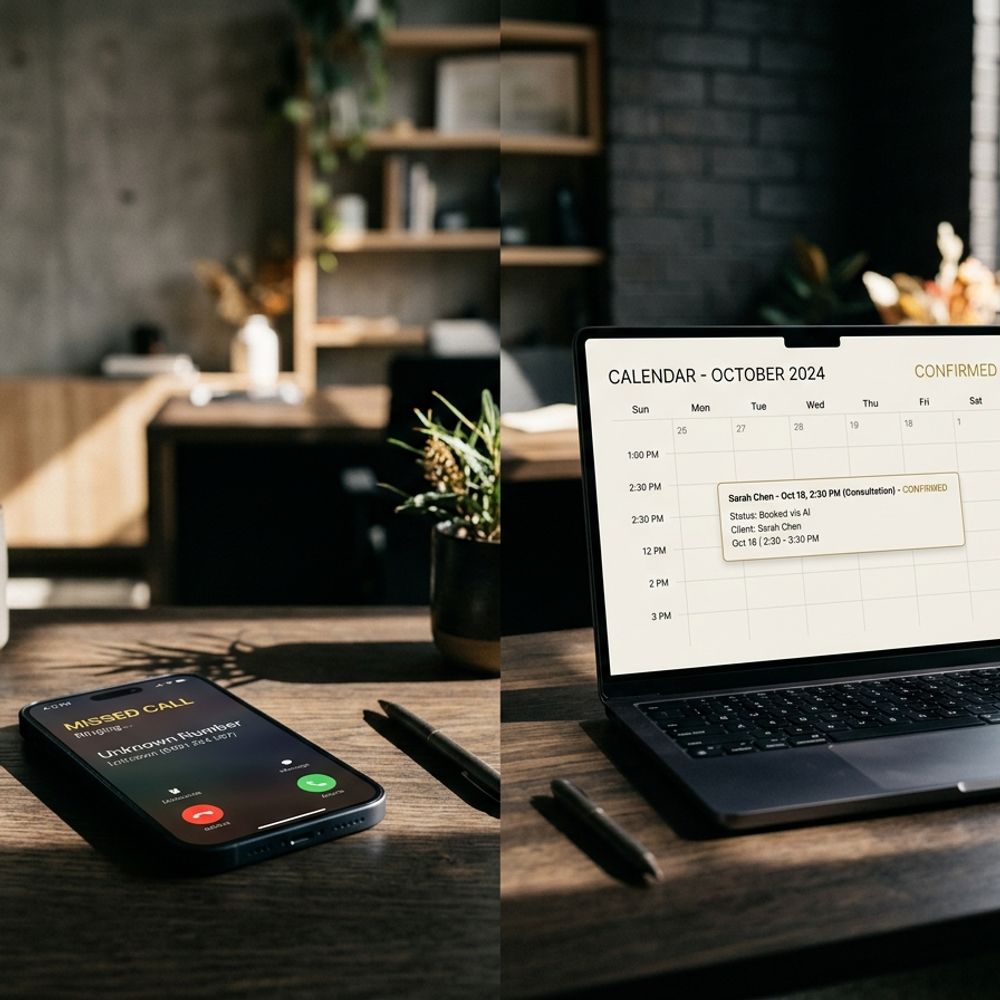
Missing calls is costing you time and revenue. Learn if an AI receptionist for growing businesses in Australia fits, what to set up first, and what to measure.
In this article
- //The real cost of “we missed your call”
- //What an AI receptionist actually does (in plain English)
- //AI receptionist vs hiring a receptionist vs answering service
- //Where this works best (and where it fails)
- //The setup checklist (what to decide before you switch it on)
- //How to know if it is paying for itself
- //Where this fits in a broader system
Missing calls is not just a missed call. It’s a broken chain of follow-up, a distracted team, and another week where you’re the bottleneck. If you’re looking at an AI receptionist because your phone never stops, this post will help you decide if it’s the right move, and how to set it up so it actually buys back time.
The real cost of “we missed your call”
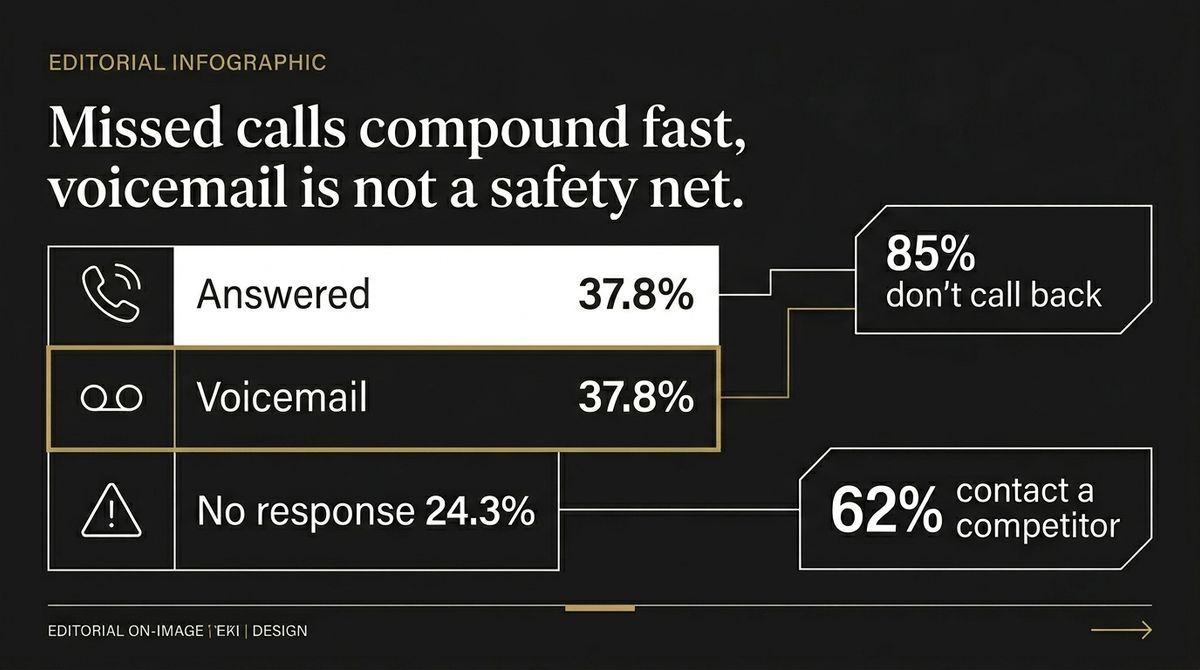
Most businesses treat voicemail like a safety net. It isn’t.
According to a 2024 study cited by AIRA, only 37.8% of incoming calls were answered by a live person, 37.8% went to voicemail, and 24.3% received no response (AIRA citing 411 Locals, 2024). AIRA also reports that 85% of people whose calls go unanswered will not call back, and 62% will contact a competitor immediately (AIRA citing PATLive and Dialzara).
That is not a “maybe we’ll call them back later” problem. It is a leak.
Here is what that leak looks like inside a growing business:
- Revenue loss: the caller moves on, or never becomes a lead in the first place
- Admin creep: your team tries to chase the message, tag the right person, and piece together what the caller wanted
- Founder interruptions: if nobody owns the follow-up, it comes back to you
The after-hours issue makes it worse. NextPhone’s analysis of 347,609 calls found 28.5% of calls arrive outside standard business hours, and 34.8% of after-hours callers express buying intent.
If a third of your buying intent is happening when your phone is on silent, you are not short on leads. You are short on response.
What an AI receptionist actually does (in plain English)
An AI receptionist is not a menu that says “Press 1 for sales.” It is a conversational voice agent that can handle the first part of a call the way a capable receptionist would.
In practical terms, a good AI receptionist can:
- Answer the call instantly, including after hours
- Work out what the caller needs using a simple script and a few qualifying questions
- Capture the details that matter, not just a name and number
- Book the appointment based on your calendar rules
- Transfer the call to a person when it should be handled by a person
- Send a summary to your team so the follow-up is clean and fast
The goal is not to “replace humans.” The goal is to remove the lowest-value interruptions, and stop high-intent calls dying in the gap.
"Businesses that attempted to contact potential customers within an hour were nearly seven times as likely to have meaningful conversations with key decision makers as those that tried to contact the lead even an hour later."
AI receptionist vs hiring a receptionist vs answering service
If you are considering this at all, you are already in a capacity problem. You have too many calls, too many questions, and too many handoffs.
Here is the simplest way to think about the options.
Hiring a receptionist
This works when:
- Calls mostly come in during business hours
- Your call types are messy and require judgment
- You have enough volume to justify the cost
It can break down when:
- After-hours demand is real
- You need consistent logging, tagging, and follow-up across the team
- The receptionist becomes another manual step instead of a system
An answering service
This works when:
- You need overflow coverage, not a full process
- You want callers to reach a person, every time
It can break down when:
- Booking requires context, rules, and access to systems
- Your team still has to clean up and chase details
An AI receptionist
This works when:
- You want speed and consistency more than small talk
- You have repeatable call types, like bookings, enquiries, quotes, and follow-ups
- After-hours calls matter, and you want to capture them cleanly
It can break down when:
- Your policies are unclear, or change daily
- Calls require complex judgement, empathy, or exception handling
- Nobody owns the setup and ongoing improvement
One of the safest paths for many businesses is a hybrid model, AI handles the first line, and anything uncertain is escalated to a human backup (OfficeHQ).
Where this works best (and where it fails)
AI receptionists are a great fit when your calls are high-volume and predictable.
Works best when:
- You have lots of inbound calls and you are missing them
- Bookings and appointments are the main job
- Calls are urgent, and speed matters
- You have meaningful after-hours demand
Fails when:
- Callers need complex advice before they can book
- The right answer depends on “who is on today” or “it depends, ask the owner”
- You do not have clear rules for emergencies and edge cases
If you are not sure where you sit, that is normal. The deciding factor is not the tool, it is whether you can define the rules you want the tool to follow.
The setup checklist (what to decide before you switch it on)
Most AI receptionists fail for one reason. They are turned on before the business has decided what “good handling” looks like.
Here is what we recommend you decide in week 1.
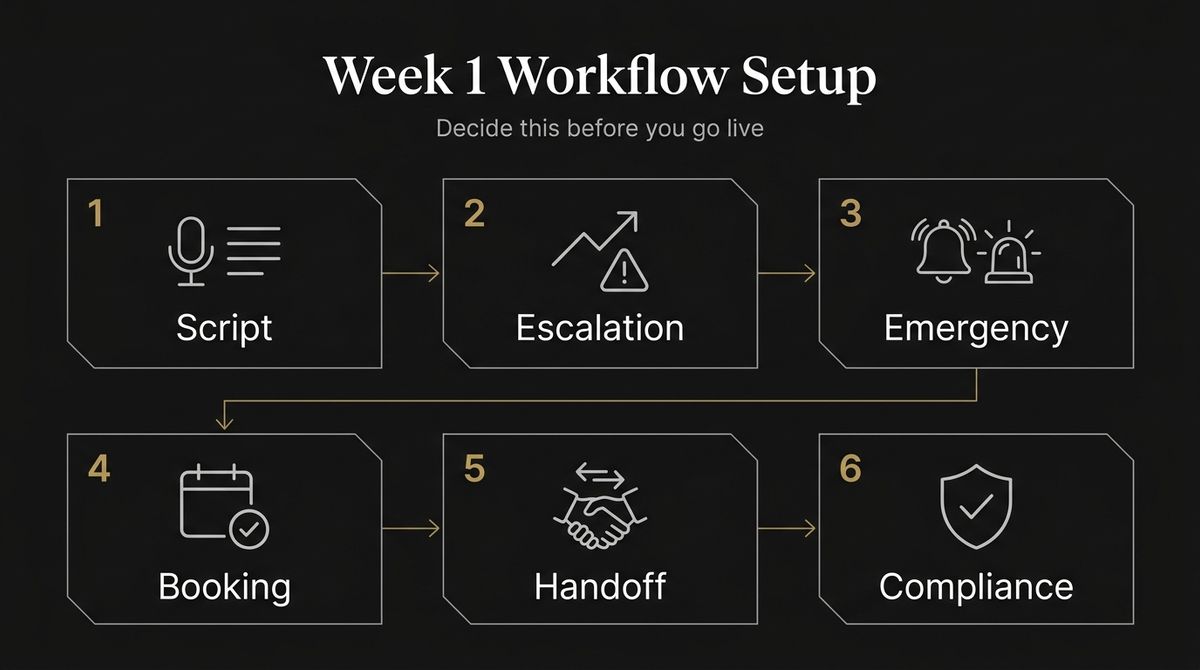
1) Your script and tone
- What should the receptionist say in the first 10 seconds
- What are the 3 to 5 most common call reasons
- What wording fits your business, without sounding like a robot
2) Escalation rules
- Which calls get transferred to a person
- Which calls get a callback promise
- What happens if nobody answers the transfer
3) Emergency rules
- What is considered urgent
- What you will never handle by AI
- What the caller should do instead
4) Booking rules
- What can be booked automatically
- Which calendar it books into
- Buffer times, travel time rules, and cut-off times
5) Data capture and handoff
- What details must be captured every time
- Where that data goes, like a CRM field or a booking form
- Who gets notified, and how fast
6) Compliance and consent
- Whether calls are recorded
- How you disclose it to callers
- What you store, and who can access it
How to know if it is paying for itself
If you are in growth mode, the question is not “is the AI good.” The question is “is it reducing interruptions and saving deals.”
Track these basics for the first 30 days:
- Missed call rate before and after
- After-hours capture rate
- Booked appointments from calls
- Time-to-first-response for calls that still need a human
- Escalation rate (how often the AI needs a person)
If you are seeing fewer interruptions and more booked outcomes, you have bought capacity. That is why this feels like a hire, not a phone system.
Where this fits in a broader system
An AI receptionist is most valuable when it is connected to the rest of your workflow. It should not be a standalone tool that creates more admin.
Done well, it plugs into:
- Your CRM, so every call becomes trackable follow-up
- Your calendar, so bookings are consistent and visible
- Your automation, so confirmations and next steps happen without someone remembering
That is how you turn “we’ll call you back” into “it’s booked,” without adding another person.
If you want that built as a system, not another answering gadget, see how we set up AI assistants for growing companies.

WRITTEN BY
Felipe Chaparro
Systems Architect and Founder of SYSBILT. Felipe engineers custom automation, AI workflows, and performance web architectures for scaling Australian service businesses.