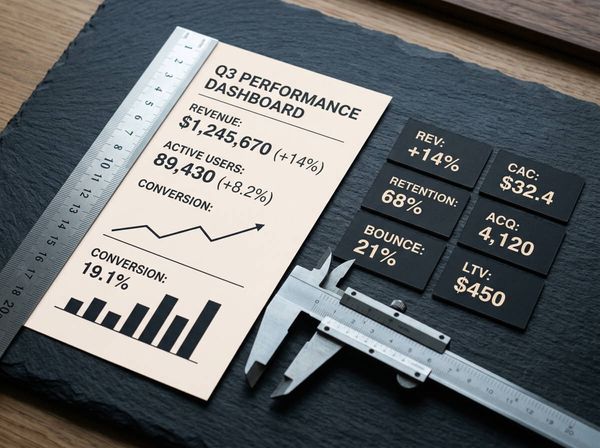
Your revenue is up but your bank account is empty. Here are the five cash leaks hitting growing Australian businesses and how to fix them.
IN THIS ARTICLE
You just finished your best quarter. Revenue is up. The pipeline is full. And when you check your bank balance, you can't make payroll without moving money from your personal account.
You're not alone, and you're not doing anything wrong. Nearly 80% of Australian businesses reported significant cash flow impacts in the past 12 months (CommBank & UNSW, 2025). The problem is not your business model. It's the gap between what you've earned and when that money actually lands in your account.
This post breaks down why growing businesses run out of cash, where the leaks are, and what you can do about it this week.
The Growth Trap Nobody Warns You About
Growing a business costs money before it makes money. You hire ahead of demand. You buy materials before the invoice is paid. You commit to bigger premises, better tools, and longer projects, all funded by cash you haven't collected yet.
That's the growth trap. Revenue goes up on your profit and loss statement, but cash goes down in your bank account. The two numbers move in opposite directions, and if you're only watching one of them, you won't see the crisis coming.
Of the Australian businesses surveyed by NAB in April 2025, 43% named cash flow as their single biggest business concern, ahead of profitability and inflation (NAB Business Survey, 2025). These are not failing businesses. These are businesses that are growing and still running out of cash.
"We were always focused on our profit and loss statement. But cash flow was not a regularly discussed topic. It was as if we were driving along, watching only the speedometer, when in fact we were running out of gas."
Five Cash Leaks That Hit Growing Businesses Hardest
Cash doesn't disappear. It gets trapped in places your P&L doesn't show you. Here are the five most common leaks we see in growing Australian businesses.
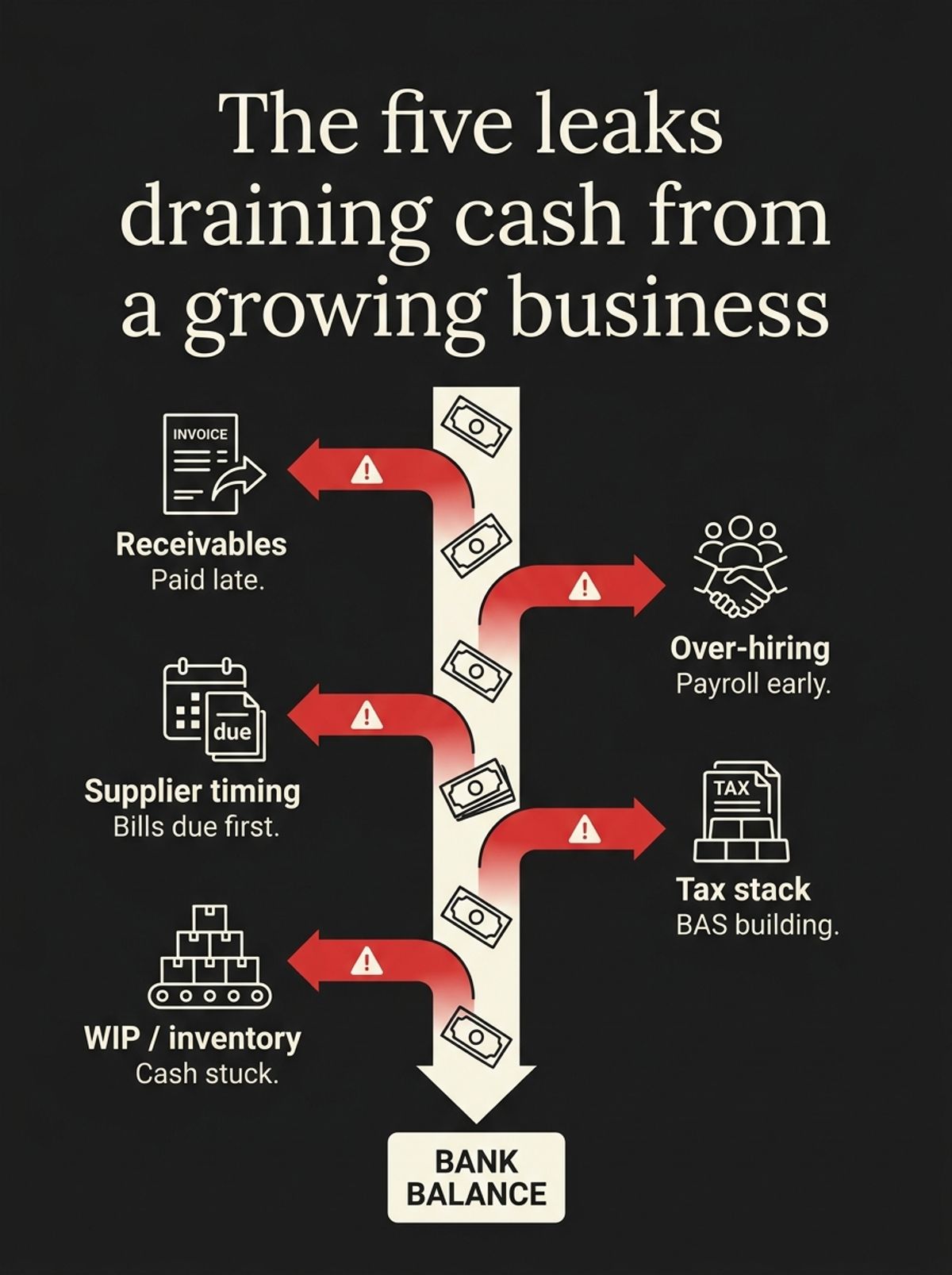
- Receivables blowout. You delivered the work three weeks ago. The invoice is sitting at 45 days. Your client isn't in a rush, but your suppliers are. Every day that gap widens, your cash position gets worse
- Over-hiring ahead of revenue. You won a big contract, so you brought on two new staff to deliver it. Payroll starts immediately. The first payment from the client arrives in 60 days. That's two months of wages funded by cash you don't have yet
- Supplier payment misalignment. You're paying your suppliers on 14-day terms while your clients pay you on 30 or 45-day terms. The maths doesn't work, and the gap compounds every month you grow
- Tax liability stacking. BAS, super, PAYG. The obligations pile up quarterly, but the cash to cover them leaks out daily. 27% of Australian business owners dipped into personal savings or skipped their own salary last year to cover obligations like these (CommBank & UNSW, 2025)
- WIP and inventory build-up. Work in progress is revenue you've earned but can't bill yet. Inventory is cash sitting on a shelf. Both are assets on paper and invisible to your bank balance
Any one of these is manageable. When three or four hit at once, which is exactly what happens during a growth phase, you've got a serious problem.
Why Your Accountant's Report Won't Save You
Your monthly P&L tells you what happened 30 days ago. That's useful for tax time. It's useless for deciding whether you can afford to take on a new project next week.
The real issue is timing. Cash flow problems don't show up in profit reports because profit is an accounting concept, not a bank balance. You can be profitable on paper and insolvent in practice. In fact, 47% of business insolvencies in Australia cite poor cash flow or financial management as a contributing factor (ASIC via ScaleSuite, 2025).
Here's the stat that should concern you most: 67% of businesses entering insolvency had no formal cash flow forecasting system in place (ASIC data via Keeping Company). They weren't tracking the problem, so they couldn't see it coming.
The fix is not a better accountant. It's better visibility. A live dashboard that shows you where your cash is right now, not where it was last month.
What a Weekly Cash Flow Dashboard Actually Shows You
You don't need a finance degree to track your cash flow. You need five numbers, updated weekly.
- Cash in bank right now. Not projected. Not accrued. The actual number in your operating account today
- Accounts receivable ageing. Who owes you money, how much, and how many days overdue. If this number is growing faster than your revenue, you have a collection problem
- Accounts payable due. What you owe in the next 7, 14, and 30 days. This is the pressure on the other side
- Committed costs. Payroll, rent, subscriptions, and any project costs you've already agreed to. These are leaving your account whether or not new cash arrives
- Projected cash gap. The difference between what's coming in and what's going out over the next 30 days. This is the number that tells you whether you're safe or whether you need to act
When you see these five numbers together every Monday morning, you stop being surprised. You start making decisions based on what's actually happening instead of what your gut tells you. For a deeper look at which numbers matter most, see What KPIs Should a $5M Business Track Weekly.
How to Stop the Bleeding This Week
You can't fix a cash flow problem you can't see. Start with three actions you can take this week.
- 01Shorten your payment terms. If you're invoicing on 30-day terms, move to 14. If you're invoicing on completion, move to progress payments. Every day you bring forward is a day you're not funding your client's business with your own cash
- 02Set up a 13-week cash flow forecast. It doesn't need to be complex. A spreadsheet with weekly rows showing expected cash in, expected cash out, and the running balance. Update it every Friday. If you want a more detailed guide, read How to Project Cash Flow 90 Days Out
- 03Build a live dashboard. Connect your accounting software to a simple dashboard that pulls the five numbers above in real time. You'll spend 10 minutes a week checking it and save yourself from the kind of surprises that close businesses. If you're losing margin on individual jobs and can't figure out why, Why Your Job Profit Margins Are Shrinking covers the other half of that equation
Growth should feel like progress, not panic. If your revenue is climbing but your bank account isn't keeping up, the problem is almost always visibility. You can't manage what you can't see, and right now, most growing Australian businesses can't see where their cash is going until it's already gone.
If this sounds like your business, book a call and we'll walk you through how a live dashboard applies to your situation.

WRITTEN BY
Felipe Chaparro
Systems Architect and Founder of SYSBILT. Felipe engineers custom automation, AI workflows, and performance web architectures for scaling Australian service businesses.