
Your margins are shrinking but your P&L won't show you where. Learn how per-job margin tracking catches profit leaks before they compound.
IN THIS ARTICLE
You're busier than last year, revenue looks healthy on paper, and jobs keep coming in. But when you check the bank balance, it doesn't match the effort. If you've been asking yourself why your job profit margins are shrinking, the answer isn't as simple as "raise your prices" or "cut your costs."
The real problem is that you can't see where the margin is going. You're measuring profit at the business level, not the job level, so the leaks stay invisible until your accountant hands you a quarterly P&L that confirms what your gut already suspected. This post breaks down the five places margin silently leaks in a service business, explains why your P&L won't catch it in time, and shows you what to measure instead.
"Most business owners don't have a revenue problem. They have a profit problem."
Revenue Is Up but Profit Feels Flat
Australian businesses are caught between two forces moving in opposite directions. Company gross operating profits recorded 0.0% quarterly growth, while wages and salaries grew 6.3% annually (ABS Business Indicators, 2025). Revenue is rising just enough to mask the fact that costs are eating it faster than it arrives.
95% of businesses report being negatively impacted by rising wage and Superannuation Guarantee costs (COSBOA/CommBank, 2025), and 64% reported lower profits than the previous year. The outlook isn't improving either. Industry expectations for gross profit margins remain mildly negative heading into 2026, with cost increases likely to consume most of any revenue uplifts achieved this year (Australian Industry Group, 2026).
When your biggest expense grows faster than your revenue, margin compresses on every job you complete, even when your pricing hasn't changed. You don't feel the squeeze on any single invoice. It shows up weeks later when you check the bank balance and the number doesn't match what you expected based on how busy the team has been.
The core problem isn't that your business is failing. You're measuring profit at the business level, not the job level, so the leaks stay invisible until the quarterly P&L lands on your desk. By the time you see the damage, you've already quoted dozens more jobs using the same assumptions that caused the loss.
Five Reasons Your Job Profit Margins Are Shrinking
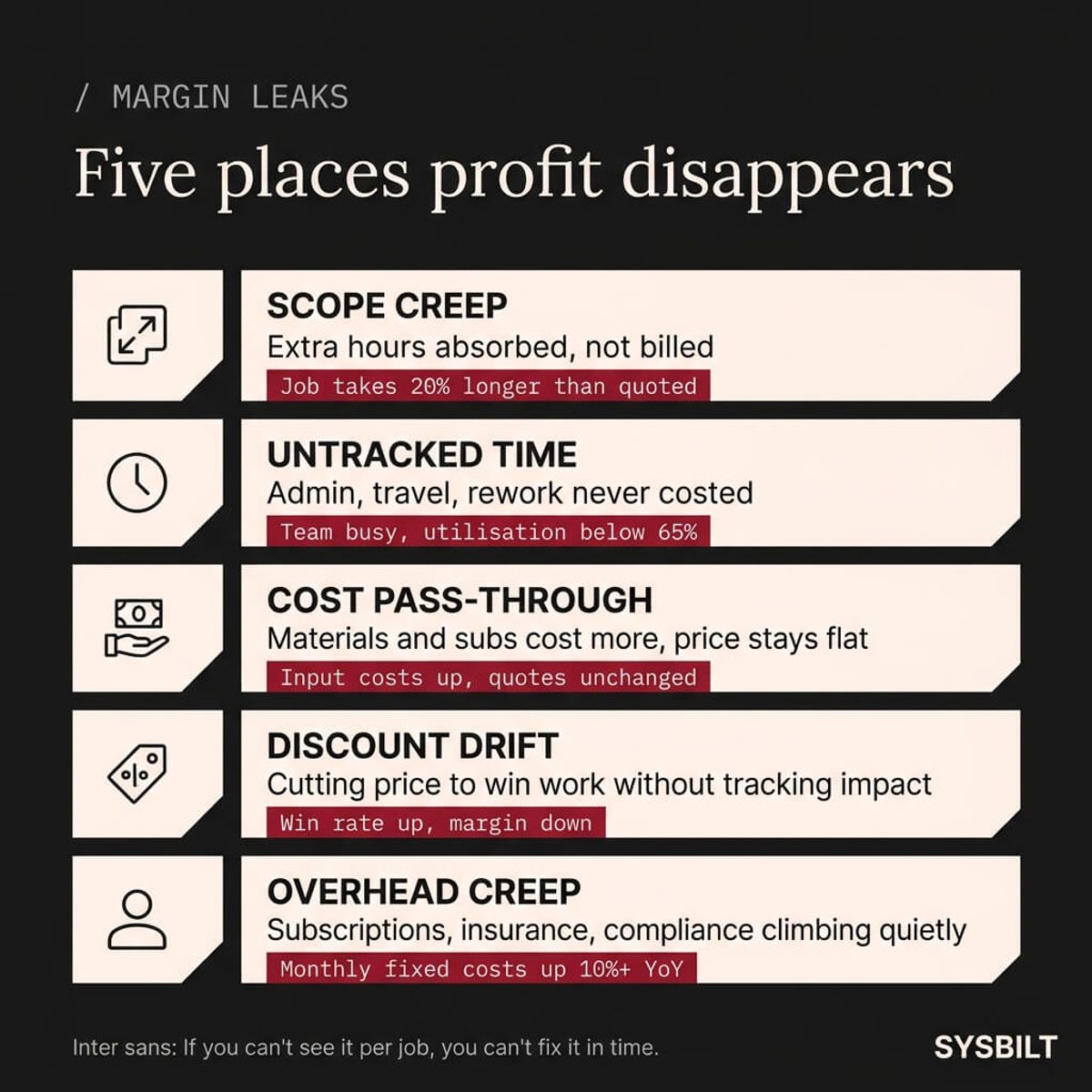
Margin doesn't usually disappear in one dramatic hit. It leaks slowly across dozens of jobs, in five predictable places.
01Scope creep on quoted jobs
A job gets quoted at 20 hours and takes 26. Nobody adjusts the invoice, and the extra six hours are absorbed as cost. The job that looked profitable on paper finishes underwater.
This rarely happens because someone agreed to more work. It happens because the scope wasn't defined tightly enough at the quoting stage, or because small client requests get absorbed as goodwill. Over a quarter, those absorbed hours add up to entire jobs worth of unbilled labour.
02Untracked non-billable time
Admin, travel, rework, and callbacks never get costed against the job they belong to. Your team looks busy, but utilisation sits below 65% and you can't see where the hours actually went.
The problem isn't that non-billable time exists. Every business has it. The problem is that it isn't allocated to the jobs that caused it, so your per-job margin calculations look healthier than reality. A job that required three site visits instead of one cost more than you think, but that cost lives in a general overhead bucket instead of on the job card.
03Materials and subcontractor costs not passed through
Your suppliers raised their prices, but your quotes haven't changed. The gap between what you pay and what you charge narrows quietly on every job.
This is especially common in businesses that quote from memory or use last year's pricing templates. If you haven't reviewed your cost base in six months, you're likely quoting jobs at margins that no longer exist. The fix isn't to raise every price across the board. It's to know exactly which input costs have moved and adjust the specific quotes that are affected.
04Discounting to win work
Dropping your price by 10% to secure a job feels like a small concession. But if your net margin is 15%, that discount just wiped out two-thirds of your profit on that job. Win rate goes up while margin goes down.
The danger is that discounting becomes a habit rather than a strategy. Without tracking the margin impact of each discount, you can't tell whether the jobs you won at lower prices actually contributed to the business or just kept the team busy at a loss.
05Overhead drift
Subscriptions, insurance premiums, compliance costs, and software licences climb by small amounts every quarter. Individually they're trivial, but together they can add thousands to your annual fixed costs without a single line item standing out.
Overhead drift is the quietest of the five leaks because no single increase triggers a review. Your monthly fixed costs creep up by a few hundred dollars here and there, and unless you're comparing this quarter's overhead to last quarter's line by line, the drift stays invisible until it shows up in the annual numbers.
Why Your P&L Won't Save You
A profit and loss statement shows you the result after the damage is done. It tells you what happened last month or last quarter, not which specific job lost money or why.
If you review your numbers monthly, you're making decisions on data that's 30 to 90 days old. A job that bled margin in January doesn't show up until March, and by then you've quoted 40 more jobs using the same pricing assumptions that caused the loss.
72% of businesses cite rising costs as their biggest obstacle (COSBOA/CommBank, 2025). If costs are the single largest pressure and you can't see which jobs are absorbing those costs, you're guessing where the problem lives.
The P&L tells you that profit dropped, but it doesn't tell you whether it was the residential jobs, the commercial jobs, or the jobs where you used a particular subcontractor. That level of visibility requires per-job margin tracking, and most established service businesses don't have it.
What Per-Job Margin Tracking Actually Looks Like
Per-job tracking connects your quoting, time tracking, and cost inputs to a single view that shows margin per job as it happens. Every job gets a record that captures the quoted price, the actual hours worked, materials costs, and subcontractor costs. When the job closes, you can see instantly whether it made money and by how much.
At minimum, each job record needs four data points:
- Quoted price (what you charged the client)
- Actual labour hours (multiplied by your true cost per hour, including super and leave loading)
- Materials and subcontractor costs (what you actually paid, not what you estimated)
- Allocated overhead (a fair share of your fixed costs applied to each job)
Your accounting tool likely supports this already. Xero, MYOB, and most modern platforms have project-level or job-level reporting built in, but the feature only works if someone configures it properly and your team records time and costs against each job consistently.
The 15-minute weekly review
The real shift isn't the tool, it's the cadence. A 15-minute weekly review of per-job margins shows you which jobs were profitable, which ones bled, and what pattern is forming across the month.
Every Monday morning, pull up the jobs closed in the previous week. Sort by margin percentage, lowest to highest. The bottom three jobs tell you where the leaks are. If the same type of job keeps appearing at the bottom, you've found a pricing problem. If different jobs keep appearing but the cause is always labour overruns, you've found an estimating problem. Either way, you've found it in a week instead of a quarter.
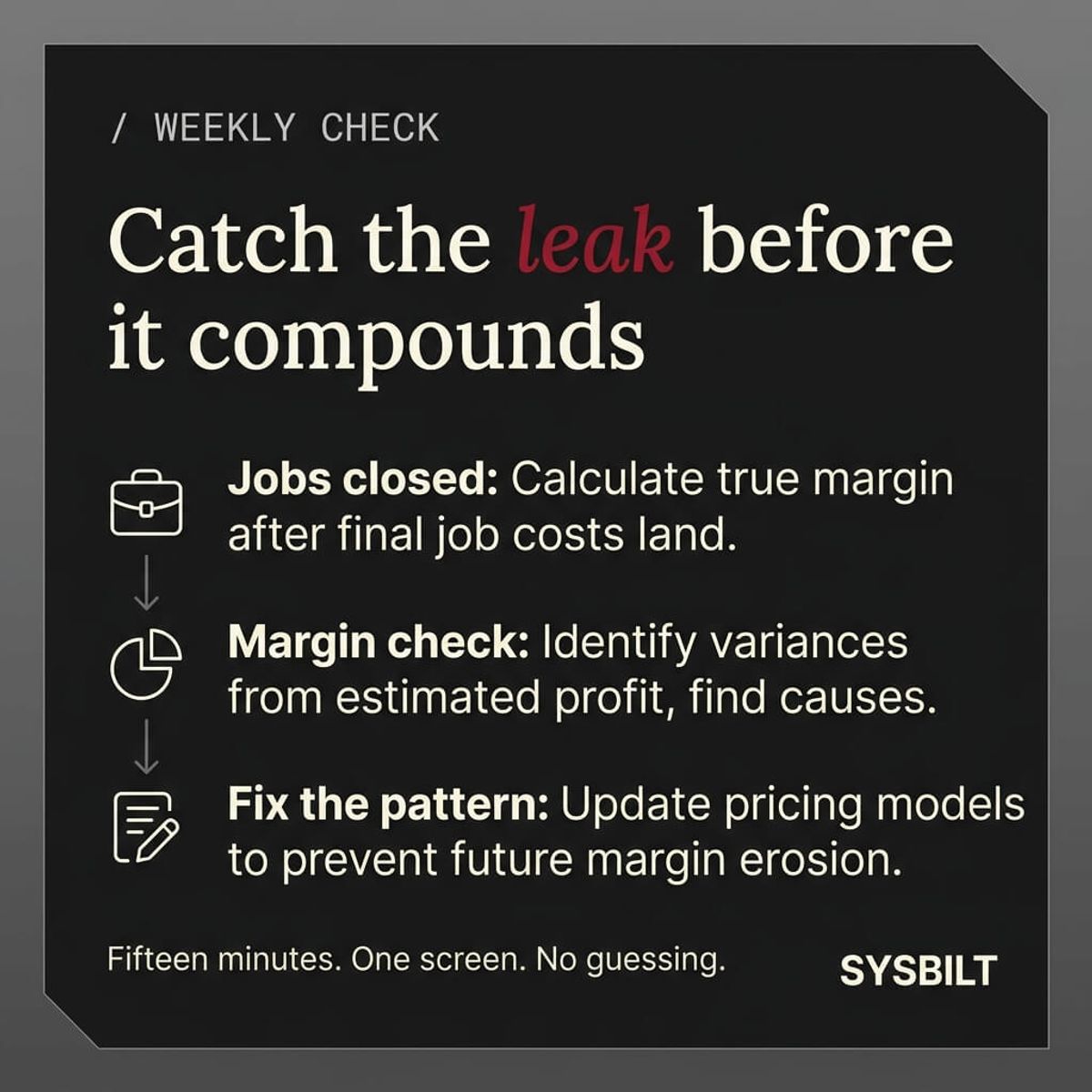
You catch scope creep in week two instead of quarter two, and if you don't have this view yet, dashboards and real-time reporting are where it starts.
Start Measuring This Week
You don't need to overhaul your entire operation to get started. Three actions this week will give you more margin visibility than most business owners have all year.
- Pick five recently completed jobs and calculate the actual margin on each one. Compare the quoted price against the real cost of labour, materials, and subcontractors. If you can't find that data easily, that's the first problem to solve
- Turn on job-level tracking in your accounting tool. Set up project codes or job numbers so every cost gets recorded against the job it belongs to, not dumped into the general ledger
- Review per-job margins weekly. Fifteen minutes every Monday morning. Look at which jobs made money, which didn't, and flag any job where actual margin came in more than five percentage points below the quote
Nearly 80% of Australian businesses experienced significant cash flow impacts in the past 12 months, and 27% of those affected used personal savings or skipped their own salary (CommBank/UNSW, 2025). The businesses that survive the current cost environment won't be the ones that cut the hardest. They'll be the ones that see exactly where their money goes, job by job, week by week.
If this sounds like your business, book a call and we'll walk you through how this applies to your situation.

WRITTEN BY
Felipe Chaparro
Systems Architect and Founder of SYSBILT. Felipe engineers custom automation, AI workflows, and performance web architectures for scaling Australian service businesses.