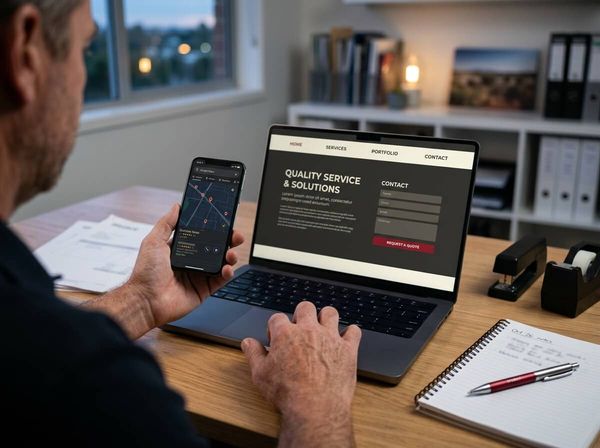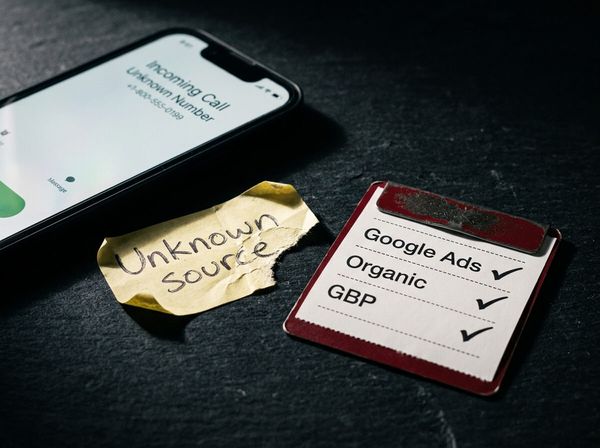
Your website feels invisible, and the phone stays quiet. Learn why it happens and how to fix why my business website isn't getting calls.
In this article
You paid for a website, you did the right thing, and the phone still isn't ringing. If you're searching why my business website isn't getting calls, this post will walk you through the most common reasons and the fixes that actually move the needle for your business.
Your website has one job, and it probably isn't doing it
A business website isn't a brochure. It's your front door, and if that front door is hard to find, hard to use on a phone, or gives people no reason to trust you, they don't call. They keep scrolling and tap the next option.
The good news is you usually don't need to rebuild from scratch. Most silent websites are quiet for a handful of fixable reasons.
"The purpose of a business is to create and keep a customer."
That line is decades old, and it still cuts to the core of the problem. If your website isn't creating customers, it isn't doing its job.
Five reasons your website isn't getting calls
01Your phone number is buried, or it's hard to tap on mobile
If someone has to hunt for your number, they won't find it. On a phone, that problem is even worse.
What to fix today
- Put your phone number in the top right of the header on desktop
- On mobile, add a sticky Call button that stays visible as they scroll
- Make the number a tap-to-call link, not an image
- Add opening hours near the number so people know when to try
02The site talks about you, not the customer's problem
Most websites open with a paragraph about the business, but that's not what the visitor is looking for. They're thinking: Can you help with my problem, and can you do it soon.
What to fix today
- Rewrite the first section of your homepage to lead with the problem you solve
- Use plain language, the same words customers use on the phone
- Add one clear next step, either call, book, or request a quote
03There's no reason to call right now
People don't call because a website exists. They call when it's obvious what happens next, and if your website is vague, visitors delay the decision. Delay usually means never.
What to fix today
- Give one clear promise, for example “Call us and we’ll confirm availability and give an honest ballpark”
- Add a short “What happens when you call” section
- Add a simple form option for people who cannot call in that moment
04The website is slow, broken, or awkward on a phone
If the page takes too long to load, or if the layout jumps around, people bail.
This is one of the easiest problems to miss because it can look fine on your computer.
What to fix today
- Test your site on your own phone using mobile data, not Wi-Fi
- Check that forms are easy to fill in with a thumb
- Remove anything that slows the page down, like oversized images and unnecessary pop-ups
05It doesn't feel trustworthy
You might do great work, but the website has to prove it quickly. That means real proof, not generic claims.
What to fix today
- Add three to six real reviews in the body of the page, not hidden on a separate page
- Show real photos of your work, your team, or your process
- Add licensing, insurance, memberships, and certifications where relevant
- Add a short “Areas we serve” section if you work locally
The hidden problem: what happens when you miss the call
Even if your website is doing everything right, calls will still be missed. You're busy, you're in meetings, you're driving, and your team is flat out. The real leak isn't the missed call itself. It's what happens afterwards.
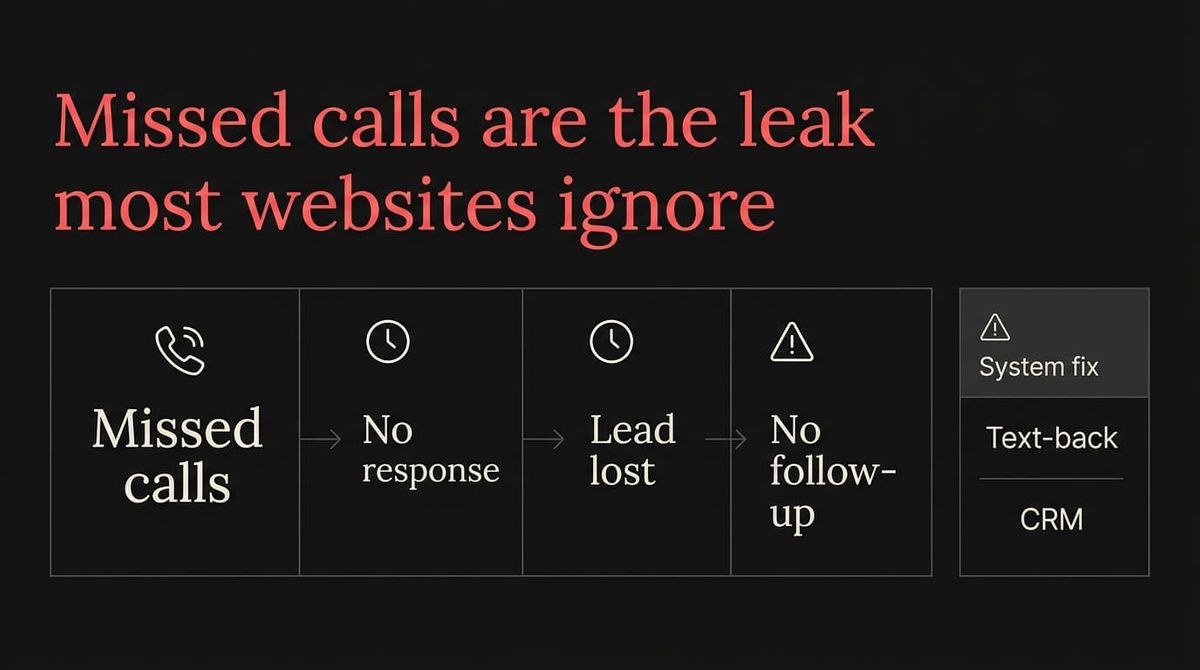
When someone calls and gets no answer, most businesses do nothing. There's no follow-up, no text, and no way to capture the enquiry another way. The lead simply disappears.
Here's the system fix:
- If a call is missed, an automatic text goes out within a minute, saying you'll call back and offering a link to book a time
- If someone fills in a form after hours, they get an instant confirmation so they know it went through
- Every enquiry goes into one place, so nothing sits in an inbox and dies
- If nobody follows up within a set time, the system reminds someone until it's done
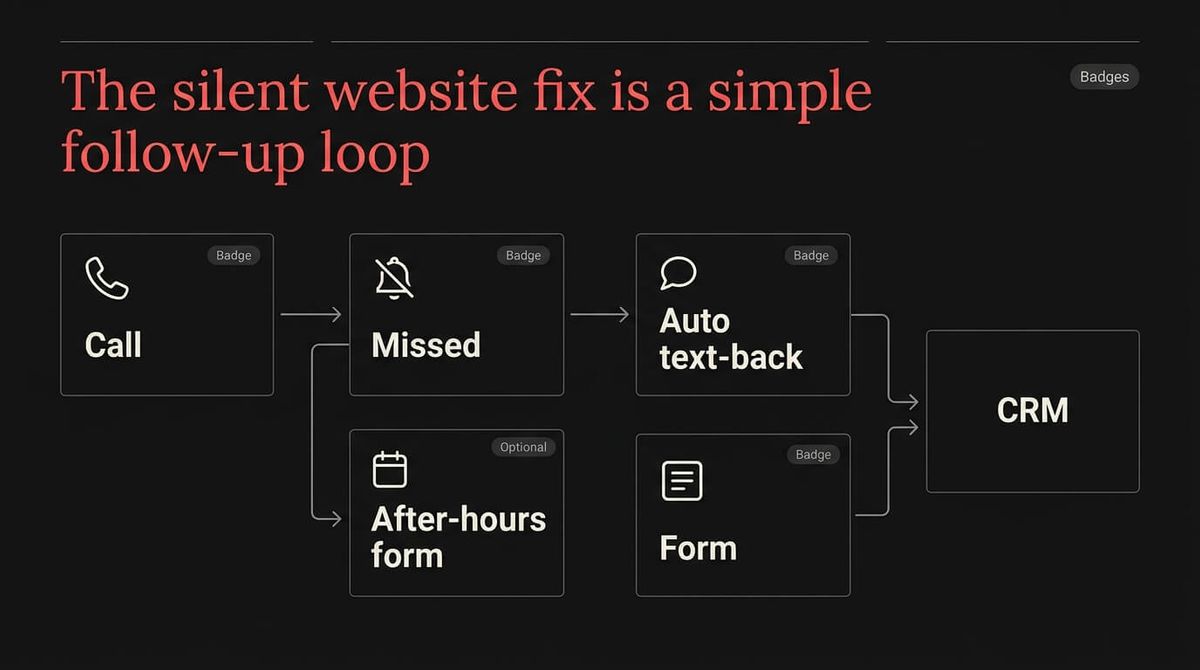
This is the part most website rebuilds ignore. Your website can only do its job if it's connected to a follow-up loop.
How to fix a silent website without starting over
If your site is quiet, start with fixes that reduce friction and increase trust.
Make calling effortless
- Put your number everywhere it matters, header, footer, and contact section
- Add a sticky click-to-call button on mobile
- Add a “Call now” line that says what they get when they call
Add one simple capture option for after hours
Not everyone can call at 8 pm, but plenty of people are still searching at 8 pm.
- Add a short form with three fields, name, number, and what they need
- Add a booking link if you can handle it operationally
- Make sure the confirmation message is clear and specific
Put proof where the decision happens
Don't make people work to find reassurance.
- Reviews near the services section
- Case examples near the proof section
- Clear next steps near every major section
Connect it to the system behind the scenes
A website that gets calls is only half the job. The other half is what happens after the first touch, and that usually means a clean lead inbox, a simple follow-up process, and automation that catches the missed moments.
If this is the piece you're missing, start here: Websites & E-commerce
What a website that actually gets calls looks like
It's simpler than you think:
- The phone number is impossible to miss
- On a phone, the call button is always right there
- The copy sounds like a real conversation, not a marketing page
- Proof is visible, with real reviews, real photos, and real credibility
- After hours, there's a clear way to make contact
- If a call is missed, the follow-up happens automatically
If your website cost you money but isn't making you money, it's not a website. It's a poster.
Final note on what we build
At SYSBILT, we build websites as part of a system. The site captures the enquiry, and the rest of the system makes sure it doesn't disappear.
WRITTEN BY
Felipe Chaparro
Systems Architect and Founder of SYSBILT. Felipe engineers custom automation, AI workflows, and performance web architectures for scaling Australian service businesses.