How to Stay Visible Online Without Content Consuming Your Week
The 2026 Guide to Building a Content System That Produces Consistent, Quality Output Without Depending on the Business Owner
For Australian businesses who know they should be creating content but cannot find the time to do it properly
Why Content Has Become a Systems Problem, Not a Creative One
Most business owners know they should be producing content. Blog posts, social media, newsletters, case studies. The evidence is clear: businesses that publish consistently get more traffic, more trust, and more inbound leads than those that do not. The problem is not awareness. It is execution. Content gets started and abandoned. A blog launches with three posts and then goes quiet for six months. Social media runs hot for two weeks and then dies when the owner gets busy. The newsletter goes out once and never again.
This is not a discipline problem. It is a systems problem. And three things have changed that make solving it both more urgent and more achievable than ever.
AI tools can now draft blog posts, write social captions, generate email sequences, and repurpose long-form content into short-form assets in minutes. But AI without a system produces a pile of drafts with no strategy, no consistency, and no connection to business goals. The businesses getting real value from AI content tools are the ones that built the workflow first and then plugged AI into it, not the ones that started with the tool and hoped the strategy would emerge.
Paid ads stop working the moment you stop paying. A trade show generates leads for one weekend. But a blog post published today can still drive traffic and generate enquiries two years from now without costing another dollar. Content compounds. Every post you publish adds to a library that works for the business permanently. The businesses that started building their content libraries a year ago are not just 12 months ahead. They have 12 months of compounding search rankings, backlinks, and audience trust that latecomers will take years to match. No other marketing channel delivers this dynamic, which is why content has shifted from a marketing activity to a structural asset.
Google's algorithms increasingly favour websites that demonstrate expertise, publish regularly, and cover topics in depth. AI models like ChatGPT, Gemini, and Perplexity reference and recommend businesses that have structured, authoritative content. If your website has thin content, outdated blog posts, or no content at all, you are invisible to both traditional search and the growing AI search channel. The compound effect of consistent publishing builds over time, and the businesses that started a year ago are now reaping benefits that latecomers will take years to match.
This guide covers how to build a content system that produces consistent output without depending on the business owner's time, creative energy, or memory.
How we do it
We audit the client's current content output, publishing history, and competitive landscape before recommending anything. A recent client had published four blog posts in two years, all written by the owner on weekends. We built a content system with a calendar, a workflow, and AI-assisted drafting. They now publish two posts per week and a monthly newsletter without the owner writing a single word.
Before You Create Any Content
The biggest waste in content marketing is producing content that nobody reads, that does not rank, and that does not connect to a business goal. Before you write a single word, you need to make three decisions that determine whether everything that follows is worth the effort.
Content that tries to speak to everyone connects with nobody. You need to know exactly who your ideal reader is, what problems they are trying to solve, and what language they use to describe those problems.
This is not a demographic exercise. "Small business owners aged 30–50" tells you nothing useful about what to write. You need psychographic detail: What frustrates them? What have they tried before? What do they search for at 10pm when they are worried about the business? What would make them stop scrolling and actually read?
The more specific you are about the reader, the more effective every piece of content becomes. One well-targeted blog post that speaks directly to a specific problem will outperform ten generic posts that speak to nobody in particular.
How we do it
We build a reader profile for every content system. It includes the target reader's situation, their primary frustrations, the questions they search for, and the language they use. Every piece of content is written for this profile. If a topic does not serve the target reader, it does not get produced.
Content pillars are the three to five core topics your business will consistently publish about. They should map directly to your services, your expertise, and the problems your target reader is trying to solve.
For a service business, the pillars might be:
- The core problem your service solves (e.g. "how to get more leads online")
- The process or methodology you use (e.g. "how modern business systems work")
- Industry trends and changes that affect your audience (e.g. "what AI means for small business")
- Common mistakes or misconceptions (e.g. "why most websites do not convert")
Everything you publish should fit within one of these pillars. If a content idea does not fit, it either means the idea is off-strategy or the pillars need updating. This constraint is what keeps your content focused and your brand authority building in a clear direction.
How we do it
We define content pillars during the strategy phase, before any content is produced. The pillars are based on keyword research, competitor analysis, and the client's service offering. We typically start with three pillars and add a fourth once the first three are producing consistently.
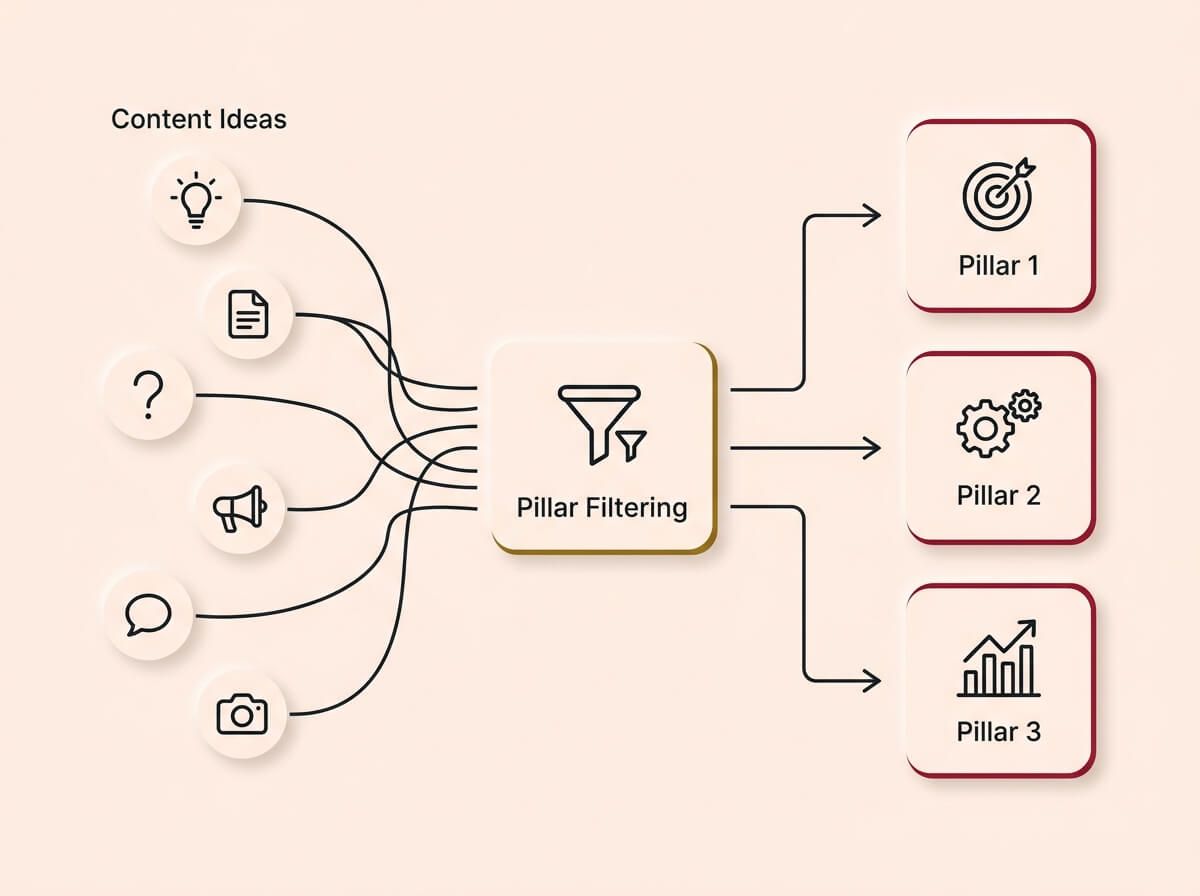
Define your content pillars before you publish. Restricting your content strategy to three to five core topics that map directly to your services and expertise ensures every idea you execute is on-strategy, focused, and consistently builds clear brand authority.
The most common content mistake is starting too ambitiously. Publishing five posts in the first week and then nothing for three months is worse than publishing once a week consistently for a year. Consistency matters more than volume.
Start with a cadence you can maintain without heroic effort:
- Blog posts: One per week is ideal. One every two weeks is sustainable for most small businesses.
- Social media: Three to five posts per week on your primary platform. Do not try to be everywhere.
- Newsletter: Once per month minimum. Fortnightly if you have enough content to repurpose.
The cadence should be based on your capacity, not your ambition. It is better to commit to one post per week and hit it every week than to aim for three and deliver inconsistently.
How we do it
We set the publishing cadence based on the client's actual capacity, not an ideal scenario. We build in buffer time so a busy week does not derail the schedule. Most clients start with one blog post per week and three social posts, then scale once the system is running smoothly.

Consistency matters more than volume. Publishing five posts in your first week and then nothing for three months damages your brand authority. Set a publishing cadence based on your actual capacity rather than ambition, and commit to a steady, sustainable rhythm.
Building the Content Workflow
A content system is not a list of ideas. It is a repeatable process that takes a topic from idea to published asset with clear roles, deadlines, and quality checks at each step.
The five stages of a content workflow
Every piece of content should move through these stages:
The workflow should be documented so anyone on the team (or any AI tool) can follow it. If the process lives in one person's head, the system breaks when that person is unavailable.
How we do it
We build the full content workflow in the client's project management tool (usually Notion). Every piece of content moves through a pipeline with clear stages, assignees, and deadlines. The client can see at a glance what is in progress, what is ready for review, and what is scheduled to publish.
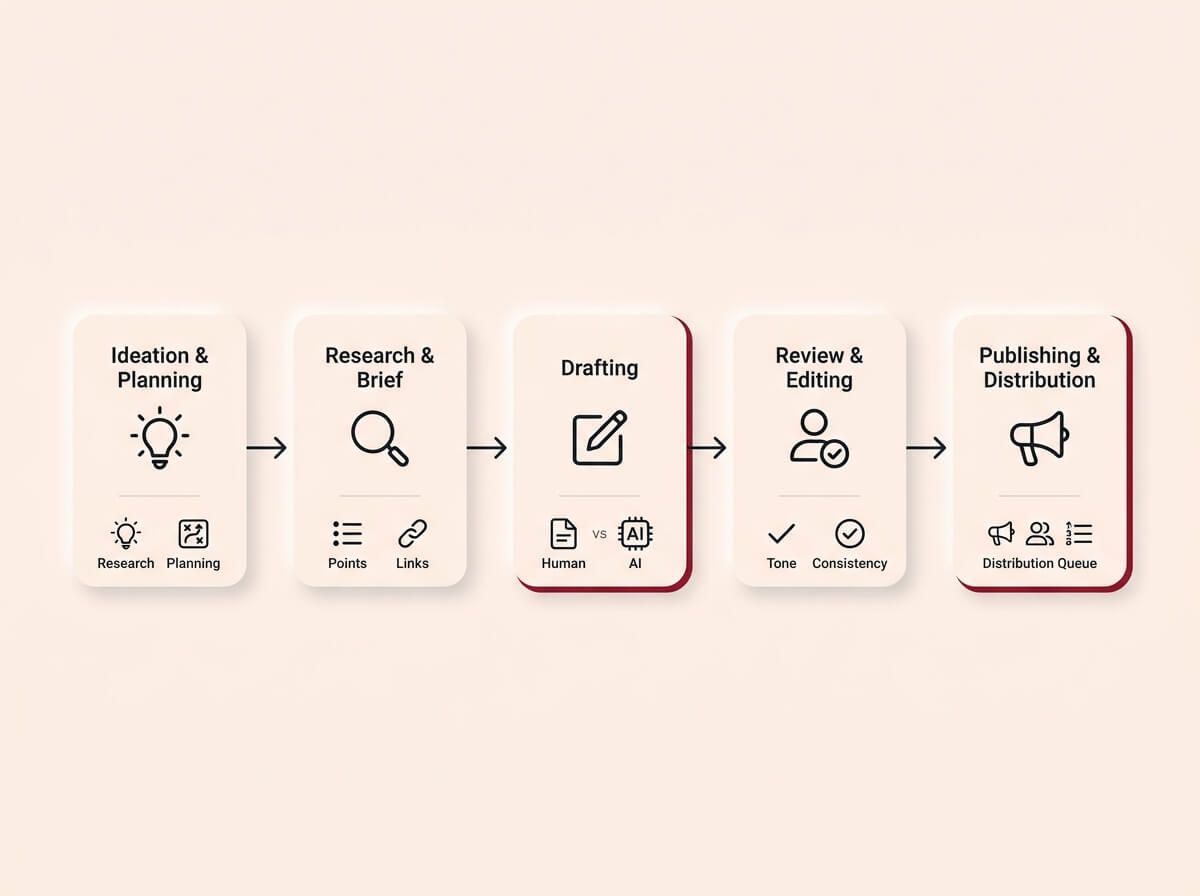
Every piece of content needs a documented workflow, meticulously moving through structured stages from ideation and planning right through to publishing and distribution. Defining these five clear stages transforms a potentially chaotic content creation process into a visible, manageable pipeline, ensuring consistent quality and preventing system breakdowns, regardless of whether human or AI resources produce the initial drafts.
Using AI in the workflow
AI is most valuable at stages 1, 2, and 3. It can generate topic ideas based on keyword gaps, produce research briefs from competitor analysis, and draft content from a structured brief. It is least valuable at stages 4 and 5, where human judgement, brand knowledge, and strategic decisions matter most.
The key rule: AI drafts, humans edit. Never publish AI-generated content without human review. The quality gap between a raw AI draft and an edited AI draft is the difference between content that builds authority and content that undermines it.
Practical ways to use AI in your content workflow:
- Topic generation: Feed your content pillars and target keywords into an AI tool and ask it to generate topic ideas with angles.
- Brief creation: Give the AI a topic, a target reader profile, and competitor examples, and ask it to produce a structured brief.
- First drafts: Provide the brief, brand voice guidelines, and a reference post for tone, and let the AI produce the first draft.
- Repurposing: Take a finished blog post and ask the AI to create social captions, newsletter snippets, and email content from it.
How we do it
We use AI at every stage where it saves time without sacrificing quality. Our content workflow uses AI for topic research, brief generation, and first drafts. Every draft is reviewed and edited by a human before it is published. The AI accelerates the process from weeks to days without changing the quality bar.

AI is most valuable when integrated into your existing workflow to accelerate stages like topic generation, brief creation, and first drafts. The core principle remains: AI drafts, but humans edit. Adhering to this ensures every piece of content you produce maintains the human judgement, brand knowledge, and strategic intent necessary to build authority rather than undermine it.
The Content Calendar
A content calendar is the operational backbone of the system. It answers three questions: what are we publishing, when is it going out, and who is responsible for each step?
What the calendar should contain
For each piece of content:
- Title or topic
- Content pillar it belongs to
- Format: Blog post, social post, newsletter, video, case study
- Target keyword (for SEO content)
- Publish date
- Status: Idea, briefed, drafted, in review, scheduled, published
- Owner: Who is responsible for moving it to the next stage
Planning horizon
Plan at least four weeks ahead. Ideally, maintain a rolling eight-week calendar where the next four weeks are fully briefed and the following four weeks have topics assigned. This buffer prevents the "what do we publish this week" scramble that kills consistency.
Balancing content types
Not every piece of content serves the same purpose. A healthy content mix includes:
- SEO content (blog posts): Long-term traffic generation. These compound over time as they rank in search.
- Social content: Short-term visibility and engagement. Keeps the brand present and active.
- Email content (newsletters): Nurtures existing contacts and keeps the business top of mind for people who are not ready to buy yet.
- Conversion content (case studies, guides): Builds trust with people who are actively evaluating options.
The ratio depends on your business goals, but a common starting point is 60% SEO content, 20% social, 10% email, and 10% conversion content.
How we do it
We build a content calendar for every client with a rolling eight-week planning horizon. The calendar lives in the same project management tool as the workflow so the team can see the schedule and the status of each piece in one place. We review the calendar weekly and adjust based on performance data and business priorities.
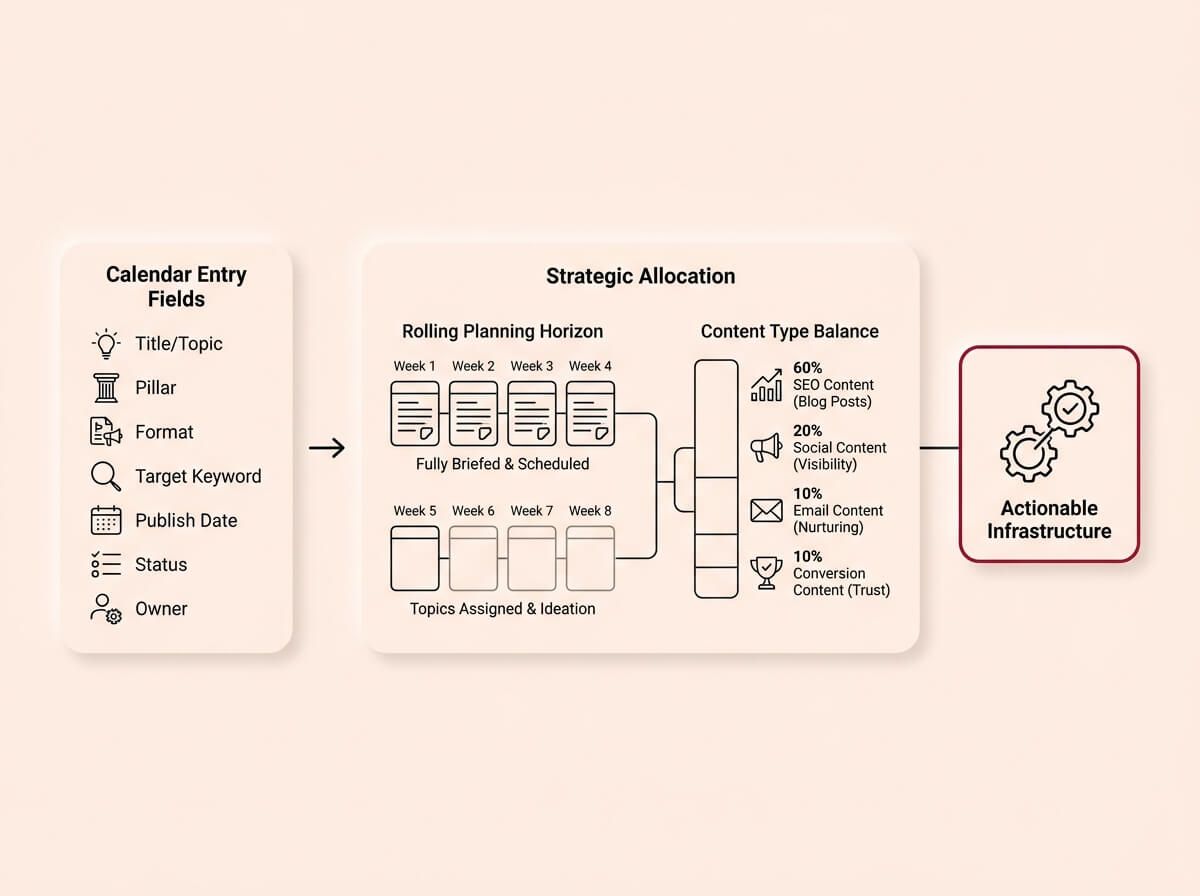
A professional content calendar is actionable infrastructure, not just a list of topics. Your system must combine a disciplined rolling eight-week planning horizon with a strategic balance of 60% SEO, 20% Social, 10% Email, and 10% Conversion content, ensuring every idea you execute serves a specific business purpose and prevents last-minute scrambles that damage consistency.
Content Types and How to Use Them
Different content formats serve different business goals. Understanding which format to use and when is the difference between a content system that generates results and one that just generates noise.
Blog posts
The foundation of most content systems. Blog posts rank in search engines, attract organic traffic, and build topical authority over time. The compound effect is significant: a blog post published today can still drive traffic and leads two years from now.
For maximum impact, every blog post should target a specific keyword, answer a specific question, and include a clear next step for the reader (a CTA, a related post, a downloadable resource).
Social media content
Social content is about visibility, not depth. Its job is to keep the brand present, drive traffic to longer-form content, and start conversations. The most effective social content for business accounts is repurposed from longer-form content, not created from scratch.
A single blog post can generate five to ten social posts: key quotes, stats, questions, short takes, and visual summaries. This is where AI repurposing tools save the most time.
Newsletters
Email is the only channel you own. Social platforms can change their algorithms and kill your reach overnight. Your email list is yours. A monthly or fortnightly newsletter keeps your brand in front of people who have already expressed interest but are not ready to buy.
The best newsletters are short, useful, and consistent. Curate your best recent content, add a brief personal note or insight, and include one clear CTA. Do not try to write a novel. Five minutes of reading time is the maximum.
Video and audio content
Short-form video (Reels, YouTube Shorts, LinkedIn video) and podcasts are major visibility channels in 2026. They build familiarity and trust faster than text because the audience sees and hears a real person.
That said, video is not where most businesses should start their content system. Video requires a different production workflow, different skills, and more time per asset than written content. If you are not yet publishing written content consistently, adding video will spread your capacity thinner, not make you more visible.
The practical approach: build the written content system first. Once blog posts and newsletters are running consistently, repurpose them into video and audio. A blog post becomes a script for a two-minute video. A newsletter insight becomes a LinkedIn video clip. A case study becomes a podcast episode. The written system feeds the video system, not the other way around.
Case studies and guides
Conversion content for people who are actively evaluating. Case studies show proof. Guides show expertise. Both build trust faster than any other content type.
Case studies follow a simple structure: the problem, what was built, and the result. Guides follow the structure you are reading right now: teach the reader enough to act, surface the complexity, and show how you handle it.
How we do it
We build the content mix into the calendar from day one. Each month includes a defined number of blog posts, social posts, newsletter issues, and conversion pieces. The mix is based on the client's goals: if inbound traffic is the priority, we lean heavy on SEO content. If nurturing existing leads matters more, we prioritise email and case studies.
Tools and Platforms
The tools you use should serve the workflow, not define it. Here is an honest breakdown of the main options for each part of the content system.
Content management and workflow
- Notion: Strong for content calendars, briefs, and workflow management. Flexible, customisable, and works well as a central hub. The trade-off is that it requires setup and discipline to maintain.
- Trello or Asana: Simpler project management options with Kanban-style boards. Good for smaller teams who need a visual pipeline without the complexity of Notion.
- Google Docs: Still the most common tool for collaborative drafting and editing. Integrates with everything. Limited for workflow management but excellent for the writing itself.
AI content tools
- ChatGPT, Claude, or Gemini (direct): The most flexible option for content drafting, brainstorming, and repurposing. You control the prompts, the context, and the output. Requires more skill to use well but offers the most power.
- Jasper, [Copy.ai](http://Copy.ai), or similar: Purpose-built AI writing tools with templates for specific content types. Easier to use for non-technical teams but less flexible than direct model access. Good for social content and short-form copy.
- Built-in AI features: Many CMS and social media tools now include AI drafting features. These are convenient but limited. Use them for quick tasks, not for cornerstone content.
Publishing and distribution
- WordPress or headless CMS (Sanity, Contentful): For blog publishing. WordPress is the most common. Headless CMS options offer more control for custom-coded websites.
- Social scheduling tools (Buffer, Later, Hootsuite): For scheduling and publishing social content across platforms. These save time and ensure consistency.
- Email platforms (HubSpot, Mailchimp, ConvertKit): For newsletters and email sequences. Choose based on your CRM and the complexity of your email workflows.
Cost considerations
A functional content system for a small business can run on free or low-cost tools. Notion's free tier handles the calendar and workflow. AI tools cost between $20 and $100 per month for the level of usage most small businesses need. Social scheduling tools start at $15 per month. The total infrastructure cost is typically $50 to $200 per month, far less than the cost of the time it replaces.
How we do it
We build content systems in Notion because it handles the calendar, the workflow, the briefs, and the asset library in one place. We use AI tools for drafting and repurposing, and we connect the publishing workflow to the client's CMS and social scheduler. The client gets one system that manages the entire content pipeline from idea to published.
SEO and Content Strategy
Content without SEO strategy is writing for an audience that may never find it. SEO is not a separate discipline. It is a lens that shapes what you write, how you structure it, and how you measure success.
Keyword research as content planning
Keyword research tells you what your target audience is actually searching for. It turns guessing into data. Every blog post should target a specific keyword or phrase that your audience uses to find information related to your services.
The process:
- Start with seed topics from your content pillars.
- Use keyword tools (Google Keyword Planner, Ahrefs, SEMrush, or free alternatives like Ubersuggest) to find specific search queries related to those topics.
- Evaluate search volume and competition. High-volume keywords are harder to rank for. Low-volume, specific keywords (long-tail) are easier to rank for and often convert better because the searcher has a clearer intent.
- Map keywords to content. Each blog post targets one primary keyword and two to three related keywords.
Content structure for search
Search engines read your content structurally. Proper heading hierarchy (H1, H2, H3), clear meta descriptions, descriptive image alt text, and internal linking all affect how your content is indexed and ranked. These are technical requirements that should be baked into your content workflow, not treated as an afterthought.
Measuring content performance
If you are not measuring, you are guessing. The key metrics for content:
- Organic traffic: How many people are finding your content through search?
- Keyword rankings: Are your target keywords moving up or down?
- Engagement: Are people reading the content or bouncing immediately?
- Conversions: Is the content generating leads, enquiries, or sales?
Review these monthly. Double down on what works. Cut what does not. Adjust the content calendar based on data, not intuition.
How we do it
We run keyword research before writing a single post. Every piece of content targets a specific keyword with known search volume. We track rankings, traffic, and conversions monthly and adjust the content calendar based on what the data shows is working. The client gets a monthly performance report that shows exactly what their content investment is producing.
Quality Control and Brand Consistency
The fastest way to undermine a content system is to publish inconsistent, low-quality content. Every piece that goes out represents the business. Quality control is not optional, especially when AI is involved in the drafting process.
Brand voice guidelines
Every content system needs a documented brand voice guide that answers: How do we sound? What words do we use? What words do we avoid? What tone is appropriate for different content types?
The guide should be specific enough that a new writer (human or AI) can produce content that sounds consistent with everything else the business publishes. Vague guidelines like "professional but friendly" are not useful. Specific guidelines like "use contractions in body copy, no exclamation marks, no jargon, write at a level a dentist and a mechanic both understand" are.
Editorial review process
Every piece of content should be reviewed before publishing. The review checks for:
- Accuracy: Are the facts, stats, and claims correct?
- Brand voice: Does it sound like us?
- SEO: Is the target keyword used naturally? Are headings structured correctly? Is the meta description written?
- Quality: Is it genuinely useful to the reader, or is it filler?
- Compliance: Does it follow the brand guidelines? Are there any banned words, unsupported claims, or broken links?
The review does not need to be slow. A well-structured checklist can turn a 30-minute review into a 10-minute check. The point is that nothing goes live without a second pair of eyes.
AI quality management
AI drafts require more careful review than human drafts because AI can produce confident-sounding content that is factually wrong or tonally off-brand. Specific things to check in AI-generated content:
- Hallucinated facts or statistics. AI sometimes invents data. Verify every stat.
- Generic language. AI defaults to safe, corporate phrasing. Edit for your brand voice.
- Repetitive structure. AI tends to follow the same sentence patterns. Vary the rhythm.
- Missing nuance. AI does not understand your specific business context unless you provide it. Fill in the gaps.
How we do it
We build a brand voice guide and an editorial checklist for every client. Every piece of content passes through the checklist before publishing. AI-generated drafts get an additional review pass specifically for hallucination, generic language, and brand voice compliance. Nothing goes live without human approval.
What Happens After the System Is Running
A content system that is producing and publishing consistently is a significant achievement. But the real value comes from what you build on top of it.
Every long-form piece of content can be broken into five to ten smaller assets. A blog post becomes social posts, newsletter snippets, email content, and slide decks. A case study becomes quotes, stats, and before-and-after comparisons for social. This is where AI repurposing tools save the most time and where the content system generates the most output per hour invested.
How we do it
We build repurposing into the workflow as a standard step, not an afterthought. Every blog post has a repurposing brief that specifies what derivative assets to create. The AI handles the initial drafts of the derivative content. A human reviews and publishes.
When content is connected to your CRM and automation layer, it becomes a lead generation tool, not just a visibility tool. A blog post with a downloadable resource captures an email address. That email triggers a nurture sequence. The nurture sequence moves the contact through the pipeline. The content is not just attracting attention. It is feeding the sales system.
How we do it
We connect the content system to the client's CRM and automation platform. Downloadable resources trigger lead capture. Blog engagement data feeds into the contact record. The content team can see which posts generate leads, and the sales team can see which content a prospect engaged with before booking a call.
The content calendar should evolve based on performance data. Topics that rank well and generate leads get more attention. Topics that underperform get re-evaluated or dropped. The system gets smarter over time because the data tells you what your audience actually cares about, as opposed to what you assumed they care about.
How we do it
We review content performance monthly with every client. We show what ranked, what drove traffic, what generated leads, and what underperformed. The next month's calendar is adjusted based on the data. Over time, the system converges on the topics and formats that deliver the most value.
Why Now, Not Later
The cost of not having a content system is not just missed traffic. It is a compounding disadvantage that gets harder to reverse the longer you wait.
Every month without consistent content is a month your competitors are publishing, ranking, and building the topical authority that search engines and AI models use to decide who gets recommended. Content marketing compounds like interest. The business that started publishing consistently a year ago is not just 12 months ahead of you. It is 12 months of compounding search authority, backlinks, audience trust, and data ahead of you. That gap does not close by publishing faster for a few weeks. It closes by starting now and sustaining.
* Your competitors are already publishing. The businesses that invested in content systems early now have libraries of ranked content that generate leads without ongoing effort. Every month you delay widens the gap. * AI has made content production faster and cheaper than ever. The bottleneck is no longer the writing. It is the system that directs the writing. Building the system is a one-time investment. The output is ongoing. * Search engines and AI models compound the value of consistent publishing. A blog post published today will still be generating traffic in two years if it is well-structured and well-maintained. The sooner you start, the sooner the compounding begins. * Your email list is the one channel you own. Every week without a newsletter is a week where your existing contacts are forgetting about you and warming up to whoever is showing up in their inbox.
The cost of building a content system is a fraction of the revenue it generates over its lifetime. The longer you wait, the more ground you have to make up.
How we do it
We build content systems that are designed to compound. The first month produces the foundation. The third month shows early traction. By month six, the system is generating consistent inbound traffic and leads without the owner's time. We build for the long game because that is where content delivers its real return.
How We Build It
You can take everything in this guide and do it yourself. We have written it specifically so that you can. But if you want a team to do it for you, here is exactly how we work. No surprises.
Step 1: Content audit and strategy. We audit the client's existing content, competitor landscape, and keyword opportunities. We define the target reader, content pillars, and publishing cadence.
Step 2: Workflow and calendar build. We build the content workflow and calendar in Notion. Every stage has clear roles, deadlines, and quality checks. The calendar is populated with the first eight weeks of topics.
Step 3: Brand voice and editorial setup. We create the brand voice guide, the editorial checklist, and the AI prompting templates. These ensure every piece of content sounds consistent regardless of who (or what) writes the first draft.
Step 4: Production and review. We produce the first batch of content, run it through the editorial process, and publish. The client reviews and approves before anything goes live.
Step 5: Distribution, measurement, and optimisation. We connect the content to social scheduling, email marketing, and the CRM. We track performance monthly and adjust the calendar based on what the data shows. The client gets a system that runs, measures, and improves itself.
That is the process. Start to finish. Everything we described in this guide, delivered.
Content System Diagnostic Checklist
Run your current content operations against these checks. If you fail more than three, your content is either costing you more time than it should or not delivering the results it could.
Strategy and planning
- Do you have a defined target reader profile (not just demographics, but psychographics and search behaviour)?
- Are your content topics organised into three to five content pillars that map to your services?
- Do you have a publishing cadence that you have maintained consistently for the last three months?
- Is your content calendar planned at least four weeks ahead?
Workflow and production
- Is your content workflow documented (not just understood by one person)?
- Does every piece of content go through a research and briefing stage before drafting begins?
- Are you using AI tools to accelerate drafting and repurposing?
- Does every piece of content go through human editorial review before publishing?
- Can your content process continue if the business owner is unavailable for a month?
SEO and distribution
- Does every blog post target a specific keyword with known search volume?
- Are your headings, meta descriptions, and image alt text optimised for search?
- Is your content structured for AI search models to reference (clean HTML, structured data, authoritative content)?
- Are you distributing content across at least two channels (blog + social, blog + email, etc.)?
- Are you repurposing long-form content into short-form assets (social posts, newsletter snippets, email content)?
Quality and consistency
- Do you have a documented brand voice guide that anyone on the team can follow?
- Is there an editorial checklist that every piece of content passes through before publishing?
- Are AI-generated drafts specifically checked for hallucination, generic language, and brand voice?
Measurement and optimisation
- Are you tracking organic traffic, keyword rankings, and conversions monthly?
- Do you adjust your content calendar based on performance data?
- Is your content connected to your CRM so you can see which posts generate leads?
- Do you review and update older content that is losing traffic or has become outdated?
Count your failures. If you scored under 15 out of 22, your content system is either missing or underperforming.
Ready to fix this?
Book a call and we will walk you through how this applies to your business. We will give you an honest read on whether it is worth doing right now, and if so, exactly where to start.
BOOK A CALLWe do not upsell. We do not surprise you with hidden costs. We tell you what you need, what it costs, and how long it takes. If it is not worth doing, we will tell you that too.