Your next hire costs $89K, not $55K. Learn how to scale a service business without hiring by building systems that do the work instead.
In this article
- //The Hiring Trap That Catches Every Growing Business
- //What Australian Businesses Are Actually Doing Instead
- //Five Ways to Scale a Service Business Without Hiring
- //Hiring vs Building a System
- //Where to Start and What to Build Next
- //What AI Can Actually Handle in Your Business Today
- //Why Most Businesses Fail at This
- //Scale Without Hiring in 90 Days
The Hiring Trap That Catches Every Growing Business
Your business is growing, but so is the bottleneck. Every new client means more hours, more follow-ups, and more decisions that only you can make. If the only answer you can see is hiring another person, you're about to spend far more than you think.
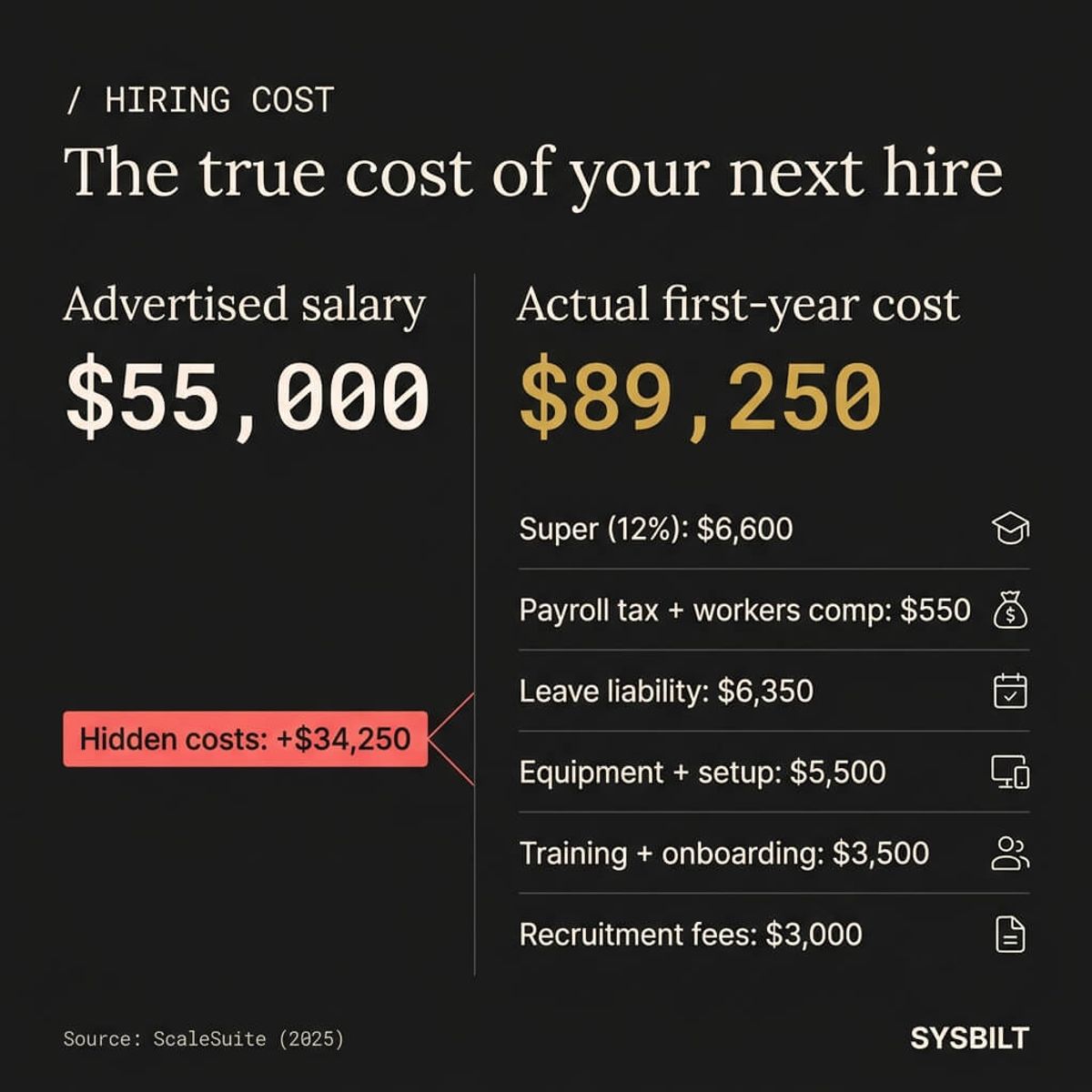
The real cost of a $55,000 hire in Australia isn't $55,000. Once you add superannuation, payroll tax, workers' compensation, leave entitlements, equipment, training, and recruitment fees, that number climbs to approximately $89,250 in the first year (ScaleSuite, 2025). Recruitment costs alone doubled from $10,500 to $23,860 per worker between 2020 and 2021 (HR Industry Benchmark Survey, 2021).
That's a significant chunk of cash flow for a business earning $1M to $5M. And if it doesn't work out, employee turnover costs Australian businesses an average of $15,000 per departure (ScaleSuite, 2025).
Here's the thing most business owners don't consider: there's another path. Instead of adding headcount, you can build a system that handles the work your next hire would do. Not all of it, but the repetitive, predictable, time-consuming parts that are eating your week right now. This post walks through exactly how to scale a service business without hiring, step by step, starting with where the money actually goes.
What Australian Businesses Are Actually Doing Instead
You're not alone in asking this question. Across Australia, 40% of SMEs are currently adopting AI, a 5% increase from the previous quarter (Australian Government, 2024). Among the smallest businesses with up to four employees, AI adoption jumped from 25% to 34% in the same period.
Looking ahead, 68% of Australian business executives plan to adopt AI across their organisation in 2026 (LinkedIn, 2025). The direction is clear: Australian business owners are looking for ways to grow without defaulting to another salary.
But here's where most get stuck. They adopt individual tools without connecting them into a system. A chatbot here, an automation there, a dashboard nobody checks. The tools exist, but they don't talk to each other, and the founder is still the glue holding everything together. The gap between adopting tools and building a system is where most of the value gets lost.
Five Ways to Scale a Service Business Without Hiring
Scaling without hiring isn't one decision. It's five, and each one removes a different bottleneck.
Automation of repetitive admin. Follow-up emails, invoice reminders, data entry between your CRM and accounting software, job completion notifications. These tasks don't require judgment. They require consistency, and a system delivers that better than a person juggling twelve other priorities. Automation handles the handoffs your team currently does manually.
AI assistants for customer-facing tasks. Phone answering, lead qualification, appointment booking, and responding to common enquiries. An AI assistant works after hours, doesn't call in sick, and handles the same question for the hundredth time with the same quality as the first.
Content systems that don't consume the founder's weekend. Posting consistently on social media and writing blog posts shouldn't require your Saturday morning. A content system turns one piece of expertise into a month of output across channels.
Team training that makes existing staff twice as effective. Your team already has capacity you're not using. When training and documentation are built into the system, your people stop waiting on you for answers and start solving problems themselves.
Dashboards that replace the founder as the single source of truth. If your team asks you "how are we tracking?" every week, the problem isn't the question. It's that the answer lives in your head instead of on a screen. Dashboards and reporting give everyone the same view without a meeting.
"The most valuable businesses of coming decades will be built by entrepreneurs who seek to empower people rather than try to make them obsolete."
That's the point. Scaling without hiring isn't about replacing your team. It's about giving them systems so they can do more of what actually matters.
Hiring vs Building a System
Let's put real figures next to each other for a business earning $1M to $5M in Australia.
The cost of hiring:
- Advertised salary: $55,000
- Superannuation (12%): $6,600
- Workers' compensation: $550
- Annual leave liability: $4,235
- Sick leave provision: $2,115
- Equipment and setup: $5,500
- Training and onboarding: $3,500
- Recruitment: $3,000
- Actual first-year cost: approximately $89,250 (ScaleSuite, 2025)
That's before you factor in ramp time. Most new hires take three to six months before they're fully productive. And if they leave within the first year, you're looking at another $15,000 in turnover costs (ScaleSuite, 2025) plus the whole cycle starts again.
Now consider the alternative. A system that automates follow-ups, qualifies leads, sends reminders, updates your CRM, and keeps your dashboard current doesn't take sick days, doesn't need three months to ramp, and doesn't leave for a competitor.
The cash flow argument is just as strong. Nearly 80% of Australian businesses have experienced cash flow impact in the past twelve months (UNSW/CommBank, 2025). An $89,000 hire puts pressure on cash that's already tight. A system built over 90 days spreads the cost, delivers value from month one, and compounds over time.
Where to Start and What to Build Next
The biggest mistake is trying to automate everything at once. These five levers work in a specific order, and each one feeds the next.
Start with capture and follow-up. Before you automate anything, make sure leads actually get captured and followed up. Your website needs to convert visitors into enquiries, and your CRM needs to track every one of them. If leads are falling through the cracks, no amount of AI or automation will help because there's nothing in the pipeline to work with.
Then automate the handoffs. Once leads are being captured and tracked, connect the tools. When a form submission arrives, the CRM creates a deal, the team gets notified, and a follow-up sequence begins automatically. Automation removes the manual steps between your systems so nothing stalls waiting for someone to copy and paste.
Then add AI for the tasks that eat the team's day. With your pipeline running and your processes connected, you can layer in AI assistants to handle phone enquiries, qualify leads before they reach your team, and answer common questions around the clock.
Then build the content engine. With the operational system running, you have capacity to grow visibility. A content system turns your expertise into a consistent presence across channels without requiring you to create every post from scratch.
Then train the team so everything sticks. New systems only work if people use them. Team training with proper documentation and onboarding means your staff can run the system without checking with you first.
Then see clearly. The final layer is dashboards and reporting that pull data from every system into one screen. You stop relying on gut feel and start making decisions based on what's actually happening.
This order matters. Each step solves a dependency for the next. If you skip ahead to AI before your CRM is capturing leads properly, you're automating a process that doesn't exist yet.
What AI Can Actually Handle in Your Business Today
AI isn't coming. It's here, and nearly 90% of Australian jobs have medium-to-high augmentation exposure (Jobs and Skills Australia, 2025). That doesn't mean AI will replace your team, but it will change what their day looks like.
Here's what AI can realistically handle in a service business right now:
- Phone answering and lead qualification. An AI voice assistant picks up after hours, asks the right questions, and routes qualified leads to your team in the morning. No more missed calls turning into missed jobs.
- Customer email responses. Routine replies, booking confirmations, quote follow-ups, and FAQ responses can be handled by AI without sounding like a template.
- Internal knowledge base. Your team stops interrupting you with "where's the process for X?" because the AI assistant pulls the answer from your documented SOPs.
- Data extraction. Messy emails, PDF attachments, and form submissions get parsed and entered into your CRM automatically.
What AI still can't do: make relationship decisions, set business strategy, handle complex negotiations, or read the room in a difficult client conversation. Those are your jobs. Everything else is a candidate for augmentation.
Why Most Businesses Fail at This
Knowing what to build and actually building it are different problems. Here's where most businesses come unstuck.
Buying tools without connecting them. You've got a CRM, an email tool, an accounting package, and a project management app. None of them share data. Your team manually moves information between them, which creates errors, delays, and frustration. Tools in isolation aren't a system. They're just software you're paying for.
Automating a messy process. If your quoting process takes six steps, three emails, and a phone call because nobody ever mapped it properly, automating it won't fix it. It'll just break faster. Clean the process first, then automate it.
Skipping team training. You spent three months building a new system and your team still uses the old spreadsheet. This happens when training isn't part of the build. Documentation, walkthroughs, and hands-on onboarding aren't optional. They're what make the investment pay off.
No visibility. You can't improve what you can't measure. If there's no dashboard showing pipeline value, conversion rates, and task completion, you're guessing whether the system is working. Build the measurement layer from the start.
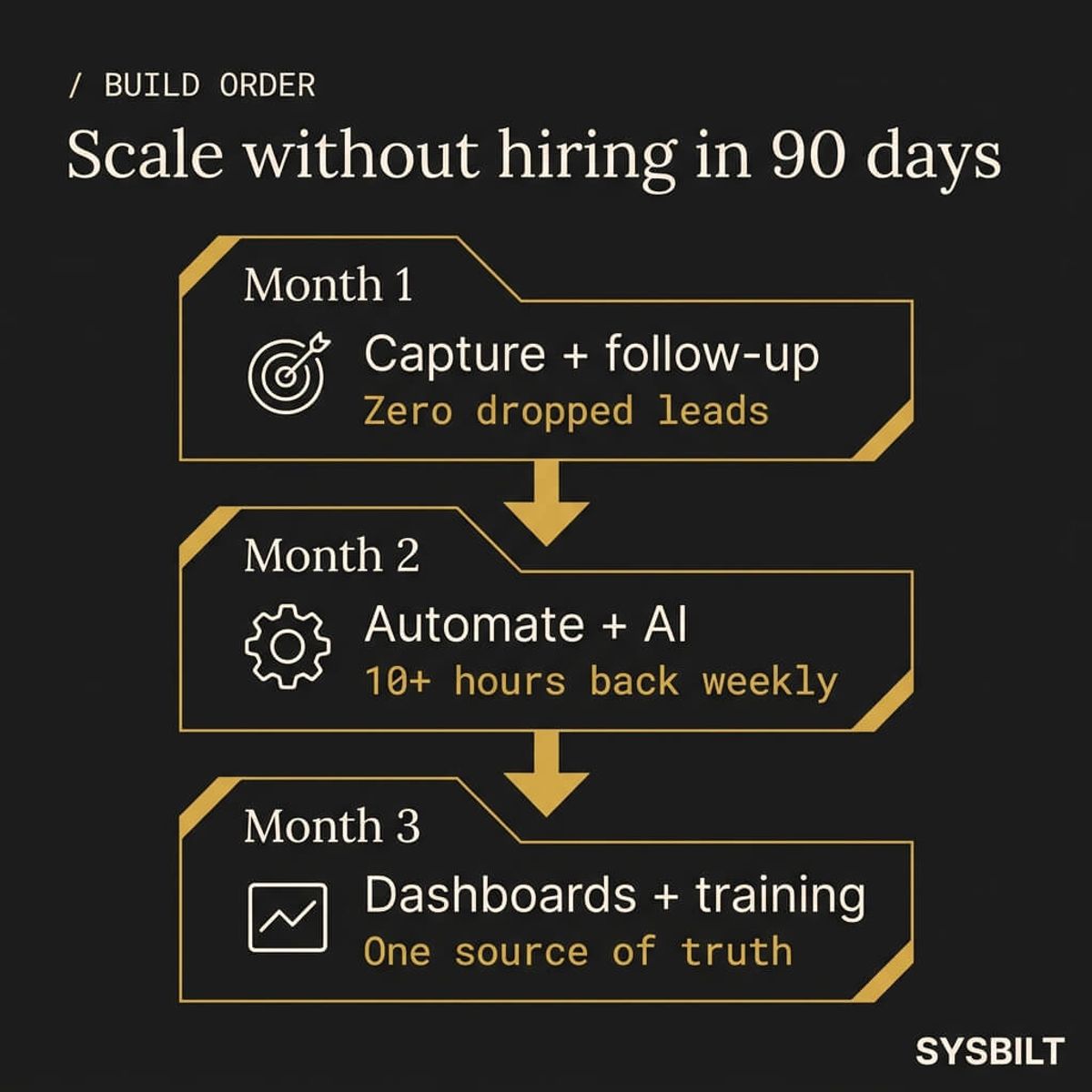
Scale Without Hiring in 90 Days
You don't need a twelve-month roadmap to start. Here's a practical 90-day plan for a service business earning $1M to $5M.
Month 1: Map and capture. Identify your three most expensive bottlenecks, the tasks where your time or your team's time is being wasted on repetitive work. Fix your lead capture and follow-up first. Make sure every enquiry gets into a CRM and gets a response within minutes, not hours.
Month 2: Automate and deploy. Connect your CRM to your quoting tool, your email system, and your accounting software. Automate the top three repetitive tasks you identified in month one. Deploy one AI assistant for after-hours phone answering or lead qualification.
Month 3: Measure and train. Build a dashboard that shows your pipeline, conversion rate, and key operational metrics in one view. Document the new workflows and train your team on how the system runs. From this point, the system compounds. Every month it handles more and you handle less.
This isn't about replacing your team. It's about building the infrastructure that lets your existing team handle twice the work without twice the stress. The businesses that figure this out in 2026 won't just grow faster. They'll grow with better margins, less burnout, and a model that doesn't fall apart when one person takes a holiday.
If you want to see how all seven levers connect into one system, start here.
If this sounds like your business, book a call and we'll walk you through how this applies to your situation.

WRITTEN BY
Felipe Chaparro
Systems Architect and Founder of SYSBILT. Felipe engineers custom automation, AI workflows, and performance web architectures for scaling Australian service businesses.