
Every ServiceM8 vs Tradify comparison is written by a vendor. This one isn't. Real AUD pricing and an honest breakdown to find the right fit.
In this article
If you're comparing ServiceM8 vs Tradify for your Australian business, you've probably noticed something frustrating: every comparison online is written by one of the vendors, and each one claims they win. This post is different. We don't sell either tool, and we're going to break down what each platform actually does, what it costs in real Australian dollars, and which one fits based on how your business runs right now.
Why This Decision Costs You More Than the Subscription
Choosing the wrong job management tool doesn't just waste money. It wastes months of setup, training, and data entry that you can't get back.
More than 78% of Australian service business owners report drowning in paperwork, and 66% have lost work because of the time they spend on admin instead of billable jobs (The Key Work Pressure Report, 2024; Small Business Connections, 2024). The right software should cut that load significantly. The wrong one adds to it, because your team resists the switch, jobs fall through the cracks during the transition, and six months later you're shopping for something else.
"I wanted to achieve something significant and that has been helping tradies to improve both their business and their personal lives."
Both tools exist because the problem is real. The question isn't whether you need one. It's which one matches the way your business actually operates.
ServiceM8: What It Does and Who It Suits
ServiceM8 is built for businesses that run a high volume of shorter jobs. Think reactive service work where a call comes in, someone gets dispatched, the job gets done, and the invoice goes out the same day. The entire platform is designed around that workflow.
Pricing in AUD (current as of 2026):
- Free: $0/month (1 user, 30 jobs)
- Starter: $29/month
- Growing: $79/month
- Premium: $149/month
- Premium Plus: $349/month
All paid plans include unlimited users. You're paying for features and job volume, not headcount (ServiceM8, 2026).
Key strengths: ServiceM8 works offline, which matters when you're in a basement, a commercial building, or a rural area with no mobile signal. The iOS-native app includes a built-in phone system, integrated payment processing with lower merchant fees and next-day payouts, and AI-powered features for job management.
Best for: Solo operators and Apple-based teams running high-volume reactive jobs. Electricians, plumbers, pest control operators, and cleaners who process dozens of short jobs per week will get the most out of it.
The limitation: The full app is iOS-only. There's an Android Lite version, but it's restricted in what it can do. If even one team member carries an Android phone, this creates daily friction that doesn't go away.
Tradify: What It Does and Who It Suits
Tradify is built for growing teams that need everyone working from the same system, regardless of what device they carry. It's simpler to learn than most alternatives, with a clean focus on quoting, job tracking, and invoicing.
Pricing in AUD, ex GST (current as of 2026):
- Lite: $48/user/month
- Pro: $52/user/month
- Plus: $62/user/month
Tradify charges per user. The more people on your team, the higher the monthly cost (Tradify, 2026).
Key strengths: Tradify works on both iOS and Android with full functionality. It's rated 4.7/5 across major review platforms and consistently praised for ease of use (Software Advice, 2026). Subcontractor scheduling is included at no extra cost, and it integrates natively with Xero, QuickBooks, and MYOB.
Best for: Growing teams of two to ten staff who need a straightforward, cross-platform system. Project-based service businesses like builders, HVAC operators, and painters will find Tradify fits the way they already work.
The limitation: No offline mode. If your team works in areas with unreliable internet coverage, every dropped connection means lost time re-entering data or waiting for signal.
The Five Differences That Actually Matter
Most comparison pages list dozens of features side by side. Most of those features won't change your decision. These five will.
Pricing model
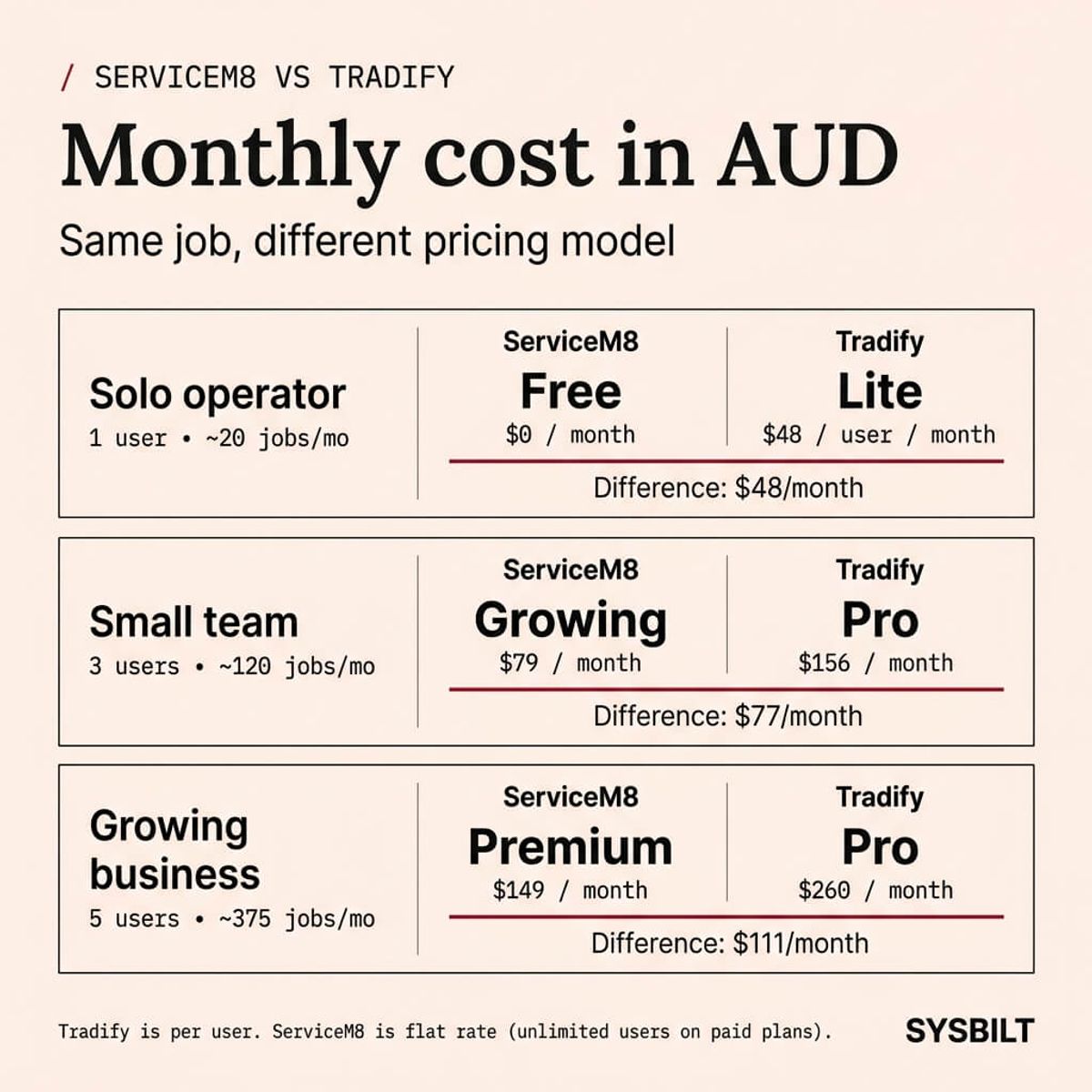
This is the biggest financial difference and the one most comparisons bury. ServiceM8 charges a flat monthly rate with unlimited users. Tradify charges per user. For a solo operator, the gap is manageable. For a growing team, it compounds quickly.
| Business size | ServiceM8 | Tradify | Annual difference |
|---|---|---|---|
| Solo operator (1 user, ~20 jobs/mo) | Free $0/mo | Lite $48/mo | $576/year |
| Lean team (3 users, ~120 jobs/mo) | Growing $79/mo | Pro $156/mo | $924/year |
| Growing business (5 users, ~375 jobs/mo) | Premium $149/mo | Pro $260/mo | $1,332/year |
(ServiceM8, 2026; Tradify, 2026)
Mobile platform
ServiceM8's full app is iOS-only. The Android Lite version covers the basics but misses key features. Tradify works fully on both platforms. If your team carries a mix of iPhones and Android devices, Tradify removes that friction entirely.
Offline access
ServiceM8 works without an internet connection and syncs when you're back online. Tradify requires an active connection. For businesses operating in basements, new builds, or regional areas, this isn't an edge case. It's a daily reality.
Payment processing
ServiceM8 offers integrated payment processing with lower merchant fees and next-day payouts. Tradify handles invoicing but relies on external payment gateways for card processing. If faster cash flow and fewer transaction costs matter to your operation, ServiceM8 has the advantage here.
Accounting integrations
Both platforms connect to Xero and QuickBooks. ServiceM8 also integrates with MYOB and Sage. Tradify connects with MYOB as well. Check which accounting package you already use before deciding, because a clean integration saves hours of reconciliation every week.
How Australian Businesses Should Choose Between ServiceM8 and Tradify
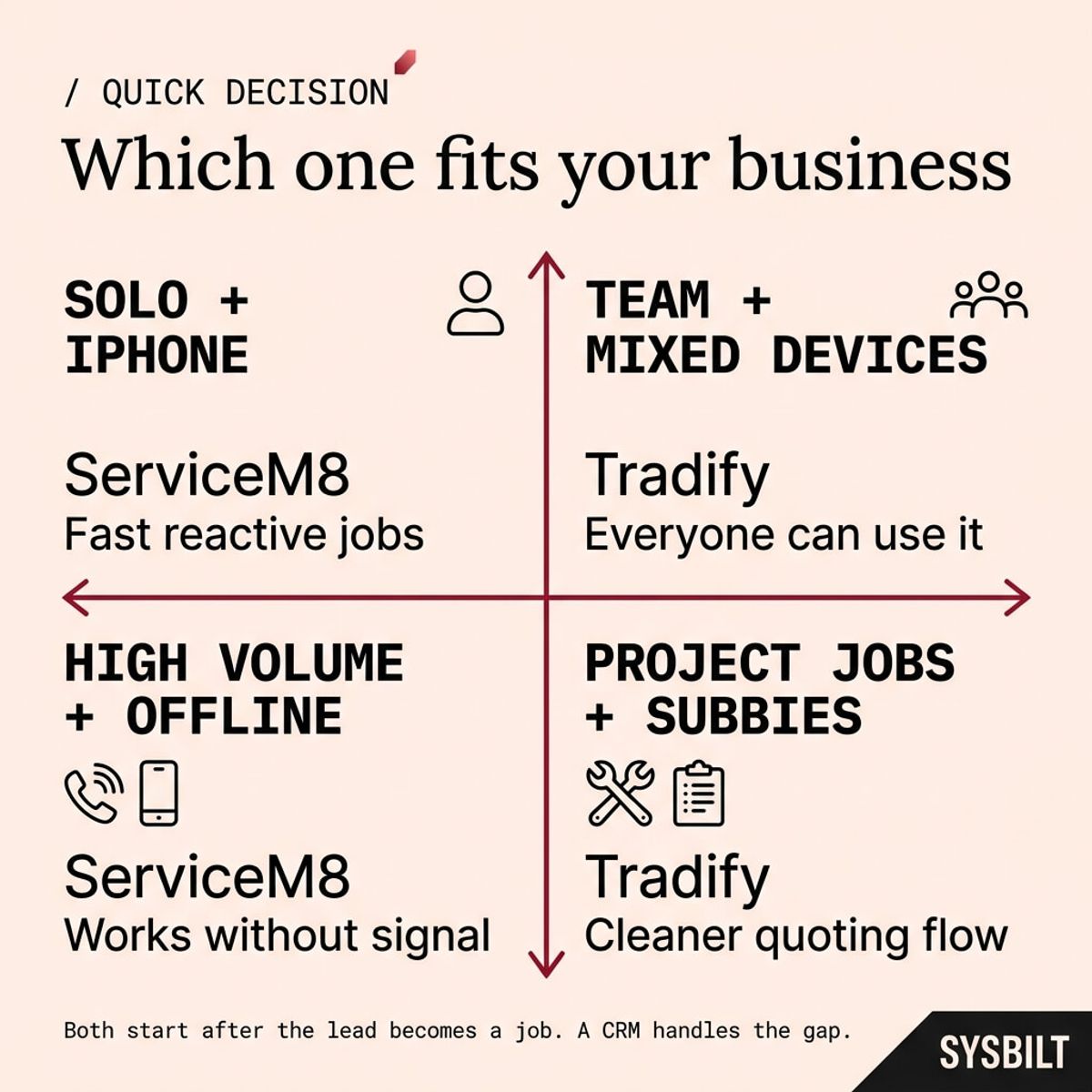
The right choice comes down to four things: your team size, your devices, your job type, and your volume.
- Solo operator on iPhone, running reactive jobs: ServiceM8 Free gets you started without spending a dollar
- Growing team of three to five staff, mixed devices: Tradify Pro keeps everyone on the same system without platform headaches
- High-volume reactive service, all Apple devices: ServiceM8 Growing or Premium gives you offline access, payment tools, and speed at scale
- Project-based work with subcontractors: Tradify Plus includes subcontractor scheduling and suits longer, multi-stage jobs
Here's the part most comparison posts skip entirely. Both ServiceM8 and Tradify are job management tools. They organise work that's already been won. Neither one captures leads from your website, tracks enquiries from first contact, or automates follow-up when a quote goes unanswered.
If leads are coming in through your website, phone, or social media and you don't have a system that follows up automatically, that's a different problem, and it's what a CRM solves. See how CRM & Lead Tracking works for Australian service businesses.
The Gap Neither Tool Fills
Job management starts after you win the work. But what about the enquiries that never made it to a job card?
The quote request that came in on a Saturday night and got no response until Monday. The phone call that went to voicemail because you were mid-job. The follow-up you meant to send three days ago but never did. 66% of Australian service business owners have lost work because admin consumed their day (Small Business Connections, 2024), and a significant portion of that lost work wasn't lost during a job. It was lost before the job even existed, in the gap between someone enquiring and someone responding.
ServiceM8 and Tradify are both strong tools for what they do. Pick the one that matches your team, your devices, and the way you work. But don't stop at job management. The real cost isn't the monthly subscription. It's the leads you're losing before they ever become a job.
If this sounds like your business, book a call and we'll walk you through how this applies to your situation.

WRITTEN BY
Felipe Chaparro
Systems Architect and Founder of SYSBILT. Felipe engineers custom automation, AI workflows, and performance web architectures for scaling Australian service businesses.