Missed calls are costing you leads and revenue. See the real missed-call maths and how to stop the leak fast.
In this article
Most service businesses treat a missed call like a small admin problem. It is not. It is often a potential client who was ready to talk, ready to book, and happy to call someone else if your business did not answer.
This post breaks down the real maths behind missed calls, why they happen in growing service businesses, and what to fix first if you want to stop losing easy revenue.
Why a missed call is not admin
When someone calls a service business, they are usually not browsing for fun. They want a quote, an answer, a booking, or a solution now. Industry research consistently shows that the majority of service business customers prefer to call rather than fill in a form when they are ready to book or make a purchase (CallRail, 2024). That makes the phone call a high-intent moment, not background admin.
The problem is that most service businesses are not set up to catch that moment consistently. Calls come in while you are with a client, driving between jobs, answering another line, or trying to get through the day. That is why missed calls matter more than most owners realise. You are not missing a chat. You are missing a lead that already made the hardest move, which was reaching out in the first place. That puts the missed call much closer to a sales problem than a phone problem.
"What gets measured gets managed."
What a missed call is actually costing you
Here is a simple way to work it out.
Take your average job value. Multiply it by your typical close rate on inbound leads. That gives you the revenue at risk per missed call. It is not a guaranteed loss, but it is the opportunity you are walking away from every time a call goes unanswered.
Here is the formula:
- Your average job value (what a typical completed job is worth to your business)
- Your close rate on inbound leads (what percentage of enquiries you convert into paying jobs)
- Revenue at risk per missed call = your average job value multiplied by your close rate
Now think about what happens when you miss just three qualified calls a week. That revenue at risk compounds quickly:
- Weekly: three missed calls multiplied by your revenue at risk per call
- Monthly: that weekly figure multiplied by four
- Annually: a number that surprises most business owners when they actually run it
For a trade business closing one in five inbound leads, missing three calls a week is not a rounding error. It is a meaningful slice of annual revenue. The exact figure will vary by business, but the direction is always the same: the cost compounds, and it stays invisible until you measure it.
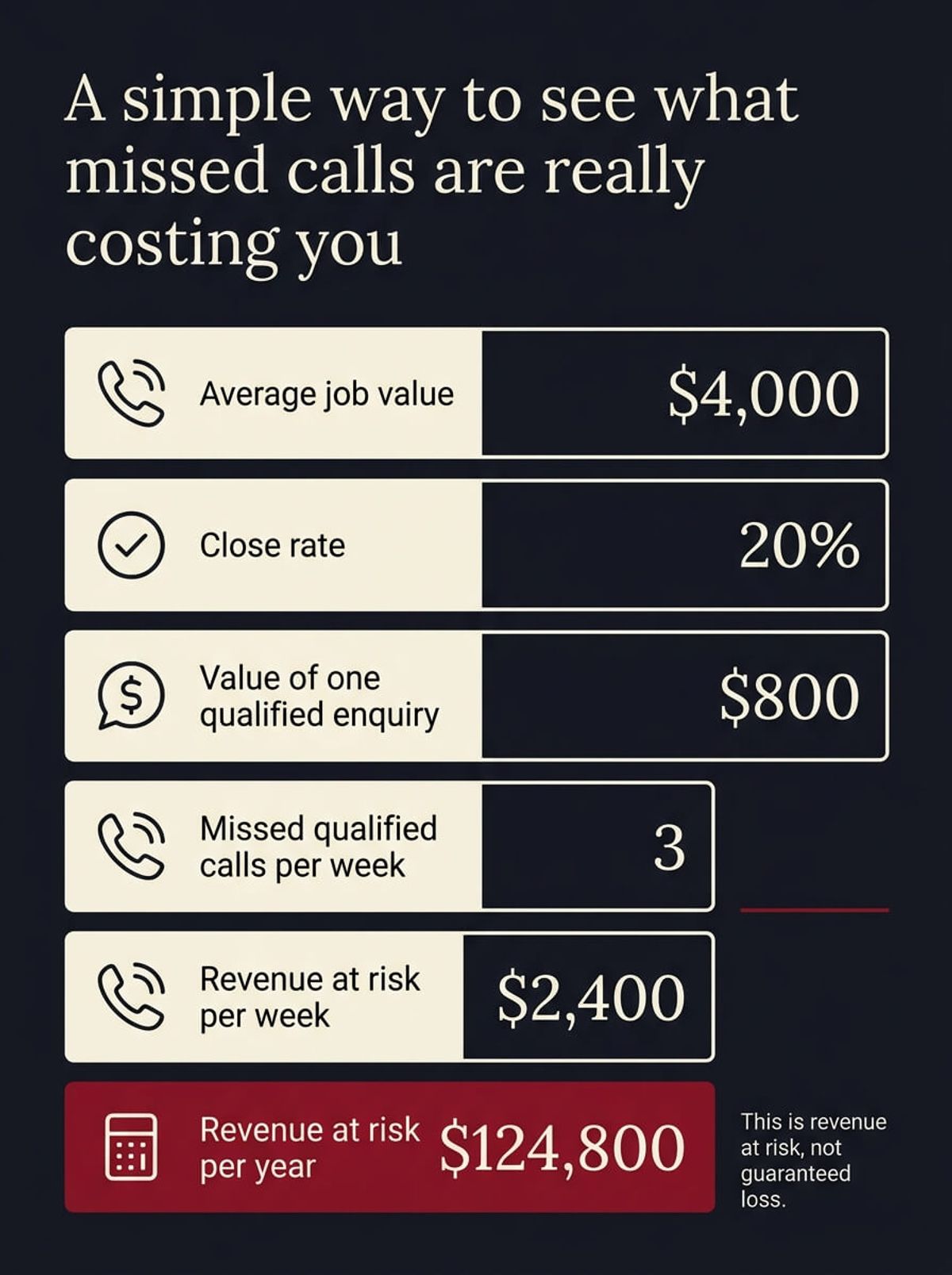
Two important notes:
- This is not guaranteed lost revenue. It is revenue at risk, which is exactly what you need to make a sensible decision
- If you run paid ads, missed calls can also mean wasted spend, because you paid for the click and the enquiry but nobody captured it
Why growing service businesses miss calls
The frustrating part is that businesses usually miss more calls when they are growing, not when they are quiet.
That happens for a few predictable reasons:
- You are doing the work. The phone rings when you are with a client, on the road, or halfway through something that cannot be interrupted
- Calls come after hours. A lot of enquiries happen at lunch, after 5pm, and on weekends, exactly when the business is least prepared to answer
- Nobody owns the phone system. The call just rings wherever it rings. If that person is unavailable, the lead disappears into voicemail
- There is no fast backup path. No instant text back, no quick quote form, no clear booking option, no routed overflow
- The website forces a phone call but does not support it. If your site says “Call now” everywhere but your business cannot answer consistently, you built a lead path with a leak in the middle
This is why missed calls are not just a phone issue. They are a systems issue. If your enquiry path depends on one person being free at the exact right second, it is fragile by design.
How to stop the leak this week
You do not need a call centre. You need a better capture system.
Start with these five fixes:
- 01Set up a missed-call text back. If someone calls and nobody answers, they should get an automatic text immediately. The message should confirm they reached the right business and give them the next step
- 02Route calls properly. If one person cannot answer, the call should ring somewhere else. Shared business numbers, forwarding rules, and overflow logic matter more than most owners think
- 03Add a fast quote path on the website. Some visitors would rather fill out a short form than wait for a callback. If you need help closing that gap, read How to Track Phone Calls From Your Website
- 04Track missed calls as a number. If you do not measure missed calls per week, missed-call response time, and callback conversion, you are guessing. That is exactly how easy leaks stay invisible
- 05Tighten the message on your website. If visitors are not sure what you do, where you work, or how to get help fast, they hesitate. And hesitation kills calls. Why Your Website Isn't Getting Calls and How to Fix It breaks this down properly
The good news is that these are not massive projects. Most service businesses can fix the biggest part of the problem by tightening call handling, adding one instant backup path, and making their website easier to act on. You do not need enterprise software to do this. You need a simple system that catches the lead while you stay focused on the work in front of you.
Build a lead capture system, not a phone gamble
The real fix is not “answer every call forever.” That is not realistic. The real fix is building a lead capture system that still works when you are busy.
That system usually includes:
- a website that makes the next step obvious
- a phone path that routes or responds fast
- a short form for people who do not want to wait
- basic call tracking so you can see what is being missed
- a follow-up process that does not depend on memory
That is what a proper websites and e-commerce system is meant to do. It does not just make your business look better. It catches the people who were already ready to call, already ready to buy, and already close to choosing someone.
If you are still relying on hope, voicemail, and “I'll ring them back later,” the missed calls are almost certainly costing more than you think. For a deeper look at the website side of the problem, read Google Business Profile vs a Website: Which One Gets You More Calls.
See how we fix this
See the exact system we build to fix this
Show me where missed calls are costing us money
WRITTEN BY
Felipe Chaparro
Systems Architect and Founder of SYSBILT. Felipe engineers custom automation, AI workflows, and performance web architectures for scaling Australian service businesses.