What vibe coding means for your business website: where AI-built pages help, what they can quietly break, and six checks before one goes live.
In this article
One of your dentists has built a new page for teeth whitening with an AI website tool. It took an afternoon, and it looks better than your current site. Before it goes live, it's worth knowing what vibe coding means for business websites, where it helps, and what it can quietly break.
The short answer
Vibe coding means building software by describing what you want to an AI tool and using what it makes, often without reading the code. It's fine for drafts, tests and internal tools. Before an AI-built page goes live on your business website, someone has to check the forms, tracking, privacy, security and the rules for your industry.
What vibe coding means
The term came from AI researcher Andrej Karpathy in early 2025, as Google Cloud explains. You describe what you want, an AI tool writes the code, and you keep asking for changes until it looks right, often without reading the code at all.
Google Cloud separates two ways of working. In "pure" vibe coding, you trust whatever the AI makes, which suits quick experiments, or what Karpathy called "throwaway weekend projects". In responsible AI-assisted development, someone reviews, tests and understands what the AI made, and takes ownership of it. Only the second belongs on your live website.
Where vibe coding helps
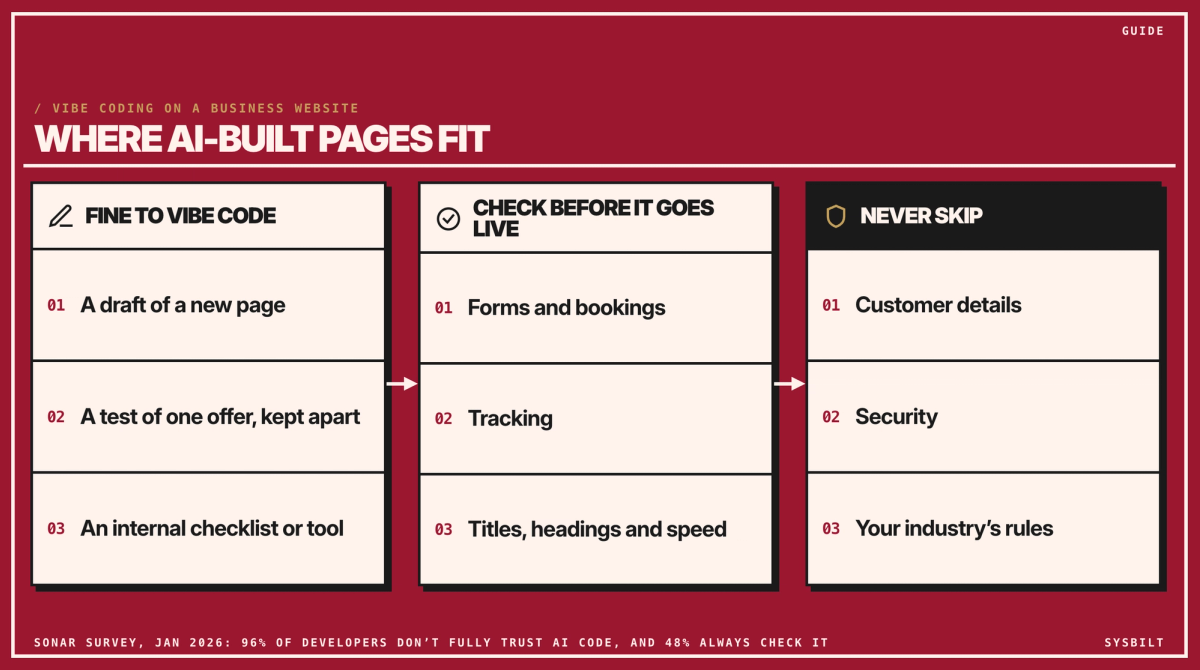
Used as a draft, it's useful:
- A first draft of a page, to show your web developer exactly what you want. A working draft is a clearer brief than a description.
- A test of one offer, on a page kept apart from your main site until it's checked.
- Internal tools, such as a checklist for new staff, that never touch customer details.
If your site is on a website builder, its own AI tools keep the page inside the builder, which still looks after hosting and security. Our post on when a website builder starts costing you leads covers what builders do well.
What an AI-built page can quietly break
Even professionals skip the checks. In a January 2026 survey of more than 1,100 developers by Sonar, a company that sells code-checking software, 96% said they didn't fully trust that AI-written code worked correctly. Yet only 48% always checked it before using it. A page built in an afternoon is easy to put live without checks.
- Forms and bookings. A form can look right and send nothing, or send to an inbox nobody reads.
- Tracking. Tracking is the code that tells Google Analytics, or your ads account, that a booking came from this page. If the new page leaves it out, you can't tell whether the promotion worked. Whoever set up your ads can check it.
- Customer details. Even a name and a phone number are personal information. For a health practice, the OAIC says all personal information collected while providing a health service is health information, which is sensitive information under the Privacy Act. The answers sit in a database, the store behind the form, and its access rules decide who can see them. In 2025, the US National Vulnerability Database listed a flaw in some sites built with Lovable, an AI website builder: where those access rules weren't set up, outsiders could read or change the data. The record is marked as disputed, because Lovable says each customer is responsible for protecting their own site's data. Either way, the responsibility sits with you.
- Security. Tests by Veracode, a company that sells security testing, found AI tools often write code with weaknesses that make a site easier to break into.
- Your industry's rules. An AI tool doesn't know the rules for your industry. A health practice, for example, must follow Ahpra's advertising rules. If the AI writes testimonials or claims into the page, check them before anything goes live.
- Google basics. Page titles, headings and speed on a phone can all slip. Our post on how fast a business website should load shows how to test the speed.
The rule: draft fast, check before it goes live
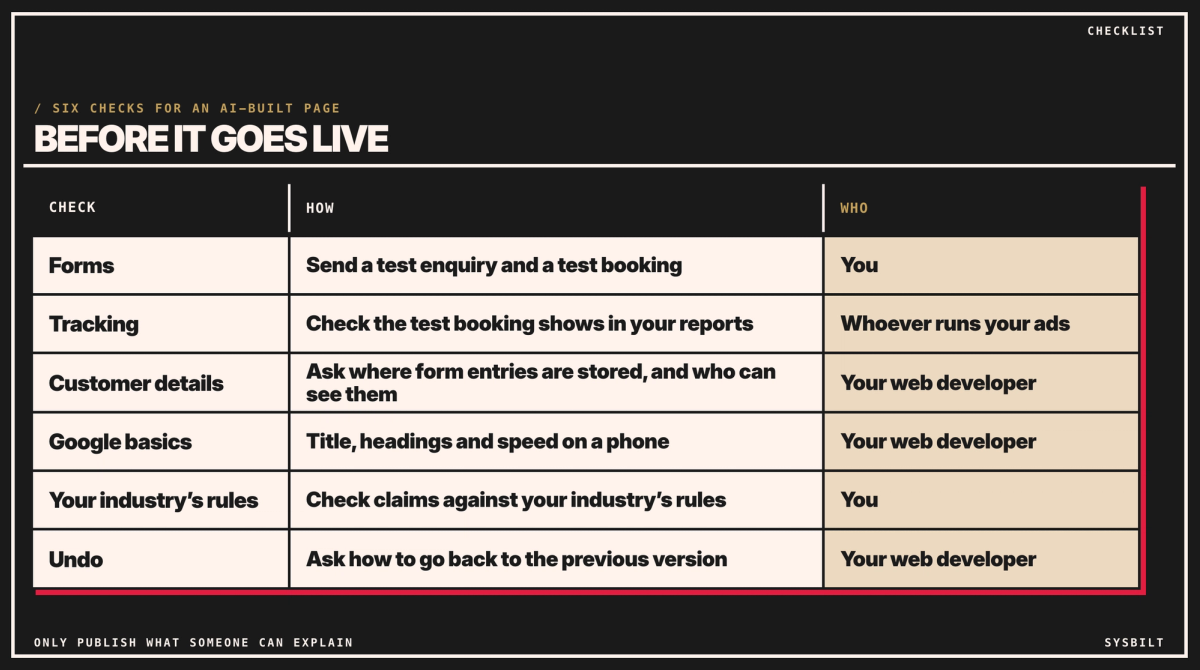
Only publish what someone can explain: what changed, what it affects, and how to undo it, which means going back to the previous version if something breaks. It isn't a judgement on the page. Every page that collects customer details needs the same checks.
You can do two of the six checks yourself: send a test enquiry and a test booking, and read the wording against your industry's rules. Send the rest to your web developer, whoever looks after your website. If nobody does, or someone on your team built the page on their own, a freelance web developer can run them.
Send this to your web developer. Paste it into an email:
Hi [name],

We've drafted a new page with an AI tool, and we'd like it live for a promotion next month. Before it goes live, could you check:
1. The form sends, and enquiries and bookings reach the right place.
2. Our tracking still records bookings and calls from the page.
3. Where form entries are stored, who can see them, and that we only collect what we need.
4. The page title, headings and speed on a phone.
5. How we'd go back to the previous version if something breaks.
6. Where the page will live: on our website, or on the AI tool's own servers at a separate address.

Could you tell us what each check would cost and how long it would take?

We'll check the wording against our industry's advertising rules ourselves.

Thanks,
[your name]
There's no reliable Australian guide to what these checks cost, so the email asks for a price and a time for each. Ask this week, and you'll know whether the promotion date holds. If it doesn't, run the promotion on your current site and add the new page once it's checked.
We build and check business websites, including pages drafted with AI, so they're safe to put live and connected to your bookings. That's our Websites & E-commerce service, which covers business websites, not just online shops.
Run your two checks and send the email first. If there's nobody to send it to, book a 15-minute call with our team in Sydney, by phone or video. We'll go through the page with you and tell you what needs fixing before it goes live. There's no obligation after the call, and we don't upsell.
WRITTEN BY
Felipe Chaparro
Systems Architect and Founder of SYSBILT. Felipe engineers custom automation, AI workflows, and performance web architectures for scaling Australian service businesses.