The Revenue Engine: 7 Systems Every Growing Business Needs
The 2026 Guide to Building a Connected Business System That Gets Clients, Scales Operations, and Shows You What Is Actually Working
For Australian business owners who know the business should run better than it does
The Problem Nobody Talks About
Most business advice focuses on getting more customers. Run ads. Build a website. Post on social media. And for many businesses, that advice works well enough to get revenue moving. But at some point, the growth creates a different kind of problem. The business has customers, has revenue, and has a team, but everything depends on the owner being in every decision. Leads slip through because nobody followed up. The team uses five different tools and none of them talk to each other. Reports take hours to assemble and are outdated by the time they are finished. The owner works harder as the business grows, which is the opposite of what growth is supposed to deliver. This is not a marketing problem. It is a systems problem. The business has outgrown the way it operates, and no amount of additional marketing will fix operational chaos. Three things have changed in the last two years that make this the moment to solve it.
The tools that used to require enterprise budgets and dedicated technical teams are now available to any growing business. AI assistants that handle customer questions. Automation platforms that connect your tools without code. Dashboard builders that show real-time data from every part of the business. The technology barrier has dropped from "hire a developer" to "define what you need and connect it."
People expect instant responses, consistent follow-up, and a professional digital presence from every business they interact with. A missed call, a slow reply, or an outdated website does not just lose one customer. It signals to every potential customer that the business is not keeping up. The bar has moved, and it is not moving back.
Every lead that slips through a broken follow-up process is lost revenue. Every hour the team spends on manual data entry is capacity that could be used for real work. Every decision made on incomplete data is a gamble. These costs are invisible because there is no system measuring them. That is the trap: the businesses that need systems the most are the ones least equipped to see what the lack of systems is costing them.
This guide introduces the three systems that solve these problems and the seven pillars that make up each system. It is designed to show you the full picture, help you identify where your biggest gaps are, and give you a clear starting point.
How we do it
We start every engagement with a systems audit. We map the client's current tools, processes, and gaps across all seven pillars before recommending where to start. A recent client came to us thinking they needed a new website. The audit revealed that their website was fine, but they were losing 30% of their leads because there was no follow-up system. We started with lead tracking and automation instead. The website came later.
Get Clients
This system solves the problem of inconsistent or invisible lead generation. If the phone is quiet, if leads come in but disappear, or if the business depends entirely on word of mouth, this is where the fix starts. The Get Clients system has three pillars.
A website that works is not a brochure. It is a system that answers three questions in under ten seconds: what do you do, who is it for, and what should the visitor do next. It captures attention after hours when you are unavailable, converts visitors into enquiries without friction, and feeds those enquiries into the rest of the system automatically.
The shift that most businesses have not caught up with: AI search engines like ChatGPT and Gemini now recommend businesses directly. If your website is not structured for AI to read and reference, you are invisible to a growing percentage of potential customers. The businesses that structure their sites for both traditional search and AI search now will have a compounding advantage that latecomers will take years to close.
How we do it
We build websites with modern code frameworks for speed and control, structured for both Google and AI search from day one. Our sites load in under 1.5 seconds with no plugin dependencies. Every site is connected to the CRM on launch day so leads are captured automatically.
For the complete guide on building a website that works, see our Websites guide.
Every enquiry, whether it comes from the website, a phone call, social media, email, or a referral, needs to land in one system. If it does not exist in the system, it does not get followed up. A CRM is not optional for a growing business. It is the memory that ensures no lead is lost, every follow-up happens on time, and the business can see exactly where every opportunity stands.
The shift: modern CRMs now include AI-powered lead scoring, predictive deal forecasting, and automated data entry. Businesses using these features are making faster, better-informed decisions about where to spend their time. Businesses still working from a shared inbox or a spreadsheet are structurally disadvantaged.
How we do it
We connect every lead source to the CRM, set up automated first responses within 60 seconds, and build follow-up sequences that run without the team having to remember anything. The business owner can see the full pipeline from their phone.
For the full lead tracking guide, see our CRM & Lead Tracking guide.
Every business has tasks that get done the same way, every time, by a person who could be doing something more valuable. Confirmation emails, data transfers between tools, invoice reminders, team notifications, status updates. Automation handles these tasks instantly and consistently, freeing the team to focus on work that actually needs a human brain.
The shift: automation has moved from an efficiency shortcut to core business infrastructure. The businesses pulling ahead treat automation as the connective tissue between tools, teams, and customers. It is no longer about saving a few minutes. It is about building a connected system where one action triggers the next automatically.
How we do it
We map the repetitive tasks across the business, score them by time cost and error risk, and automate the highest-impact ones first. A recent client's admin team was spending 12 hours a week on data entry between three tools. We automated the data flow. The 12 hours dropped to zero.
For the complete automation guide, see our Automation guide.
Scale Faster
This system solves the problem of the founder bottleneck. Revenue is real, the team is busy, but the business cannot grow without the owner being in every decision. The ceiling is not talent or effort. It is the sheer volume of repetitive work and decisions that accumulate as the business scales. The Scale Faster system has three pillars.
AI assistants are not chatbots. They are defined roles within your business that handle specific tasks using your own data. A customer-facing assistant that answers common questions from your knowledge base. An internal assistant that helps the team find information without searching through folders. An email triage system that classifies incoming messages and routes them to the right person.
The shift: AI has moved from novelty to operational tool. The businesses deploying AI assistants inside their actual workflows are handling more volume without adding headcount. The cost has dropped from thousands per month to hundreds, and the tools now work without a developer.
How we do it
We identify the tasks where AI adds the most value, build a structured knowledge base, and deploy the assistant with hallucination guardrails and human escalation paths. We test with at least 50 real-world scenarios before going live.
For the complete AI assistant guide, see our AI Assistants guide.
Consistent content builds trust, drives traffic, and generates inbound leads. But most businesses start strong and then stop because content depends on the owner's time and creative energy. A content system removes that dependency by building a repeatable workflow: research, brief, draft (AI-assisted), review, publish, distribute.
The shift: content is the only marketing investment that gets cheaper over time. A blog post published today can still drive traffic two years from now without costing another dollar. The businesses that started building their content libraries a year ago have a compounding advantage that latecomers will take years to match.
How we do it
We build the content workflow, calendar, and brand voice guide so the system produces consistent output without the owner writing a single word. AI handles drafting and repurposing. Humans handle editing and strategy.
For the full content systems guide, see our Content guide.
The tools are not the problem. The adoption is. Most growing businesses have invested in software that is being used partially, incorrectly, or not at all. The assumption is that the tool is intuitive enough, or that a group training session will be sufficient. Neither is true. Training needs to be short, role-specific, and measured by actual usage, not by whether people attended a session.
Here is the insight that changes the approach: most adoption failures are not training problems. They are configuration problems. The CRM has too many fields. The automation triggers at the wrong time. The tool was set up from a template, not from how the team actually works. Fix the configuration first, and adoption improves before any formal training begins.
The shift: AI tools and automations are only as good as the data your team feeds them. Poor adoption does not just waste the subscription fee. It undermines every intelligent system connected to that data. The more sophisticated your tools become, the more critical consistent human behaviour becomes.
How we do it
We audit tool adoption before training. We fix the configuration first (most adoption failures are setup problems, not training problems), then build role-based micro-training that takes under 10 minutes per task. We measure actual usage at 30 and 60 days.
For the full team training and adoption guide, see our Team Training guide.
See Clearly
This system solves the problem of flying blind. The business has data in five different tools and none of it connects. Decisions are made on gut feeling or outdated reports. Cash flow surprises come too late to prevent. Marketing spend goes to channels that stopped converting months ago. The See Clearly phase has one pillar, but it connects to everything else.
A dashboard is not a chart. It is a decision-making tool. It answers the five to seven questions that matter most: are we on track, where are the problems, which marketing channels are working, what does cash flow look like in 60 days, and which services are actually profitable.
The shift: AI-powered analytics are now accessible to any business. Natural-language queries, automated anomaly detection, and trend forecasting are built into the tools available today. The technology barrier has dropped from "hire a data analyst" to "connect your tools and configure the views."
The dashboard sits on top of everything else. When the CRM is clean, the automations are running, and the team is using the tools correctly, the dashboard shows a business that is operating predictably. When something breaks, the dashboard shows where. It is the control tower for the entire system.
How we do it
We build the dashboard as the final layer. We connect every data source, cap the executive view at seven metrics, and design it mobile-first so the owner can check the business health in 30 seconds from their phone. We add automated alerts so the dashboard tells the owner when something needs attention, rather than waiting for the owner to check.
For the complete dashboards and reporting guide, see our Dashboards guide.
How the Pillars Connect
The Revenue Engine is not seven separate projects. It is one connected system where each pillar makes the others more valuable.
A visitor finds the website through search. The website captures the enquiry. The CRM logs it and triggers an automated follow-up. The AI assistant handles the initial response. The content system keeps the business visible so the next visitor arrives. The team, trained on the tools, maintains clean data throughout. The dashboard shows the entire journey from first click to closed deal in real time.
Remove any one of those pillars and the system still works. But each one you add increases the value of the ones already running. The website generates more leads when the CRM captures them properly. The CRM is more useful when automations handle the follow-up. The automations produce better results when the team maintains clean data. The dashboard tells the truth when everything underneath is running consistently.
This is why we build the system in layers, not as a single project. You start where your biggest pain is. You build the first layer. You prove the value. Then you add the next layer when the business is ready. Nobody needs all seven pillars on day one. But the businesses that build them over time end up with something their competitors cannot easily replicate: a connected operational system that runs the business, not just the marketing.
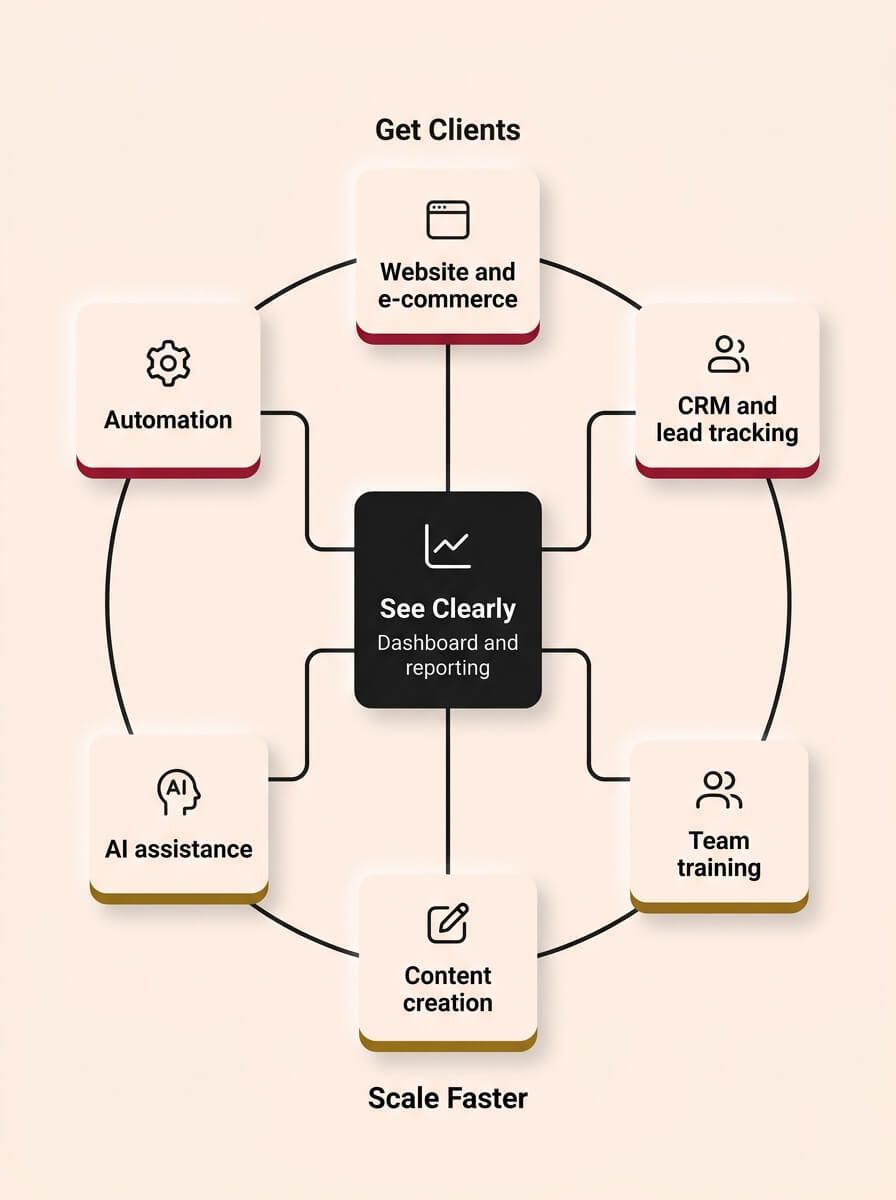
The Revenue Engine: A connected operational system for growth. This infographic visualizes how the seven baseline systems interconnect, with distinct phases for Get Clients (crimson) and Scale Faster (gold) forming an operational cycle that continuously feeds real-time data inward to the central Dashboard hub for absolute clarity.
Where to Start
The right starting point depends on where your biggest gap is. Here is a simple diagnostic.
* If leads are inconsistent or disappearing: Start with the website and CRM. Fix the front door and the memory. This is Phase 01: Get Clients. * If growth is stuck because everything runs through the owner: Start with AI assistants and automation. Remove the bottleneck. This is Phase 02: Scale Faster. * If the business is running but you cannot see what is working: Start with the dashboard. Connect the data and build the control tower. This is Phase 03: See Clearly.
Most businesses start with Get Clients because that is where the pain is most visible. But the businesses that grow fastest are the ones that build the next system before they need it, not after.
Each of the seven pillars has its own detailed guide that covers everything you need to know to build that layer yourself or evaluate whether to hire help. This overview shows you the full picture. The pillar guides give you the depth.
Business Systems Diagnostic Checklist
Run your business against these checks. They cover all three phases and all seven pillars. If you fail more than five, your business has gaps that are costing you money you cannot see.
Get Clients
- Does your website answer what you do, who it is for, and what to do next within 10 seconds?
- Does your website load in under 2.5 seconds on a mobile connection?
- Is your website structured for AI search models to reference?
- Does every enquiry (website, phone, social, email, referral) land in one central system?
- Does every new lead get a response within 5 minutes (automated or manual)?
- Is there a defined follow-up sequence for leads that do not respond to the first contact?
- Can you see your conversion rate from enquiry to closed deal?
- Are your core repetitive tasks (data entry, confirmations, reminders) automated?
Scale Faster
- Can you list the top five questions your team answers repeatedly every week?
- Is your service documentation consolidated so an AI assistant could use it?
- Do you have a content publishing cadence you have maintained for the last three months?
- Can your content process continue if the business owner is unavailable for a month?
- Is there a documented training programme for each tool your team uses daily?
- Do you measure actual tool usage (logins, records created), not just training completion?
- Can a new team member complete onboarding without relying on verbal instructions?
See Clearly
- Are your core data sources (CRM, accounting, analytics) connected to a central reporting system?
- Can you name the five to seven metrics that drive the most important business decisions?
- Can the business owner check the executive summary in under 30 seconds on a phone?
- Are automated alerts configured for key threshold breaches (revenue, lead volume, cash flow)?
- Do you know your cost per lead by channel?
- Do you know your profit margin by service line?
- Does the team trust the dashboard numbers enough to use them for decisions?
Count your failures. If you scored under 16 out of 22, your business has systems gaps that are limiting growth, costing money, or both.
Who We Are
We are SYSBILT. We are based in Sydney, and we build business systems for growing Australian companies. We are not an agency and we are not a software vendor. We come in, understand how the business actually runs, then build the systems that make it run better. Everything in this guide is achievable with tools available today, and we have written it so you can do it yourself. But if you want a team to build it for you, that is what we do.
Ready to find out where to start?
Book a call and we will walk you through how this applies to your business. We will give you an honest read on whether it is worth doing right now, and if so, exactly which system to build first.
BOOK A CALLWe do not upsell. We do not surprise you with hidden costs. We tell you what you need, what it costs, and how long it takes. If it is not worth doing, we will tell you that too.